Introduction
There's a quiet paradox at the top of most organizations: the higher a leader climbs, the less structured support they receive — and the cost of a skill gap grows with every level.
Most senior leaders arrive at the VP, SVP, or C-suite level having proven themselves repeatedly. They've delivered results, built credibility, and earned the title. What rarely gets examined is whether the skills that drove that success still apply at this level.
Most aren't — not applied in the same way. This post is written for experienced leaders who've already done the hard work of getting here. The question isn't whether you're capable. It's whether you're operating with the mental models and self-awareness the senior level actually requires, or running a sophisticated version of what worked three levels ago.
According to DDI's 2021 Leadership Transitions Report, 35% of internally promoted executives and 47% of externally hired executives were considered failures. The problem usually isn't intelligence or work ethic. It's a skill mismatch nobody talks about honestly.
Key Takeaways
- Senior leaders must shift from personal expertise to organizational impact — through the systems they build, the culture they shape, and the people they develop
- Self-awareness, strategic thinking, and cross-functional influence all operate differently at the executive level
- The most overlooked growth challenge is unlearning: habits that earned promotions can quietly undermine performance at the top
- Honest feedback becomes scarcer as seniority increases — leaders must actively build mechanisms to receive it
- Continued development at senior levels requires deliberate external support — not just more experience
Why Senior Leadership Demands a Different Skillset
Most senior leaders didn't fail to grow — they grew in the wrong direction for their current role. The expectations of a VP or C-suite executive are qualitatively different from those of a director or senior manager, not just larger in scope.
At earlier career stages, success is personal. You know the most, deliver the most, solve the hardest problems.
At the senior level, that same behavior becomes a liability. Your job shifts from being the expert in the room to building the room full of experts — and making sure they're moving in the right direction.
The Scope Problem
A senior leader's decisions ripple across entire functions, regional teams, cultural norms, and long-term strategy — simultaneously. The organizational stakes include:
- Employee engagement across hundreds or thousands of people
- Psychological safety (or fear) across entire departments
- Innovation pipeline and risk appetite
- Retention of high-potential mid-level leaders
- Business performance over multi-year horizons
McKinsey's organizational health research found that companies with healthier organizations delivered roughly 3x total shareholder returns compared to unhealthy ones. Senior leaders are the primary architects of that health — or the primary reason it erodes.
The Mental Model Gap
Senior leaders rarely derail because they lack skill. They derail because the skills that drove their earlier success — technical depth, direct execution, hands-on problem-solving — stop being primary levers at the senior level. The job title evolves. The mental model has to as well.
When it doesn't, that gap becomes the source of derailment.
The Inner Skills: Self-Awareness, Emotional Regulation, and Psychological Presence
Self-awareness is frequently cited as a foundational leadership skill. At the senior level, it operates differently than it does earlier in a career — and the stakes of getting it wrong are higher.
Research from Tasha Eurich, published in HBR, found that self-aware leaders have more satisfied employees, stronger relationships, and more profitable companies. It's an organizational outcome tied directly to how clearly a senior leader sees themselves.
The Feedback Desert
The challenge is that self-awareness requires honest input — and honest input dries up at the top. Harvard Business School's Robert Steven Kaplan has written that as executives become more senior, they are less likely to receive constructive feedback on their performance or strategy. People don't challenge senior executives directly. They route around them, agree publicly and complain privately, or simply disengage.
This means senior leaders must actively architect feedback mechanisms rather than wait for them to arrive:
Self-awareness doesn't stop at knowing your patterns — it extends to managing what you broadcast. Research by Sy, Côté, and Saavedra on mood contagion found that a leader's emotional state directly shapes group affect and collective decision-making. The more senior the leader, the wider that ripple spreads.
A senior leader who shows up reactive, anxious, or checked out doesn't just have a bad day. They create permission structures — or fear structures — that shape how hundreds of people make decisions, speak up, and engage with their work.
Dr. Wayne Pernell, whose background in clinical psychology informs DynamicLeader's coaching work, describes psychological presence as one of the most high-leverage and most overlooked dimensions of senior leadership. How you show up is a deliberate choice, and it sets the conditions for everything else.
The Strategic Skills: Thinking, Acting, and Influencing at Organizational Scale
Strategic thinking is often treated as a personality attribute — an innate trait you either possess or you don't. It isn't. Strategic thinking is a disciplined practice of asking fundamentally different questions than you asked at earlier levels.
Not "how do I solve this?" but "what does solving this create or foreclose downstream?" Not "what do we need now?" but "what are we trading off, and does this decision serve the system or just this function?"
Cross-Functional Influence: The Most Underdeveloped Senior Skill
Senior leaders can no longer rely on positional authority to drive outcomes. They must persuade, build coalitions, and earn commitment from people over whom they have no direct control — peers, boards, external partners, adjacent functions. This is influence without authority, and senior leaders consistently underestimate how unprepared they are for it.
The data is stark. CCL research with 125+ senior executives found:
- 86% said working effectively across boundaries was extremely important
- Only 7% said they were very effective at it
- 92% said cross-boundary collaboration became more important when they moved into senior-level leadership
- 71% identified horizontal boundaries as their most frequent challenge
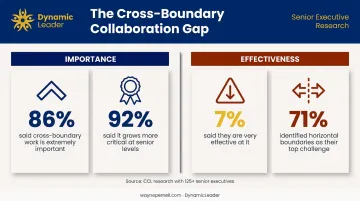
That gap — between importance and actual effectiveness — represents one of the clearest development opportunities for experienced leaders.
Strategic Communication and Trust
Cross-functional influence depends on one thing above all else: trust — and trust lives or dies through communication. Gallup found that only 18% of employees strongly agreed their leaders help them understand how current changes will affect the organization. Inconsistent or unclear messaging from senior leaders erodes trust faster than almost any other behavior.
At the senior level, communication is not just about conveying information. It's about building and maintaining trust across large, dispersed groups — through town halls, board presentations, skip-levels, and one-on-ones with high-potentials. Clarity at the top creates clarity throughout.
Strategic Agility Under Pressure
Dr. Wayne's Dancing with Chaos framework makes this distinction explicit: the goal isn't to eliminate uncertainty — it's to move decisively within it. Senior leaders who thrive in disruption don't have better information than those who stall. They have better mental models for working with incomplete information and adjusting course without losing organizational momentum.
The Human Skills: Developing People, Shaping Culture, and Building Succession
At the senior level, developing others is not a leadership responsibility alongside the real work. It is the real work.
A senior leader's long-term organizational value is measured most clearly by the quality of the leaders they grow beneath them. The succession data makes this concrete:
- 31% of CEOs strongly agree their company has a strong slate of viable future CEO candidates (Deloitte, 2024)
- 20% of CHROs report having leaders ready to fill critical business roles (DDI, 2025)
- 49% of critical roles can be filled immediately by internal talent (DDI, 2025)
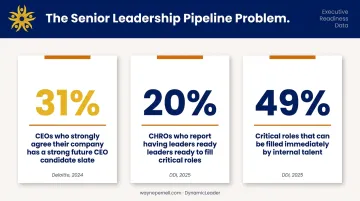
That's not a pipeline problem. It's a senior leadership development problem.
Both gaps trace back to the same source: culture. And culture starts at the top.
Culture Is Behavior, Not Policy
Senior leaders shape culture through their daily behavior — how they respond in a difficult meeting, who they reward, what they tolerate, what they model under pressure. Culture decks and value statements are secondary compared to those signals.
McKinsey research found that transformations were 5.3x more likely to succeed when senior leaders role-modeled the desired behaviors. The organization mirrors the psychological norms of the leadership team. When those norms are dysfunction, avoidance, or political self-protection, the entire culture follows suit.
Cross-Functional Leadership: From Function to Enterprise
Senior leaders who protect their function at the expense of enterprise goals create fragmented, siloed cultures. The shift required at this level is from "my team wins" to "the organization wins." That shift looks like:
- Building real peer relationships across functions — ones built on trust, not just project handoffs
- Resolving interdepartmental tension constructively rather than escalating or avoiding it
- Modeling collaborative behavior visibly, so direct reports adopt the same standard
The Skill Most Senior Leaders Overlook: Unlearning
Promotions reward the behaviors that produce results at the current level. That's the problem.
The deep technical expert who earned accolades for knowing the most in the room now needs to be the person who asks the best questions. The decisive executor who drove results through personal effort now needs to create results through systems and people.
The skills that fueled the climb become obstacles at the top — not because they're bad skills, but because the role requires something different.
Marshall Goldsmith identifies this pattern in What Got You Here Won't Get You There: successful leaders often carry habits — winning too much, telling people how smart they are, failing to listen — that worked in individual contributor or mid-level roles but actively undermine leadership effectiveness at the senior level.
Common Behaviors That Need to Be Unlearned
Senior leaders who struggle here tend to share the same habits:
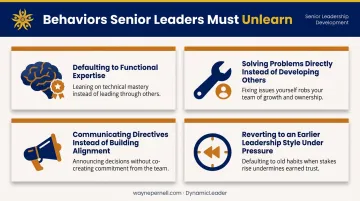
- Defaulting to functional expertise as the primary leadership tool
- Solving problems directly rather than developing problem-solvers
- Communicating directives instead of building alignment
- Reverting to a previous leadership style under pressure — the style that worked three levels ago
Why Unlearning Is Harder Than Learning
Unlearning isn't just a behavioral challenge. It's a psychological one. The identity attached to "being the expert" or "being the one who gets things done" doesn't disappear with a new title. For many senior leaders, loosening that grip feels like losing relevance.
Real change at this level requires working at the identity level — where ego, self-concept, and ingrained behavior all intersect. That's the foundation of Dr. Wayne's approach: his PhD in clinical psychology isn't a credential footnote; it's the lens through which he distinguishes genuine leadership transformation from surface-level behavior adjustment.
How Experienced Leaders Keep Growing When Support Gets Thinner
There's a structural irony in most organizations: formal development investment peaks at the mid-level and drops sharply as people reach the senior tier. A BlueSteps survey of more than 1,400 executives found that the majority of U.S. executives received no formal onboarding in their most recent roles — only 36% reported receiving any.
That gap coincides with the most complex, highest-stakes phase of a leader's career.
The Most Effective Growth Strategies for Senior Leaders
The approaches that work at this level share one quality: they provide honest external perspective that internal structures rarely deliver.
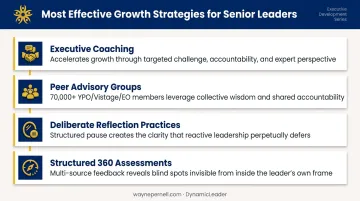
- Executive coaching — particularly from advisors who have operated at senior levels themselves.
- Peer advisory groups — small cohorts of non-competing senior leaders who meet regularly to problem-solve and challenge each other's thinking. Organizations like YPO, Vistage, and EO collectively had over 70,000 members as of recent research.
- Deliberate reflection practices — stepping back from daily operations to assess patterns, assumptions, and blind spots
- Structured 360 processes and assessments — particularly tools designed for senior-level blind spots rather than generic competency frameworks
A 2023 meta-analysis of randomized controlled trials found executive coaching produced a moderate overall effect (Hedges' g = 0.43), with significantly stronger outcomes on behavioral change (g = 0.73). The most effective senior leaders treat their own development the same way they treat any high-stakes strategic investment — deliberate, ongoing, and non-negotiable.
How DynamicLeader Supports Senior Leader Growth
DynamicLeader's executive coaching and consulting work — built around Dr. Wayne Pernell's CCB Process (Clarity. Co-strategy. Bold action.) — is structured specifically for experienced leaders who've outgrown the feedback and development support available inside their organizations.
The work spans three formats:
- Elite Mindstate™ Coaching: 1:1 private coaching for CEOs, founders, and C-suite executives — focused on identity-level transformation, not incremental behavioral adjustment
- Small-Group Leadership Cohorts: curated peer groups that combine structured development with cross-industry perspective and peer accountability
- Exponential Success Summit: an offsite mastermind (next session: September 2026 in Charleston, SC) built around real breakthroughs and a 90-day execution plan — not another conference
With over four decades of experience and work with organizations including Schwab, Pfizer, and Whole Foods, Dr. Wayne Pernell's approach starts from a straightforward premise: senior leaders don't need more information.
They need external perspective, honest challenge, and structured accountability that's genuinely rare inside most organizations.
Frequently Asked Questions
What makes senior leadership skills different from mid-level management skills?
Senior leadership shifts the primary unit of impact from a team or function to the organization as a whole. Where mid-level leaders manage execution and develop individuals, senior leaders must influence without authority, think across systems, and build the leaders beneath them — not just deliver results personally.
What is the single most important skill for a senior leader?
Self-awareness is foundational — how your behavior, presence, and emotional state shape culture and outcomes determines everything downstream. It must be paired with strategic thinking and the ability to develop others, but without self-awareness, those skills are difficult to apply accurately.
How can senior leaders get better feedback when people are reluctant to challenge them?
The most effective approaches are structural: 360-degree assessments with anonymous input, executive coaching with an advisor who has no organizational stake, and purpose-built assessments that surface blind spots normal channels miss. Visibly rewarding honest input is what actually shifts what people feel safe saying.
Why do some experienced leaders struggle when promoted to senior roles?
Most senior-level struggles trace back to over-relying on the skills and identity that drove earlier success — technical depth, direct execution, tight control — rather than adapting to the broader, more ambiguous demands of the role. The transition demands active unlearning of what used to work.
How do senior leaders develop strategic thinking?
Strategic thinking is built through disciplined practice: regularly stepping back from daily operations, asking systems-level questions, challenging assumptions with people who will push back, and actively seeking outside perspectives. It develops through repeated practice — not as a fixed personality trait some leaders have and others don't.