

Introduction
Picture a leader who has done everything right. Strong track record. Respected team. Clear strategy. Yet every time they push toward the next level, something stops them — and it isn't a market problem, a talent gap, or a resource constraint. The ceiling is internal.
This is more common than most senior leaders admit. The ingrained patterns driving your behavior — how you interpret feedback, what you believe about your limits, how you respond under pressure — shape every decision you make and every culture you create.
Research on neuroplasticity from Harvard Health confirms the brain can modify its structure and neural pathways throughout life, meaning the thinking patterns holding you back aren't permanent. They're changeable with intentional, structured effort.
This article covers what mindset transformation actually is, the science behind it, how limiting beliefs block high performers, and what sustained change looks like in practice — with particular focus on leaders, whose mindset ripples beyond their own performance into the teams and cultures they build.
Key Takeaways
- Mindset transformation is identity-level change — it rewires how you interpret challenges, not just how motivated you feel
- High achievers with a fixed mindset display defensiveness, perfectionism, and avoidance — not obvious self-doubt
- Limiting beliefs self-reinforce through confirmation bias, making them nearly invisible from the inside
- Habit formation takes a median of 66 days, not 21 — sustained change requires consistent practice over months
- For leaders, mindset shapes team culture and organizational performance — it's never just a personal matter
What Is Mindset Transformation?
Mindset transformation works at the level of identity — not mood. The clarity from a weekend retreat or the energy from a keynote fades. What doesn't fade is a fundamental shift in how you interpret challenge, make decisions, and lead under pressure. That's the distinction.
Identity-Level Change vs. Surface Adjustment
Mindset transformation is the deliberate, sustained process of shifting the deeply held beliefs, assumptions, and interpretive frameworks that shape how you respond to the world. The distinction matters: surface-level attitude adjustments change what you do temporarily. Mindset transformation changes who you are in relation to a challenge.
Dr. Wayne Pernell of DynamicLeader describes this as transformation "at the level of identity, presence, and decision-making — not just behavior change." The goal isn't to feel better in the moment. It's to lead differently, consistently, even when things get messy.
The Biology Behind the Change
The science supports this kind of change. The brain adapts throughout life. A 2023 review in Brain Sciences describes how synapses that fire together repeatedly strengthen over time through a mechanism called long-term potentiation — the biological basis for why repeated thought patterns and behaviors reshape neural architecture.
This means mindset change isn't metaphorical. It's physiological. New ways of thinking, practiced consistently, create new neural pathways. Old pathways weaken from disuse. The brain adapts.
What Mindset Transformation Is Not
- A seminar high that disappears by Monday morning
- A productivity hack or rebranded positive thinking
- A one-time exercise in self-awareness
- Therapy or clinical treatment
The process requires intention, structured reflection, and guided support over an extended period. DynamicLeader engagements, for example, range from 90-day intensives to year-long partnerships — because meaningful transformation doesn't fit into a two-hour workshop.
Why This Matters at Scale
A leader's mindset isn't a private matter. How a leader interprets failure, responds to ambiguity, and receives critical feedback sets the ceiling for their entire team. When that mindset is rooted in fear or fixed assumptions, people stop raising problems, stop taking risks, and stop thinking creatively. The individual limitation becomes a cultural one.
Fixed vs. Growth Mindset: The Foundation of Change
Carol Dweck's research, formalized in Mindset: The New Psychology of Success (2006, Ballantine Books), established the foundational distinction that most leadership development still underutilizes.
Fixed mindset: Abilities and traits are static. You either have it or you don't. Effort is a sign of inadequacy.
Growth mindset: Skills and intelligence develop through learning and effort. Setbacks are data, not verdicts.
How Fixed Mindset Hides in High Achievers
In senior leaders, fixed mindset rarely shows up as obvious self-doubt. In high performers, it disguises itself as:
- Defensiveness when receiving feedback, especially from direct reports
- Reluctance to delegate (because no one else can do it as well)
- Avoidance of unfamiliar challenges where success isn't guaranteed
- An overriding need to appear competent at all times
A manager who believes talent is fixed is less likely to coach, develop, or take risks on people. Research in Personnel Psychology found that managers' implicit beliefs about whether people can grow directly predicted their coaching behavior with employees.
What a Growth Mindset Looks Like in Practice
Growth mindset in action isn't relentless optimism. It's a specific orientation toward difficulty:
- Staying curious under pressure rather than contracting
- Treating a failed initiative as information rather than indictment
- Actively seeking perspectives that challenge existing assumptions
- Viewing an unfamiliar challenge as developmental, not threatening
Dweck herself has flagged a common misrepresentation: growth mindset is not simply being open-minded or praising effort. The real version requires learning from setbacks and changing strategy — not just tolerating difficulty.
The Organizational Evidence
Research across seven Fortune 1000 companies, reported in Harvard Business Review, found that employees in growth-mindset organizations were:
- 47% more likely to say colleagues are trustworthy
- 65% more likely to say the company supports risk-taking
- 49% more likely to say the company fosters innovation
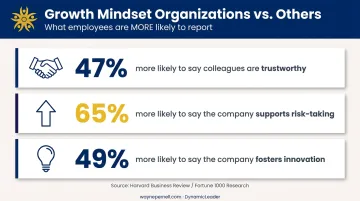
These numbers trace directly back to leadership behavior. Depending on context — a career threat, a public failure, a high-stakes presentation — even growth-oriented leaders can snap into fixed thinking. Self-awareness is what catches that shift before it costs you.
How Limiting Beliefs Silently Block Your Success
Limiting beliefs are deeply embedded convictions, often unconscious, about what you're capable of, what you deserve, or how the world operates. Common examples in senior leaders:
- "I'm not strategic enough to operate at the next level."
- "If I slow down, I'll fall behind."
- "Conflict means something has broken down."
- "Asking for help signals weakness."
These beliefs don't announce themselves. They formed quietly — from early critical feedback, environments that rewarded certain behaviors, or experiences where early failures became permanent verdicts.
The Confirmation Bias Loop
The mechanism that makes limiting beliefs so durable is confirmation bias. As defined in foundational research by Nickerson, confirmation bias is the tendency to seek or interpret evidence in ways that are partial to existing beliefs. Once you hold a belief about yourself, your brain filters incoming information to confirm it — and discards evidence that contradicts it.
This creates a self-reinforcing loop. The belief generates behavior that produces results consistent with the belief, which strengthens the belief further. From the inside, it feels like observation, not distortion.
Automatic Negative Thoughts (ANTs)
Daniel Amen coined the term "ANTs" — Automatic Negative Thoughts — to describe the rapid, often unconscious mental commentary that narrows options and drives emotional response. The concept builds on Aaron Beck's foundational CBT work from the 1960s, which identified automatic thoughts as the engine behind emotional reaction and behavioral avoidance.
A 2020 study in Nature Communications estimated that people experience more than 6,000 distinct thoughts per day, measured through fMRI tracking of brain meta-state transitions. Most of those thoughts operate below conscious awareness. Most leaders never examine even a fraction of it.
A Two-Step Identification Practice
You don't need to examine every thought. Start with patterns:
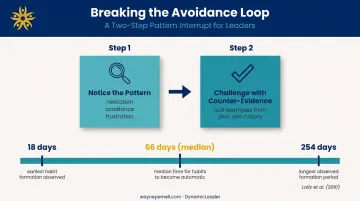
- Notice recurring moments of hesitation, avoidance, or frustration. When you catch yourself pulling back, ask: "What am I believing to be true right now?" Name it explicitly.
- Challenge the belief with counter-evidence from your own experience. Not affirmations — actual examples from your own history where the belief didn't hold.
The goal isn't to argue yourself out of the belief. It's to interrupt the automatic cycle long enough to see the belief as a belief — not a fact. That gap, however small, is where change starts.
5 Strategies to Start Transforming Your Mindset
3 Strategies to Start Transforming Your Mindset
Reframe Before You React
When a negative thought surfaces, the move isn't to suppress it — it's to substitute a more useful interpretation. That's a deliberate choice about which mental frame you operate from, made in real time.
A practical if/then structure: "If I hear the voice saying I'll fail at this, then I will immediately recall three times I navigated a comparable challenge successfully."
Dr. Wayne Pernell's 1:1 mindset coaching builds exactly this capacity — developing reframing as a practical skill, not a theoretical concept, so it's available when a board meeting turns hostile or a key initiative stalls.
Start Small to Build Momentum
Massive mindset transformation is built from small, repeated actions. The goal isn't dramatic overnight change — it's daily micro-evidence that you're different from who you were yesterday.
Practical starting points:
- One honest reflection per day on how you responded to a challenge
- One perspective per week that challenges a current assumption
- One difficult conversation you've been actively avoiding
These aren't symbolic. They're the raw material from which new neural pathways form. Research from Lally et al. (2010) found that habit automaticity reached its plateau at a median of 66 days, with a range of 18 to 254 days — not the often-cited 21 days. Small, consistent actions compound.
Audit Your Environment
Mindset isn't purely internal. The people you spend consistent time with, the content you consume, and the conversations you engage in all either reinforce or erode the mindset you're building.
Ask honestly: Does my environment model the thinking I'm trying to develop, or does it confirm the patterns I'm trying to leave behind?
DynamicLeader's small-group coaching and mastermind experiences — including the Exponential Success Summit — are designed around this principle. Curated peer groups create a context where growth-oriented thinking is the default, not the outlier. One participant described the result: "I feel healthier, more alive, a better sense of direction of where I want to be. There are a lot more options open to me."
The Leadership Imperative: Mindset Transformation at the Top
What happens inside a leader expresses itself outward. A leader who hasn't examined their own fear, ego protection, or fixed assumptions will recreate those patterns in team dynamics, hiring decisions, and organizational culture — often without realizing it.
Dr. Wayne frames this as "becoming more in order to do more and to have more." When a leader levels up internally, the team follows. That shift travels — through decisions, reactions, and the standards a leader holds without ever stating them aloud.
Leader Mindset Is Contagious
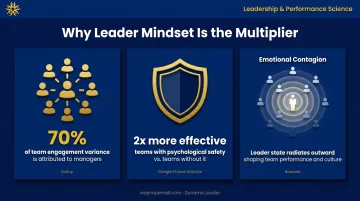
Gallup research reports that managers account for 70% of the variance in team engagement. That's not a small lever. A leader who responds to setbacks with blame builds a team that hides problems. A leader who treats challenges as learning opportunities builds a team that surfaces problems early and solves them collaboratively.
Barsade's research on emotional contagion showed that moods and emotional states transfer among team members, meaning a leader's internal state shapes the emotional climate of everyone around them — not just their own performance.
Google's Project Aristotle, which studied 180 teams, found that psychological safety — the belief that it's safe to take interpersonal risks — was the single most important factor in team effectiveness. Teams with strong psychological safety were rated effective twice as often by executives. That safety starts with how the leader shows up, which makes it a leadership development problem before it's anything else.
When Leaders Get Serious About the Inner Work
Many senior leaders seek out executive coaching and advisory relationships not because something is broken, but because they understand the stakes. The higher the seat, the larger the impact of unexamined assumptions.
For leaders ready to do this work at depth, Dr. Wayne Pernell at DynamicLeader holds a PhD in clinical psychology alongside four decades of leadership experience at organizations including Charles Schwab, Whole Foods Market, and Pfizer. His approach works at the identity level — addressing how leaders think, decide, and show up — not just adjusting surface behavior.
The results from this identity-level work are measurable:
- A team of 12 high-potential leaders saw a 329% increase in production and revenue in just over a year
- A siloed IT leadership division addressed its internal dynamics through a facilitated retreat and achieved a 300% increase in effectiveness — earning an industry award in the process
Sustaining Your Mindset Shift: How to Make It Last
The brain reverts to old patterns under stress unless new pathways are deliberately reinforced. Transformation is a daily practice, not a finish line.
Practices That Consolidate Change
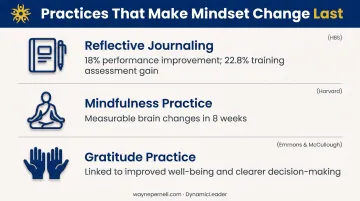
- Reflective journaling: Harvard Business School research found that reflection improved subsequent task performance by 18%, and a call-center group that spent 15 minutes in structured daily reflection outperformed a control group by 22.8% on a final training assessment — despite working less time.
- Mindfulness: An eight-week mindfulness program at Harvard was associated with measurable changes in brain regions linked to memory, sense of self, empathy, and stress response.
- Gratitude practice: Emmons and McCullough's experimental research established links between regular gratitude listing and improved subjective well-being — a foundation that supports clearer, less reactive decision-making.
The Role of Accountability and Community
Transformation accelerates in the presence of others who challenge and support your growth. Internal reflection has limits — external accountability surfaces blind spots that self-examination misses.
The right external mirrors include:
- A coaching relationship that holds you to commitments you'd otherwise negotiate away
- A mastermind group that challenges your assumptions from outside your blind spots
- A trusted peer who tells you what you need to hear, not what's comfortable
Dr. Wayne's engagements build this structure directly into the process — structured accountability, mid-engagement check-ins, and sustainability plans — so that change holds long after the engagement ends.
Redefining Failure
High achievers don't avoid failure — they prepare for it mentally and use it as data. Through a fixed mindset, failure feels personal and final. Reframe it through a growth lens, and it becomes data — external, instructional, actionable.
Stumbling during transformation isn't evidence that you can't change. It means you're attempting something hard enough to matter.
Frequently Asked Questions
What is a mindset transformation?
Mindset transformation is the deliberate process of shifting deeply held beliefs, assumptions, and thought patterns that shape how you interpret and respond to the world. Unlike positive thinking or attitude adjustment, it works at the level of identity and decision-making — the changes hold under pressure, not just in ideal conditions.
What are the 4 pillars of mindset?
The American Psychological Association identifies Psychological Capital — comprising hope, efficacy, resilience, and optimism — as a well-researched framework linked to higher job performance, engagement, and lower burnout. These four states function as a practical model for what strong mindset actually looks like in applied settings.
What are the 4 types of mindsets?
Commonly referenced mindset types include fixed and growth (sourced to Dweck), abundance vs. scarcity (attributed to Stephen Covey's The 7 Habits), and resilient (defined by the APA as successful adaptation through behavioral flexibility). Each category offers a practical lens for self-assessment, though no single research taxonomy unifies them all.
How long does mindset transformation take?
Research on habit formation (Lally et al.) puts the median at 66 days for a single habit, with a range up to 254 days. Deeper, identity-level transformation typically unfolds over months and holds more durably with structured support — timelines vary by individual and the scope of change involved.
Can mindset transformation improve leadership performance?
Leader mindset shapes decision-making, team culture, and organizational outcomes — and the performance data reflects it. In DynamicLeader engagements, teams that aligned around mindset and culture saw a 329% increase in production and revenue alongside a 300% improvement in effectiveness.