Limiting beliefs about trust, control, and risk. Reactive habits formed under decades of high-stakes pressure. Self-concept frameworks that made sense at one stage of leadership and became constraints at the next.
This is the territory success mindset coaching works in. This guide breaks down what it is, why it matters more than most leaders realize, the four core mindset types driving performance, and what the actual transformation process looks like — from the first diagnostic conversation to sustained behavioral change across a leadership team.
Key Takeaways
- Success mindset coaching targets the beliefs and thought patterns that shape how leaders decide, lead, and perform under pressure — not skills, not strategy.
- Four mindset types matter most: growth, abundance, resilience, and leadership mindset — each operating differently under stress.
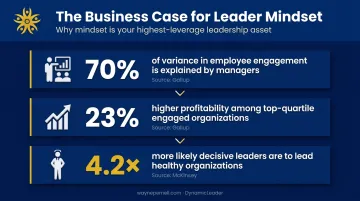
- Gallup research shows managers account for at least 70% of variance in employee engagement — making leader mindset a business lever, not a personal benefit.
- DynamicLeader's proprietary CCB Process — Clarity, Co-strategy, Bold action — drives measurable behavioral outcomes at every stage, not just reflective insight.
- The right coach combines clinical psychology depth with decades of real executive experience — and works inside your organization, not just inside a session.
What Is Success Mindset Coaching?
More Than Performance Coaching
Success mindset coaching is a structured, goal-oriented process that identifies and reshapes the habitual thought patterns, limiting beliefs, and self-concept frameworks determining how a person leads, performs, and grows.
That distinction matters, because this discipline is frequently confused with adjacent practices:
- Therapy addresses clinical issues and processes past experiences — coaching is forward-facing, focused on present behavior and professional performance.
- General life coaching pursues broader personal goals without the organizational and leadership context that defines executive work.
- Traditional performance coaching targets skills and behavioral metrics while leaving the underlying beliefs driving those behaviors untouched.
The International Coaching Federation defines coaching as "partnering with clients in a thought-provoking and creative process that inspires them to maximize their personal and professional potential." Success mindset coaching applies that process specifically to how senior leaders think — because at the executive level, thinking is the performance variable.
How Mindset Functions as a Filter
That definition points to something concrete. Research in leadership psychology establishes that a leader's core beliefs operate as cognitive filters — determining which opportunities they notice, how they read setbacks, and which decisions they consistently avoid.
Consider a concrete example: a CEO who avoids difficult personnel decisions. On the surface, it looks like avoidance or poor management. Underneath, there's often a buried belief that conflict equals failure, or that confrontation threatens the relationships the organization depends on. No leadership skills training fixes that. Coaching that surfaces and challenges the belief does.
Dr. Wayne Pernell's work at DynamicLeader operates at this level — targeting identity, presence, and decision-making rather than behaviors that sit on top of unexamined beliefs.
Who This Is For
Success mindset coaching isn't just for leaders who feel stuck. It's most relevant for:
- High-performing senior leaders who have succeeded and know there's more available
- Executive teams navigating rapid growth, cultural friction, or strategic inflection points
- Organizations where the gap between potential and performance is clearly not a skills gap
- CEOs and founders ready to shift from doing it all to building strong people and systems
The 4 Types of Mindset That Drive Success
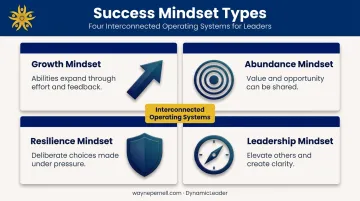
These four mindsets aren't isolated traits. They function as interconnected operating systems — and a skilled coach works on how each shapes the others in real time.
Growth Mindset
Developed through decades of psychological research, the growth mindset is the foundational belief that abilities and intelligence expand through effort, strategy, and feedback — rather than being fixed at birth.
In a leadership context, the difference shows up immediately under pressure. When a team misses a quarterly target:
- Fixed mindset leader: Looks for who to blame, avoids the conversation, or doubles down on control.
- Growth mindset leader: Asks what the miss reveals, what the team can learn, and how to adjust.
Research on growth-mindset organizations found those employees were 47% more likely to say colleagues are trustworthy, 34% more likely to feel strong ownership, 65% more likely to say the company supports risk-taking, and 49% more likely to say it fosters innovation. This is the downstream organizational effect of a leader's own mindset at the top.
Abundance Mindset
Scarcity thinking — zero-sum competition, hoarding information, fear-driven resource decisions — is extraordinarily costly at the senior leader level. When leaders operate from scarcity, it cascades: teams mirror the energy, collaboration suffers, and talent eventually exits.
Abundance mindset operates on the opposite assumption: that value, opportunity, and success can be shared and expanded rather than protected and divided. Research on scarcity psychology shows it genuinely impairs decision quality — a costly problem when a leader's choices affect hundreds of people. Abundance thinking isn't optimism for its own sake; it's a deliberate correction to that cognitive narrowing.
Resilience Mindset
A resilience mindset is the trained capacity to process adversity without losing forward momentum — making deliberate choices under pressure rather than reactive ones. "Bouncing back" barely scratches the surface of what that actually requires.
A 2023 meta-analysis of executive coaching research found coaching improved resilience with a Hedges' g of 0.57, and psychological capital more broadly at g = 0.83. These are meaningful effect sizes. The implication: resilience isn't a fixed trait some leaders have and others don't. It's buildable — and coaching is one of the most evidence-supported ways to build it.
Leadership Mindset
This is the integrating layer. A leadership mindset is the internal belief that one's role is to elevate those around them, create clarity in ambiguity, and take bold action even with incomplete information.
John Kotter's foundational work distinguishes management — which focuses on planning, control, and process execution — from leadership, which involves setting direction, aligning people, and motivating through change. Neither is inferior. The problem is that most executives were never explicitly coached into a leadership mindset. They defaulted into management habits because those habits were rewarded earlier in their careers.
Mindset coaching gives leaders a concrete mechanism to recognize those moments — and choose direction and alignment over control and process when the situation demands it.
Why Mindset Coaching Matters for Leaders and Their Teams
The Multiplier Effect
When a senior leader operates from a limiting belief — "I can't trust my team to execute without me" — that belief doesn't stay contained. It becomes micromanagement. Micromanagement becomes low team autonomy. Low autonomy produces poor morale and stalled growth.
The mindset of the leader at the top sets the ceiling for the whole organization. This isn't a metaphor. Gallup's research establishes that managers account for at least 70% of variance in employee engagement across business units — and that top-quartile engagement is associated with 23% higher profitability and 18% higher sales productivity compared to bottom-quartile units.
The Self-Awareness Gap
Most leaders believe they're self-aware. Research by organizational psychologist Tasha Eurich found that while about 95% of people believe they are self-aware, only 10–15% actually meet research-based criteria for self-awareness. That gap is precisely why external coaching matters: an objective, skilled coach surfaces blind spots that internal feedback systems routinely miss.
The Business Case
McKinsey research shows healthy organizations deliver 3x the total shareholder returns of unhealthy ones, and decisive leaders are 4.2x more likely to lead healthy organizations. The leadership behaviors targeted by mindset coaching (decision quality, empowerment, clarity, adaptability) are the same ones associated with organizational health and financial performance.
DynamicLeader's documented client outcomes reflect this directly:
- 329% increase in revenue and production for a mid-sized team of 12 after clarifying vision, processes, and expectations — in just over a year
- 300% improvement in effectiveness for a siloed IT leadership division after a three-day retreat that rebuilt cross-functional collaboration — an outcome significant enough to earn an industry award
- 2,500+ leaders impacted across finance, retail, healthcare, technology, and Fortune 50 enterprises, with engagements at organizations including Schwab, Whole Foods Market, and Pfizer
These numbers make the case for mindset coaching as a strategic investment, not a line item in a personal development budget.
What Happens Without It
Organizations that don't address leadership mindset patterns typically show the same symptoms: siloed divisions, owner-dependency, inability to execute strategy, and cultural stagnation. These aren't talent problems or skills problems. They're untreated mindset patterns operating at the organizational level.
Understanding why mindset coaching matters is the starting point. The more practical question is what a structured coaching engagement actually looks like — and how to find one calibrated to the pressures senior leaders face.
What the Success Mindset Coaching Process Looks Like
Phases of the Coaching Journey
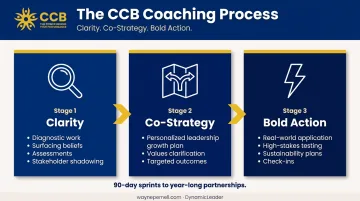
DynamicLeader's proprietary CCB Process — Clarity, Co-strategy, Bold Action — reflects the evidence-based arc of effective executive coaching, combining clinical psychology depth with real-world leadership application.
Phase 1 — Clarity
The process begins with deep diagnostic work. This means surfacing the underlying beliefs, behavioral patterns, and emotional triggers shaping how a leader currently operates — not just the goals they've stated.
At DynamicLeader, this includes proprietary assessments for individuals, leadership teams, and cultural alignment — along with leader interviews and stakeholder shadowing. The embedded observation element matters: Dr. Wayne's team watches how things actually run, listening for what's said and, critically, what isn't.
This phase often surfaces what leaders cannot see on their own, because they're operating from inside the system they're trying to change.
Phase 2 — Co-Strategy
Once blind spots and limiting beliefs are identified, coach and client co-create a practical strategy. The result is a personalized roadmap connecting new mindset patterns to specific leadership behaviors, team interactions, and business priorities.
At DynamicLeader, this means crafting a strategic leadership growth plan that identifies the big vision, clarifies values, and shapes the culture toward targeted outcomes. Clients walk away with more than insight: they leave with a concrete plan and real traction.
Phase 3 — Bold Action
This is where new mindset patterns are tested in high-stakes real-world moments: difficult conversations, unexpected strategic pivots, culture-setting decisions under pressure. The work of Phases 1 and 2 means nothing if it doesn't change behavior when it counts.
DynamicLeader builds in mid-engagement check-ins, post-training evaluations, follow-up sessions, and sustainability plans to ensure shifts stick rather than reverting when pressure returns.
Engagements typically run from 90-day culture sprints to year-long coaching partnerships. That range is deliberate: habit research confirms new behaviors take weeks to months to automate in real-world conditions.
What to Expect as a Leader
Leaders typically experience meaningful perspective shifts within the first few sessions. Sustainable transformation takes longer.
The kind of change that holds through high-pressure situations and spreads to team culture unfolds over months of consistent application and reflection. Most leaders report:
- Clearer decision-making in ambiguous or high-stakes situations
- Stronger team alignment without constant intervention
- Reduced reactivity and more deliberate leadership presence
- Behavioral habits that hold even when stress is high
The goal isn't motivation. It's rewiring — leadership instincts embedded deeply enough that they run by default.
How to Choose the Right Success Mindset Coach
Not all coaching delivers the same depth. The distinction that matters most for senior leaders is methodology and experience level.
Credentials and Clinical Depth
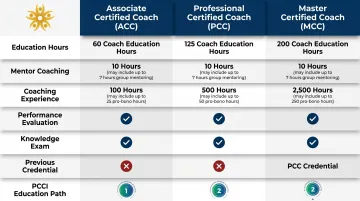
ICF data shows 85% of coaching clients say credentials are important or very important when selecting a coach. But credentials vary enormously in what they require:
| ICF Credential | Education Required | Experience Required |
|---|---|---|
| ACC | 60+ hours | 100+ hours |
| PCC | 125+ hours | 500+ hours |
| MCC | 200+ hours | 2,500+ hours |
For CEOs, founders, and C-suite leaders, the MCC standard — or equivalent depth through clinical training — is worth screening for. A coach with a PhD in clinical psychology brings fundamentally different tools than one with a weekend certification. That difference shows up in the ability to work at the cognitive and identity level — not just track behavioral commitments week to week.
The Embedded Approach
The most effective mindset coaches don't just meet weekly. They observe, shadow, and engage with the real organizational context where mindset patterns actually show up.
Ask any potential coach: how do you get beyond the session room? What does your process look like between sessions? How do you account for what's happening in the real organizational environment?
Research on multisource feedback confirms that working with real workplace data — 360 reviews, stakeholder interviews, observed behavior — produces more accurate insight than self-report alone. Shadowing gives a coach direct access to the patterns that never surface in a one-hour session.
Track Record at Your Level
A coach who works with personal growth clients operates differently from one who has run transformations at Fortune 50 companies across 120+ leadership teams. When you're a CEO or founder, that gap in context shows up fast.
Ask any coach for specific, measurable outcomes — not just testimonials. Dr. Wayne Pernell of DynamicLeader, for example, holds a PhD in clinical psychology and brings 83,000+ hours of professional leadership experience. His client work spans Charles Schwab, Whole Foods Market, PG&E, and Pfizer — across industries from finance to healthcare to retail.
Frequently Asked Questions
What are the 4 types of mindset for success?
The four core mindsets are growth, abundance, resilience, and leadership mindset. Each addresses a different dimension of how a leader thinks, decides, and performs under pressure — and they function as an interconnected system, not isolated traits.
How much does a mindset coach charge?
Pricing varies widely based on credentials, format, and scope. ICF's 2023 Global Coaching Study reports average session fees of $114–$277 globally, while enterprise executive coaching runs significantly higher. For senior leaders, the right metric is ROI against measurable business outcomes — not the hourly rate.
What is the 70/30 rule in coaching?
The 70/30 ratio (roughly 70% client speaking, 30% coach contributing) is a practitioner heuristic, not a formal standard. What research does support: effective coaching centers the client's thinking and uses guided self-discovery over advice-giving. A well-placed question moves more than a perfectly delivered answer.
What is the difference between mindset coaching and executive coaching?
Executive coaching typically focuses on leadership skills, strategy, and performance goals. Mindset coaching goes deeper — into the underlying beliefs and thought patterns driving behavior. DynamicLeader's approach integrates both: addressing identity-level beliefs while tying them directly to real business outcomes.
How long does success mindset coaching take to show results?
Leaders often notice meaningful shifts in perspective and decision-making within the first few sessions. Sustainable organizational transformation — the kind that holds under pressure and cascades to team culture — typically unfolds over several months of consistent engagement.
Can mindset coaching benefit an entire leadership team, not just an individual?
Yes — and the results can be substantial. DynamicLeader has documented a 300% improvement in effectiveness for a siloed leadership division, driven by team-level coaching that rebuilt trust, aligned culture, and created the psychological safety needed for high performance at scale.