Most leaders never fully make it. They keep the expert hat on, keep answering questions faster than anyone else in the room, and wonder why their team isn't growing. The issue isn't effort or intelligence. It's that nobody told them the rules changed when they moved up.
This guide covers what it actually means to be a coaching leader — the specific mindset shifts required, the skills worth building, and how to start putting both into practice without overhauling your leadership style overnight. If you manage other managers, this is especially relevant: your leverage now comes from how others lead, not from how well you personally solve front-line problems.
Key Takeaways
- A coaching leader develops people instead of directing them — making others' growth central to their own success.
- The mindset comes first: coaching leadership starts with what you believe about human potential, not what techniques you use.
- Three skills separate coaching leaders from conventional managers: active listening, powerful questions, and developmental feedback.
- Coaching leadership is a learnable discipline — and its impact compounds the longer you practice it.
What Sets a Coaching Leader Apart
The distinction sounds simple but cuts deep: a traditional manager optimizes output by directing tasks and providing answers. A coaching leader optimizes people by creating conditions for others to think, decide, and grow.
The goal shifts from "getting results through people" to "developing people who consistently get results." That's not a semantic difference. It changes how you run every meeting, every one-on-one, and every performance conversation.
Why This Matters More at Senior Levels
When you're managing managers, you're no longer close enough to front-line problems to solve them directly. Your leverage comes from influencing how others lead. A director who coaches their team well multiplies your impact across dozens of people. One who doesn't creates a bottleneck that eventually lands back on your desk.
This is why Dr. Wayne Pernell's approach at DynamicLeader centers on what leaders need to be rather than just what they need to do. Identity-level change at the top cascades differently than skills training in the middle. The data backs that up.
What the Research Shows
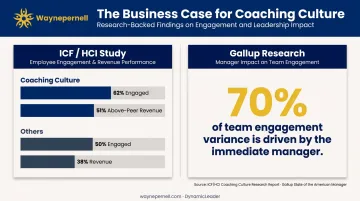
A 2016 ICF/HCI study of 879 professionals found that organizations with strong coaching cultures reported 62% highly engaged employees versus 50% elsewhere, and 51% above-peer revenue growth compared to 38%. These are correlational findings, not controlled experiments — but the pattern is consistent enough to take seriously.
Gallup's data adds another angle: the manager or team leader accounts for 70% of the variance in team engagement. Not leadership philosophy. Not perks or pay. The immediate manager. That makes coaching behaviors a senior-leader operating priority, not a soft skill.
The Mindset of a Coaching Leader
Skills without the right beliefs underneath them are just tactics. And people can feel the difference.
The Core Belief That Changes Everything
Coaching leadership starts with a foundational assumption: people are inherently resourceful and capable of growth. When a leader genuinely holds this belief, they stop hoarding solutions and start creating space for others to find them. Without it, coaching becomes a performance — something you do to look like a good leader rather than something that actually develops anyone.
This isn't a personality trait. It's a practiced orientation that gets tested every time someone walks into your office stuck on a problem.
The Expert-to-Developer Transition
For leaders who built their careers as subject-matter experts, this is often the hardest part. Your reputation was built on having the right answer fast. Now you're supposed to ask questions instead? That identity shift creates real psychological discomfort.
Linda Hill's HBR research on new managers captures this precisely: many high performers fail in early leadership roles because they misunderstand what the job requires. Management isn't exercising personal expertise — it's building the conditions for others to perform. That adjustment doesn't get easier with seniority. If anything, it gets harder, because the expertise that earned the promotion becomes the thing that limits the next level of leadership impact.
Curiosity as a Default Posture
Coaching leaders approach conversations with genuine interest in the other person's thinking — not a hidden agenda to steer them toward a conclusion they've already reached.
Most leaders do the opposite. They listen to respond, not to understand — already composing their answer while the other person is still talking. That habit signals to your team that their thinking doesn't really matter.
Growth Orientation and Self-Awareness
Coaching leaders treat challenges (in their people and in themselves) as developmental data, not deficiencies to correct. That includes being genuinely open to feedback about their own leadership. You can't model vulnerability while being defended against it.
Self-awareness is the multiplier. In practice, this means:
- Examining your own assumptions before coaching someone else through theirs
- Recognizing blind spots rather than projecting them onto your team
- Treating your own development with the same seriousness you bring to others'
Leaders who skip this work don't just stagnate — they unknowingly pass their limitations down. The quality of your coaching reflects the quality of your own inner work.

The Essential Skills of a Coaching Leader
Active Listening
Active listening is more demanding than most leaders expect. It requires:
- Suspending judgment while the other person is still speaking
- Noticing what's being said and what isn't
- Tracking emotional tone alongside content
- Resisting the urge to fill silence with solutions
When leaders listen at this depth, people feel genuinely seen. That builds the trust that makes coaching conversations possible in the first place.
A useful self-check: if you're formulating your response while the other person is still talking, you've stopped listening. Try this instead — pause, reflect back what you heard, then share your view. That sequence alone interrupts the pattern and signals that you're fully present.
The research supports this more than most leaders realize. A 2020 study of 548 participants found that supervisors' active-empathic listening was positively related to employee work engagement, with the dedication dimension most affected. Listening, it turns out, is one of the highest-leverage leadership behaviors you're probably underusing.
Powerful Questions
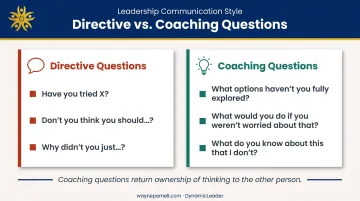
A powerful question opens thinking rather than directing it. It returns ownership of the problem to the person being coached.
The contrast matters:
| Directive question | Coaching question |
|---|---|
| "Have you tried X?" | "What options haven't you fully explored yet?" |
| "Don't you think you should…?" | "What would you do if you weren't worried about that?" |
| "Why didn't you just…?" | "What do you know about this that I don't?" |
Directive questions feel helpful. They move things forward quickly. But they transfer your thinking to the other person rather than developing theirs. Over time, that trains dependence.
HBS research on the surprising power of questions found that questioning spurs learning, idea exchange, innovation, and better performance. A single well-placed question can shift someone's entire frame on a problem they've been stuck on for weeks. This is counterintuitive for leaders rewarded throughout their careers for the quality of their answers. Better questions consistently outperform better advice when the goal is developing capability — and the same logic extends to how you deliver feedback.
Feedback That Develops
Coaching feedback is not the same as evaluative feedback. The difference:
- Evaluative feedback looks backward: "Here's what you did wrong."
- Developmental feedback looks forward: "Here's what I observed, and here's what I think it might be pointing to for your growth."
Developmental feedback is specific, timely, and connected to the other person's own goals, not just performance standards. It says something about where they're headed, not just where they fell short.
The receiving side matters too. Coaching leaders actively solicit input on their own leadership. This signals to the team that growth is a shared commitment, not a one-directional expectation. When you ask your direct reports "What's one thing I could do differently to make your work easier?" — and then do something about the answer — you demonstrate the same posture you're asking of them.
Putting Coaching Leadership Into Practice
Coaching leadership isn't an agenda item you add to a one-on-one. It's a lens you bring to all your interactions — hallway conversations, team meetings, performance reviews, moments of conflict.
The shift from transaction-mode to development-mode sounds small but changes how you engage: instead of "here's what to do," the question becomes "what are you thinking, and what would help you move forward?"
A Framework for Coaching Conversations
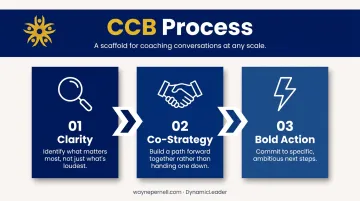
Structure prevents coaching conversations from becoming vague or unfocused. Dr. Wayne Pernell's CCB Process — Clarity, Co-strategy, Bold action offers a useful scaffold:
- Clarity — Identify what actually matters most in this situation, not just what's loudest
- Co-strategy — Build a path forward together rather than handing one down
- Bold action — Commit to specific, ambitious next steps rather than vague intentions
This three-stage structure works for 20-minute one-on-ones and multi-day leadership engagements alike. The core logic is the same: shared understanding first, collaborative planning second, specific commitment third.
The Time Objection
The most common resistance to coaching leadership is time. Leaders believe they don't have enough of it.
Reframe: investing in brief but intentional coaching conversations upstream reduces the volume of escalations, errors, and rework that consume time downstream. When your team develops the capacity to solve problems independently, you stop being the bottleneck. CCL research found that 80% of routine workplace obstacles can be addressed in less than 20 minutes of focused coaching. That's not a major calendar restructure — it's a shift in how you use the time you already have in existing conversations.
Building Toward a Coaching Culture
When coaching leadership is consistent — not occasional — the culture starts to self-sustain. Team members begin coaching each other. Developmental conversations happen organically. Psychological safety creates the candor that actually drives performance.
That's the end state DynamicLeader's engagements are designed to reach — whether it's a 90-day culture sprint or a year-long partnership. The goal isn't better-coached individuals in isolation. It's an organization where the coaching mindset shapes how work gets done.
Common Mistakes Leaders Make When Shifting to a Coaching Style
The Advice Trap
The most common failure mode is reverting to advice-giving under pressure. When a team member is stuck, the fastest-feeling solution is telling them what to do. But it trains dependence rather than capability.
Three patterns drive this, all rooted in identity:
- The impulse to prove value through having answers
- The instinct to rescue people from discomfort
- The need to maintain control by over-managing
Catching these patterns requires self-awareness before they fire — not after.
A practical interrupt: when you feel the impulse to give advice, ask one question first. Just one. See what the other person generates before you add anything.
Coaching as a Corrective Tool Only
Many leaders deploy coaching language only when someone is underperforming. That signals to the team that "being coached" means you're in trouble. It poisons the well.
Coaching leadership must be equally visible with high performers — and framed as investment, not intervention. Your best people need development too, and they'll notice whether their growth is on your radar.
Skipping the Inner Work
Both mistakes above share a common root: technique deployed without inner work. Leaders who adopt coaching behaviors without shifting their underlying mindset come across as hollow — or manipulative. Asking open-ended questions while quietly steering toward a predetermined answer isn't coaching, and experienced people recognize the difference immediately.
The starting point is always the leader's own development. Dr. Wayne Pernell's identity-level mindset coaching addresses this directly — transformation at the level of presence, decision-making, and self-concept, not technique layered on top of unchanged beliefs.
Frequently Asked Questions
What are the key C's of leadership?
Several leadership frameworks are built around "C" principles. Dr. Wayne uses Clarity, Communication, and Curiosity as a foundational set — with Curiosity extending naturally into Compassion. In a coaching leadership model, these three converge: clarity about direction, communication that builds trust, and curiosity that replaces judgment with genuine interest in others' thinking.
What is the difference between a coaching leader and a manager?
A manager directs work toward outcomes. A coaching leader develops the person doing the work — recognizing that people development is the highest-leverage path to sustained performance. Both care about results; the coaching leader knows sustained performance follows people development, not just task execution.
Can leaders develop a coaching mindset, or is it a personality trait?
Coaching leadership is a learnable discipline, not an innate trait. The mindset shifts required — particularly moving from expert to developer — take intentional practice and, often, structured coaching of their own to make stick.
What is the most important skill for a coaching leader?
Active listening is the foundation. Every other coaching capability — asking better questions, giving developmental feedback, building psychological safety — depends on a leader's ability to genuinely understand what is happening with the person in front of them. Without real listening, the other skills lose their grounding.
How does coaching leadership affect team performance and business results?
Organizations with strong coaching cultures report higher engagement, above-peer revenue growth, and better team functioning, according to ICF/HCI research. Gallup links managers who use coaching behaviors to significantly higher team engagement, lower turnover, and measurable performance improvement.
How do you start building a coaching culture as a leader?
Start with your own development — mindset first, then skills. Then bring consistent coaching behaviors into conversations that already exist: one-on-ones, team meetings, performance reviews. Culture change follows behavioral change at the top.