Most leaders instinctively look at the talent. Who's dragging things down? Who needs to be replaced? But that instinct is usually wrong.
Gallup's research shows that managers account for 70% of the variance in team engagement — meaning the conditions leaders create matter far more than the raw talent they're given. Team performance is largely a downstream result of leadership quality, not headcount.
This guide covers the core strategies that convert underperforming or stagnant teams into high-performing ones: clarity, trust, coaching, recognition, and accountability. Each section is grounded in research and field-tested leadership practice.
Key Takeaways
- Leaders who communicate clear direction and co-create strategy give their teams the fuel to accelerate instead of stall
- Trust and psychological safety are structural performance enablers — and their effects compound over time
- Consistent coaching, meaningful feedback, and recognition separate teams that sustain high performance from those that plateau
- The right metrics go beyond output — engagement and culture signals are what distinguish teams that improve from teams that stall
Why Most Teams Underperform — And What Leaders Get Wrong
The Talent Trap
When a team struggles, the first assumption is often a people problem. Wrong hire. Wrong fit. Someone not pulling their weight. Leaders cycle through personnel decisions while the real issue — the leadership system — remains intact and unchanged.
McKinsey's diagnostic of 110 teams across 42 countries found that three in four cross-functional teams underperform on key metrics. That's not a talent crisis. That's a systemic leadership problem playing out across industries.
That data tracks with what Dr. Wayne Pernell of DynamicLeader has seen repeatedly across Fortune 50 engagements and mid-market organizations: leaders stuck in firefighting mode, culture delegated instead of shaped, silos forming faster than solutions. The consistent problem is leadership conditions that prevent capable people from doing their best work.
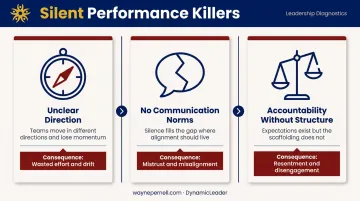
Three Silent Performance Killers
Most leadership-driven underperformance isn't dramatic. It's quiet and cumulative. Watch for these:
- Unclear direction — Teams that can't articulate what "winning" looks like default to activity over output, moving fast in the wrong direction
- No communication norms — Without shared standards for how feedback, decisions, and disagreements are handled, teams default to avoidance and reactive firefighting
- Accountability without structure — When accountability lives only in annual reviews or escalation moments, it creates anxiety rather than clarity
Managing Output vs. Leading Performance
There's a real difference between managing what gets done and leading how performance happens. Output management focuses on tasks and deadlines. Leading performance means shaping the conditions — clarity, psychological safety, development — that determine what teams are actually capable of delivering over time.
Most organizations are built for the first. The strategies below are designed for the second — because sustainable results require getting the conditions right, not just the deliverables.
Start with Clarity: Direction, Roles, and Co-Created Strategy
Communicate Vision with Clarity, Not Just Authority
Leading without directional clarity is like driving in dense fog. You don't stop — you slow down, second-guess every turn, and miss exits you didn't even see coming. Teams operate exactly the same way when leaders fail to communicate the "why" behind direction.
When people understand why a priority matters, they develop genuine ownership rather than passive compliance. They make better judgment calls, push through obstacles without hand-holding, and direct their energy toward what actually advances the work.
Practically, this means:
- Establishing a regular cadence to revisit and restate priorities (not just at kickoff)
- Defining what success looks like in concrete, observable terms
- Connecting individual roles explicitly to the larger mission — so each person can draw a straight line from their daily work to organizational impact
McKinsey data supports this directly: organizations that communicate a clear, compelling vision are more than four times more likely to be healthy than those that don't.
Define Roles with Precision — Then Co-Create the Path Forward
Role ambiguity is one of the most underrated performance drains in leadership. When team members aren't clear on their decision-making authority or the boundaries of their responsibility, work gets duplicated in some areas while critical gaps go unaddressed in others.
A 2018 peer-reviewed study found that role ambiguity had a significant negative relationship with both affective engagement and extra-role performance — meaning unclear roles don't just slow work down, they undermine commitment.
Better org charts help, but the real leverage comes from co-creating strategy with the team rather than assigning direction from above.
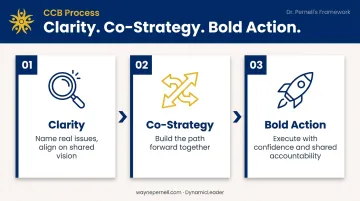
Dr. Pernell's proprietary CCB Process — Clarity. Co-strategy. Bold action. is built on exactly this principle. Rather than prescribing roles and strategy, the framework works through three stages:
- Clarity — Name the real issues, align on the shared vision, and surface what's actually happening beneath the surface
- Co-strategy — Build the path forward collaboratively, so team members own the direction rather than comply with it
- Bold action — Execute with confidence, decisiveness, and shared accountability
Organizations that used this framework to clarify vision, establish processes, and redefine expectations have seen a 329% increase in production and revenue within just over a year.
Once roles and direction are co-created, translate them into SMART goals and shared commitments. Then — critically — revisit those commitments regularly. Clarity isn't established once in a kickoff meeting — it's maintained through consistent, deliberate conversation over time.
Build Trust, Communication, and Psychological Safety
Why Trust Is the Multiplier Behind Every Other Strategy
Google's Project Aristotle research identified psychological safety as the single most important factor in effective team performance — ranking above dependability, structure, meaning, and impact. Teams where members feel safe to take interpersonal risks outperform those where silence is the safer choice.
A 2022 study of 1,150 leaders across 160 management teams found psychological safety correlated with task performance at r = 0.51 — a strong relationship that held across team types and organizational levels.
When trust is present, teams:
- Surface problems early, before they compound
- Challenge ideas without triggering defensiveness
- Handle conflict through dialogue rather than avoidance
- Collaborate freely without political posturing
The leader behaviors that build this trust are specific and learnable: admitting mistakes openly, following through on commitments consistently, explicitly welcoming pushback, and modeling vulnerability when uncertainty exists. These behaviors compound over time.
A leader who gets this right early creates a team that functions at a qualitatively different level. One visible punitive response to bad news, though, can undo months of that progress — the cost of erosion is far higher than the cost of building.
Communication Norms That Eliminate Friction
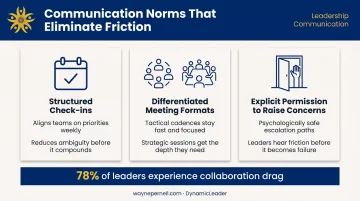
Most team communication problems trace back to missing norms. Without shared expectations for how feedback is given, how decisions get made, and how disagreements are surfaced, teams default to assumptions, avoidance, and reactive firefighting.
HBR's Gartner-cited research found that 78% of organizational leaders experience "collaboration drag" — including too many meetings, too much peer feedback, and unclear decision authority. That's not a collaboration problem. It's a communication-norms problem.
Practical structures that help:
- Structured check-ins with a defined agenda (not open-ended status updates)
- Differentiated meeting formats — operational stand-ups for tactical alignment, separate sessions for strategic conversation
- Explicit permission to raise concerns — leaders who normalize problem-flagging before problems become crises see dramatically less compounding damage
When norms are explicit, communication shrinks in volume and grows in impact. Less noise. Fewer misalignments. Faster decisions.
Coach, Develop, and Recognize Your People
Lead Like a Coach, Not Just a Manager
Gallup's research shows that only 21% of U.S. employees strongly agree they received meaningful feedback in the last week. Meanwhile, 80% of employees who did receive meaningful feedback in the past week are fully engaged.
That gap — between how much feedback teams need and how much they get — is one of the most direct causes of performance variance. And it's entirely within the leader's control.
Coaching leadership looks different from performance management:
- Schedule one-on-ones around each person's development edge — not status updates or open-ended check-ins
- Hold mid-project conversations rather than waiting for end-of-cycle reviews
- Ask questions that build problem-solving capacity: "What have you tried?" and "What would you do differently?" instead of just directing the next step
The manager is the single largest controllable factor in team engagement. Dr. Pernell frames his coaching philosophy as "comforting the afflicted and afflicting the comfortable" — the same developmental rigor leaders expect from their own coaches, applied consistently to their teams. That standard is what separates managers who maintain performance from leaders who elevate it.
Recognition Is a Performance Strategy
Recognition tied to specific behaviors reinforces what high performance looks like. It's not a perk — it's a signal that tells the team which behaviors to repeat.
Gallup's strengths research across 11,441 teams found that where 90% or more of team members knew their strengths, outcomes were consistently best. Strengths-focused organizations see 8–18% performance improvement and 14–29% increased profit.
How to build recognition into team rhythms:
- Name the specific behavior, not just the result ("The way you flagged that early saved us three weeks — that's the standard")
- Match recognition to the individual's preference — some people want public acknowledgment, others find it uncomfortable
- Connect individual contributions visibly to team and organizational goals
DynamicLeader's Culture of Caring™ framework consistently surfaces the same finding: when leaders ask team members what they actually value as recognition, money rarely ranks first. And recognition loses impact when it's applied without genuine meaning — overuse erodes the signal.
Continuous Development Drives Retention and Performance
Investing in growth signals that the organization is committed to the person's future — not just their current output. Gallup data shows organizations that make strategic investments in employee development are twice as likely to retain employees and see 11% greater profitability.
Practical development approaches:
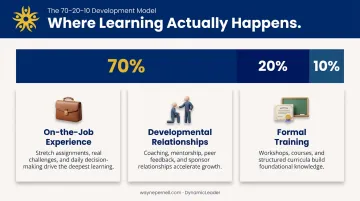
- Stretch assignments that build capability without overwhelming
- Peer learning and mentorship built into team rhythms
- Formal training used selectively (the 70-20-10 model shows only 10% of learning comes from coursework)
For leaders who want structured support building a coaching culture internally, DynamicLeader's Elite Mindstate™ Coaching provides the tools and accountability to replicate these behaviors consistently with direct reports.
Create Accountability and Measure What Actually Matters
Accountability isn't punishment. It's the structure that tells people they're on track — and gives them a clean path to course-correct without shame.
Leaders who co-create KPIs and milestones with their teams generate ownership. When people help define the targets, they're invested in hitting them. When targets are handed down, compliance is the ceiling.
Two Categories Every Leader Should Track
| Metric Type | Examples | What It Tells You |
|---|---|---|
| Output metrics | Task completion, deadline adherence, quality indicators | Whether work is getting done at the right level |
| Team health metrics | Engagement scores, psychological safety pulse checks, communication effectiveness | Whether the conditions for performance are intact |
Leaders who only track output frequently miss early signals of culture erosion — disengagement, communication breakdown, trust decay — that will eventually surface as performance crises. By then, the damage compounds.
A McKinsey study on people and organizational performance found that companies prioritizing their people's performance are 4.2x more likely to outperform peers, with 30% higher revenue growth on average.
Build a Cadence of Honest Conversations
Performance data shouldn't be held for annual reviews. Leaders who review metrics in regular, honest conversations with their teams create an environment where course-correction is normal — not a sign of failure.
Employees are 3.6x more likely to be motivated to do outstanding work when their manager provides daily feedback rather than annual feedback. The case isn't for micromanagement — it's for consistent, low-friction dialogue about what's working and what isn't. Leaders who build that cadence create teams where accountability generates energy rather than anxiety.

Frequently Asked Questions
How can leadership improve team performance?
Leaders improve team performance by creating clarity of direction, building psychological safety, coaching consistently, and embedding accountability and growth into everyday norms — not treating them as occasional initiatives. These aren't independent levers; the strongest teams benefit from all four working together.
What are the 5 C's of effective leadership?
The 5 C's are Clarity, Communication, Collaboration, Commitment, and Coaching. Together, they cover the full range of what leaders must practice consistently — from setting direction to developing people.
What is the 70-20-10 rule for leaders?
The 70-20-10 model, developed through CCL's leadership research, holds that 70% of learning comes from on-the-job experience, 20% from developmental relationships like mentorship and feedback, and 10% from formal training. Leaders can use this framework to build development programs that go well beyond the classroom.
What is the biggest mistake leaders make that hurts team performance?
Treating underperformance as a talent problem rather than a leadership system problem. Leaders who fail to provide clarity, consistent feedback, and psychological safety will see even strong individuals underperform — because the conditions for high performance don't exist.
How do you build psychological safety in a team?
Explicitly welcome dissent, respond constructively to mistakes without blame, and model vulnerability by sharing your own uncertainties. When people see that challenging ideas — including yours — is safe and expected, the team's collective intelligence starts to operate at full capacity.
How long does it take to see improvement in team performance?
Communication norms and engagement can shift within weeks of consistent leadership changes. Deeper cultural transformation typically develops over 3–6 months of deliberate practice. DynamicLeader's client engagements — ranging from 90-day sprints to year-long partnerships — are structured around this phased reality, using early wins to build momentum for lasting change.