
The research backs this up: managers account for at least 70% of the variance in employee engagement scores across business units, according to Gallup. Yet most leaders spend their energy focused on outputs — metrics, deadlines, deliverables — while rarely examining how their own behavior shapes the environment their team operates in.
This article covers what team dynamics actually are, how leaders directly shape them (often without realizing it), what the warning signs of dysfunction look like, and practical strategies for building teams that perform consistently — not just when conditions are ideal.
Key Takeaways
- Team dynamics are driven primarily by leadership behavior, not team composition
- High-performing teams are built on trust, psychological safety, role clarity, and shared purpose — all of which leaders must actively cultivate
- Dysfunction develops gradually; the warning signs often appear long before leaders notice them
- Sustaining high performance takes consistent, everyday leadership behaviors — not one-time initiatives
- The "Lift as you lead" mindset is what transforms individual contributors into a cohesive, results-driven team
What Are Team Dynamics and Why Do They Matter?
Team dynamics are the behavioral and psychological forces that shape how people work together — communication patterns, trust levels, role clarity, conflict norms, and how decisions get made. They're not fixed. They shift constantly, and leadership behavior is the primary driver of that shift.
Teams vs. Groups: A Distinction That Matters
Katzenbach and Smith's foundational Harvard Business Review work draws a sharp line here: a group shares information or space; a team shares accountability and collective outcomes. Leaders who manage groups often wonder why performance stalls — but they haven't actually built a team. When mutual accountability and common purpose are missing, coordination replaces cohesion — and performance suffers for it.
The numbers bear this out. Gallup's Q12 meta-analysis found that highly engaged business units outperform bottom-quartile units by 23% in profitability and 18% in sales productivity. Weak team dynamics generate real financial drag, not just interpersonal friction.
How Leaders Directly Shape Team Dynamics
Leadership behavior sets the emotional tone for the entire team. What a leader tolerates, models, rewards, and ignores all become implicit norms. Teams mirror their leader's standards — whether the leader intends that or not.
The Reciprocal Nature of Leadership
Leadership runs in both directions. When leaders empower their teams, teams step up. When teams demonstrate initiative and ownership, leaders who feel secure respond by granting more autonomy — and that increased autonomy drives further empowerment behaviors. The reverse is equally true: leaders who feel threatened pull back control, which suppresses team initiative over time.
Self-awareness, then, is a structural variable in team performance — not a soft skill to address later.
Dr. Wayne Pernell frames this as the "inner game of leadership": a leader's unresolved insecurities show up in team dynamics as micromanagement, blame culture, or a pattern of avoiding difficult conversations. The dynamics you observe on a team are often a reflection of the leader's internal state — not the team's capability.
Psychological Safety as the Core Mechanism
Amy Edmondson's team performance research at Harvard established that teams perform better when members feel safe to speak up, take risks, and admit mistakes without fear of judgment. A leader creates that safety — or erodes it — through every interaction with the team.
McKinsey's research reinforces this point: consultative and supportive leadership behaviors are directly associated with higher psychological safety and a positive team climate. In practice, that shows up in how leaders handle three specific moments:
- How a leader responds when someone admits a mistake
- Whether dissenting views are welcomed or quietly shut down
- How visible it is that raising a concern leads to action, not retaliation
"Lift as You Lead"
DynamicLeader's guiding principle — Lift as you lead — captures the contrast between leaders who develop capacity in others while advancing results, versus leaders who hoard information, avoid delegation, or take credit for team wins. Each of those behaviors, over time, shapes team dynamics in opposite directions. One builds ownership and initiative; the other builds compliance and silence.
The Foundations Great Leaders Build in Their Teams
Trust
Trust is the structural foundation of healthy team dynamics. Leaders build it through consistency, follow-through, transparency, and a willingness to show vulnerability. DDI research found that employees are 5.3x more likely to trust leaders who regularly display vulnerability — not a sign of weakness, but one of the most reliable trust-building signals a leader can send.
Without trust, every other team dynamic suffers. Feedback becomes threatening. Conflict becomes personal. Accountability becomes blame.
Role Clarity
Approximately half of workers lack complete clarity on what they're expected to do, according to Gallup's Q01 research. That ambiguity has a measurable cost: substantial gains on role clarity are consistently associated with 5–10% productivity improvements.
Leaders who define roles around team members' genuine strengths — rather than just job titles or seniority — see higher engagement and fewer territorial conflicts. Most teams contain a natural mix of contributor types:
- Results-drivers who push toward outcomes
- Relationship builders who maintain team cohesion
- Process thinkers who create operational reliability
- Big-picture visionaries who spot emerging opportunities
- Grounded executors who get things done
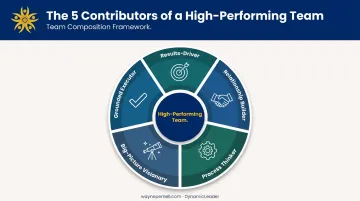
Recognizing and balancing these orientations leads to sharper decisions about who owns what — and stronger buy-in from the people doing the work.
Shared Purpose and Communication Quality
McKinsey's survey of 1,021 U.S. workers found that 70% of employees say their sense of purpose is defined by their work. When leaders connect daily work to a larger mission, teams self-organize more effectively and show more resilience when challenges arise. Deloitte's research found mission-driven companies see 30% higher innovation and 40% higher retention.
Purpose only lands, though, when communication actually reaches people. One common failure mode: leaders confuse communication frequency with communication quality. Regular all-hands meetings don't automatically produce healthy dynamics if leaders aren't listening, inviting dissenting views, or modeling honest, developmental feedback. Conflict avoidance masquerades as harmony — until it doesn't.
Warning Signs of Unhealthy Team Dynamics
Dysfunction rarely announces itself. It develops gradually, rooted in leadership patterns that have gone unexamined.
Common indicators leaders overlook:
- Feedback avoidance or groupthink — where dissent goes unpunished officially but is quietly suppressed
- Role confusion and duplicated effort, creating invisible friction between team members
- Disengagement in meetings — short answers, low participation, cameras off
- Cliques and information silos forming along functional or hierarchical lines
- Inconsistent follow-through on commitments, eroding team trust over time
The Blind Spot Problem
Leaders are often the last to see the dysfunction they're creating. A team that appears "compliant" may be disengaged. A team that "never has conflict" may be practicing dangerous groupthink. The gap between what leaders perceive and what teams actually experience is one of the most common — and costly — problems in organizational life.
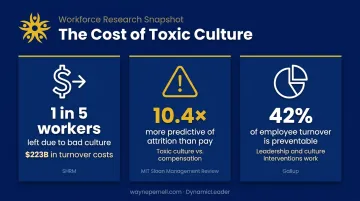
The financial consequences are concrete. Ignoring these signals isn't a soft-skills oversight — it's a retention and revenue failure:
- SHRM found 1 in 5 U.S. workers left a job in the past five years due to bad culture, with estimated turnover costs of $223 billion
- MIT Sloan's research found toxic culture was 10.4 times more predictive of attrition than compensation
- Gallup reports 42% of employee turnover is preventable — yet most leadership teams ignore the warning signs until it's too late
Practical Strategies for Leaders to Strengthen Team Dynamics
Start with Self-Awareness
Before you can improve your team's dynamics, you need an accurate read on your own. HBR research found that only 10–15% of people are genuinely self-aware, yet self-awareness is directly linked to stronger relationships, better communication, and more effective leadership.
Practical starting points:
- 360-degree feedback — structured input from direct reports, peers, and managers. When well-designed, it produces meaningful behavior change; when poorly designed, it backfires. The quality of the instrument and debrief process determines whether it drives real change.
- Proprietary leadership assessments — tools that surface communication patterns, behavioral tendencies under pressure, and blind spots in how your style lands with others. DynamicLeader's individual leadership assessments are used in this context within client engagements.
- External coaching — a skilled advisor who can observe your actual behavior in context, not just your self-report
Build Consistent Feedback Rhythms
Gallup found that 80% of employees who received meaningful feedback in the past week were fully engaged — and that employees are 3.6 times more likely to be motivated when their manager provides regular feedback rather than annual reviews.
A simple team reflection format that works:
- What's working? (2 minutes per person — specific, not generic)
- What's in the way? (Name obstacles, not people)
- One commitment for the coming week (stated aloud, tracked next session)
This can run in 15–20 minutes. The consistency matters more than the format.
Address Conflict Proactively
De Dreu and Weingart's meta-analysis found that both task conflict and relationship conflict damage team performance and member satisfaction when left unmanaged. A separate study linked a leader's cooperative conflict-management style to significant positive effects on team emotional climate and team passion.
Leaders who avoid conflict don't prevent it — they let resentment calcify. Here's what proactive conflict management looks like in practice:
- Name tensions early, before they harden into positions
- Keep focus on the issue, not the individual
- Establish shared norms for difficult conversations before conflict arises
Use a Structured Framework for Clarity and Alignment
For leaders who want a proven sequence for diagnosing and rebuilding team dynamics, DynamicLeader's proprietary CCB Process — Clarity. Co-strategy. Bold action. provides exactly that:
- Clarity — Leader interviews, stakeholder shadowing, and proprietary assessments surface what's actually happening. Real issues get named without blame.
- Co-strategy — Strategy is built collaboratively, grounded in the organization's vision, values, and people — so alignment happens before execution begins.
- Bold action — Implementation moves forward with prioritized steps and the organizational buy-in to see them through.
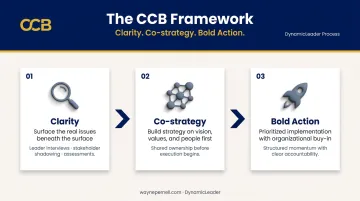
The sequencing is deliberate. Skip clarity, and your team executes toward the wrong target.
From Good Teams to Great: The Leader's Ongoing Role
Building high-performing teams is a discipline you practice continuously, not a project you finish. Teams gain new members, lose experienced ones, navigate organizational change, and face challenges that shift their dynamics over time. Leaders who treat team culture as a living system tend to sustain performance. Leaders who treat it as a one-time intervention tend to be surprised when it degrades.
The most effective leaders eventually build accountability structures and then step back — creating environments where the team can lead itself. The real sign of leadership maturity: not that the team needs you for everything, but that they've internalized the standards you set.
For leaders who want an external perspective and structured accountability, embedded coaching and observation work (the kind Dr. Wayne Pernell delivers through DynamicLeader) can accelerate transformation and surface blind spots that internal efforts consistently miss. Results from that approach include:
- A cross-functional IT group that achieved a 300% boost in effectiveness
- A misaligned team of twelve that saw a 329% increase in revenue and production in just over a year
The common thread in both: clarity, alignment, and a leader willing to examine their own role in the dynamics first.
Frequently Asked Questions
What are the team dynamics of leadership?
Team dynamics of leadership refers to the patterns of behavior, trust, communication, and influence that develop between a leader and their team — and among team members themselves. Leadership behavior is the single largest shaper of these dynamics, influencing everything from psychological safety to role clarity to how conflict gets handled.
What are the 7 basics of team leadership?
While no single standardized list exists, the core fundamentals converge around: clear vision and goals, defined roles, open communication, trust-building, psychological safety, shared accountability, and ongoing development. Leaders who fall short on any one of these tend to find the others eroding alongside it — they're interdependent, not a checklist.
What are the 5 C's of leadership?
The most commonly cited version includes Clarity, Communication, Collaboration, Commitment, and Courage — though frameworks vary by source. The label matters less than the behavior: leaders who model all five create teams that are both aligned and adaptable.
How does a leader's behavior affect team morale and performance?
Leaders set the emotional tone for the entire team — their habits, reactions, and standards become the team's norms. Gallup's research confirms that manager behavior accounts for at least 70% of the variance in employee engagement scores, making it among the most powerful levers for both morale and sustained performance.
What is psychological safety and why does it matter for team dynamics?
Psychological safety is the belief that team members can speak up, take risks, and make mistakes without fear of punishment or judgment. Edmondson's foundational research established it as a core driver of team learning and performance — and it's created (or destroyed) primarily through leadership behavior, one interaction at a time.
How can leaders rebuild trust in a dysfunctional team?
Start by acknowledging the breakdown honestly — teams know when something is wrong, and denial only deepens the distrust. Then model the behavior you want to see, follow through consistently, and reinforce the shift with structural changes: clearer roles, regular feedback rhythms, and explicit accountability.