One-on-one coaching is valuable, but it doesn't scale. And training seminars transfer poorly to real behavior change. The format that closes this gap — developing multiple leaders simultaneously with genuine depth and built-in accountability — is group coaching.
This article covers what group coaching actually delivers, the measurable advantages for leadership teams, what organizations lose when it's absent, and how to run it well.
Key Takeaways
- Group coaching places leaders in a structured cohort for individual growth, peer learning, and accountability.
- Core advantages: peer-accelerated development, durable behavior change, and scalable alignment across the organization.
- It produces outcomes individual coaching cannot replicate — it's a distinct development model, not a cost-cutting substitute.
- Organizations that skip it face misaligned leadership, stalled culture change, weakened pipelines, and missed execution.
What Is Group Coaching?
Group coaching is a facilitated development process where a small group of individuals — typically leaders or professionals — work toward aligned goals under the guidance of an experienced coach, learning from both the facilitator and each other.
Group coaching vs. team coaching: Group coaching focuses on individual growth inside a shared setting. Participants may or may not work together day-to-day. Team coaching, by contrast, targets the collective performance and dynamics of an existing team as a unit — the ICF maintains separate competencies and credentialing for each format. Choosing the wrong format for the wrong goal wastes time and money.
Group coaching vs. training seminars: Training delivers content. Coaching drives application, reflection, and behavior change. Research indicates workplace transfer from training alone can be as low as 5% without explicit application strategies, peer accountability, and repeated practice cycles — all of which group coaching builds in by design.
That multi-directional learning is what separates well-designed group coaching from a glorified webinar. At DynamicLeader, small-group leadership cohorts are carefully curated: participants bring a mix of backgrounds, challenges, and industries, so insight flows across the group, not just from coach to participant.
Key Benefits of Group Coaching for Leaders and Organizations
These aren't abstract advantages. They show up in how leaders communicate, how teams execute, and how organizations sustain performance over time.
Benefit 1: Accelerated Leadership Development Through Peer Learning
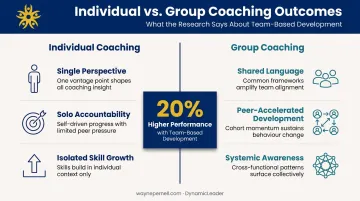
Individual coaching gives a leader one perspective: their coach's. Group coaching multiplies that. Participants gain insight from the facilitator and from the real challenges, decisions, and perspective shifts of their peers — compressing the time it takes to build genuine leadership capability.
A 2024 evidence-informed leadership development review found that team-based training produces 20% higher performance outcomes than individual training, with impact increasing significantly when three or more participants from the same organization develop together. The mechanism isn't just exposure to more viewpoints — it's the development of shared language, shared context, and systemic awareness that individual coaching can't generate on its own.
KPIs this moves:
- Leadership effectiveness scores
- Time-to-capability for developing leaders
- Alignment across leadership tiers
- Quality of cross-functional decision-making
When it matters most: Organizations scaling quickly, companies moving mid-level leaders into senior roles, and any environment where leadership inconsistency is creating visible friction.
DynamicLeader's small-group coaching cohorts are specifically designed around this mechanism — peer feedback is embedded in the session structure, not added as an afterthought. Participants come from diverse industries and roles, exposed to how leaders in non-competing environments solve similar problems. That cross-pollination surfaces blind spots faster than any solo reflection process.
Benefit 2: Accountability That Translates Insight Into Consistent Action
The most common failure mode in one-on-one coaching isn't the quality of the sessions — it's what happens between them. Leaders gain clarity, commit to new behaviors, and then return to environments that pull them back toward old patterns. Without external reinforcement, insight fades.
Group coaching changes that dynamic. When progress is visible to respected peers — not just a coach — the commitment becomes harder to quietly abandon.
This matters beyond individual motivation. ATD cites AMA Enterprise survey data showing that 69% of U.S. companies say lack of accountability damages performance, with 44% reporting it directly reduces employee engagement. Accountability isn't a soft skill — it's an organizational performance issue.
The shift group coaching creates is meaningful: from "I told my coach I'd do this" to "I told people whose professional opinions I respect." That's a different level of commitment, and it produces more durable behavior change.
KPIs this moves:
- Goal completion rates
- Frequency of new behaviors being practiced
- Team engagement scores
- Leader performance ratings from direct reports
When it matters most: Leadership teams navigating culture change, post-restructuring environments, or organizations where past training failed to produce lasting results.
In DynamicLeader's cohort programs, structured accountability isn't incidental — it's built into the program design. Participants report progress back to the group, which means every session includes a natural accountability check on the commitments made in the previous one.
Benefit 3: Cost-Effective, Culture-Wide Development at Scale
Group coaching allows organizations to develop multiple leaders simultaneously, at a lower per-participant cost than equivalent one-on-one engagements, while producing an outcome individual coaching cannot: a leadership cohort that shares frameworks, challenges assumptions together, and begins operating from common ground.
That last point is where the real leverage lives. When leaders develop in isolation, they return to their roles with individual improvements that may not reinforce each other. When they develop together, the organization gets aligned thinking at the leadership layer — reducing silos, accelerating decisions, and creating conditions for culture change that actually holds.
U.S. organizations spent $102.8 billion on training in 2024–2025, with average per-learner spend rising to $874. The question L&D and CHRO buyers should be asking isn't just "what does this cost per session?" but "what does misaligned leadership actually cost the organization?" Typically, the answer is considerably more.
KPIs this moves:
- Return on L&D investment
- Cost per leader developed
- Leadership alignment scores
- Reduction in miscommunication and internal conflict
- Cultural health metrics
Where this has the most impact: Mid-sized organizations with multiple leaders at similar development stages, companies scaling quickly, and executive teams where silos are limiting performance.
This is how DynamicLeader structures its small-group programs: individual growth and organizational cohesion aren't separate outcomes. They're engineered together. Leaders leave with sharper skills, stronger peer relationships, and a shared operating language that shows up in day-to-day decisions — not just in the debrief after a training day.
What Organizations Lose When Group Coaching Is Absent
When leadership development happens in isolation — scattered one-on-ones, passive training, or nothing formal at all — specific patterns emerge.
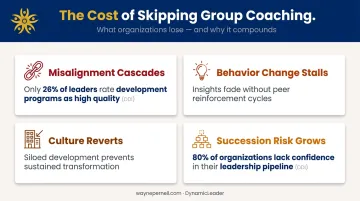
- Misalignment cascades downward. Leaders operating from different frameworks create confusion at every level below them. DDI's research shows only 26% of leaders rate their development programs as high quality — which means most organizations are already running on misaligned leadership without a clear mechanism to fix it.
- Behavior change stalls. Without peer reinforcement and repeated application cycles, insights from coaching fade. Organizations repeat the same development cycles without compounding results.
- Culture reverts. Transformation requires multiple leaders to shift simultaneously. When development is siloed, culture change collapses because the surrounding environment hasn't changed with it. No single leader can hold a new culture in place while everyone around them operates from the old one.
- Succession risk grows. When the organization depends on a single senior leader's judgment and energy, any disruption becomes a crisis. DDI reports that 80% of organizations lack confidence in their leadership pipeline — a direct consequence of underdeveloped leadership depth.
These aren't theoretical risks. DynamicLeader regularly works with organizations that arrive after previous development initiatives have already failed — and the pattern is consistently the same: leaders in firefighting mode, silos forming faster than they're being resolved, and high-potential talent leaving without warning. One SVP in IT came to the work with directors who had drifted apart and were struggling with inefficiency. A facilitated three-day retreat rebuilt cross-functional trust and collaboration — and resulted in a 300% boost in effectiveness.
That kind of turnaround doesn't happen through passive training or isolated one-on-ones. It requires leaders developing together — which is exactly what structured group coaching makes possible.
Best Practices for Running Effective Group Coaching
Structure is what separates group coaching that produces real change from group coaching that feels good but doesn't transfer.
Start With a Clear Cohort and a Defined Focus
Effective group coaching begins before the first session. That means:
- A defined coaching focus — executive presence, delegation, strategic communication, accountability (not a vague goal like "leadership development")
- 5–8 participants (the ICF's practitioner guidance supports this as the optimal range — enough for diverse perspectives, small enough for meaningful individual attention)
- Explicitly stated expectations for participation, confidentiality, and commitment before the program begins
DynamicLeader's cohorts are intentionally curated: participants come from diverse industries and roles, which creates a learning environment where peers challenge each other with fresh perspectives rather than reinforcing existing assumptions.
Balance Group Discussion With Individual Application
Every participant should be able to name the specific behaviors they're working on and report progress to the group. The coach's job is to facilitate the collective conversation while ensuring no individual's specific challenge gets absorbed into the group discussion and forgotten.
Accountability partners within the cohort amplify this. Partner check-ins between sessions create a reinforcement structure that doesn't require the coach to be present for accountability to function.
Build Sessions Around a Consistent Rhythm
Sessions structured primarily around content delivery produce the least durable results. A more effective structure:
- Reflect on commitments made in the previous session
- Report progress — or acknowledge where follow-through stalled
- Address a current challenge with group input and coach facilitation
- Set specific next actions before closing
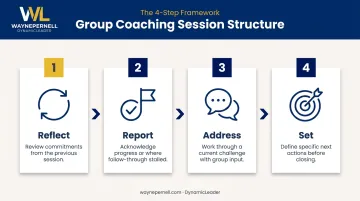
This rhythm turns each session into both an accountability check and a forward-momentum generator. It's also the backbone of DynamicLeader's CCB Process: Clarity, Co-strategy, Bold Action. Each step in that process maps directly onto this cadence, converting group conversations into trackable, committed action.
Track Progress and Adapt
Group coaching requires measurement, not assumption. Build in:
- Individual metrics tied to the specific behaviors each participant is developing
- Mid-program check-ins to assess whether the cohort is on track
- A final reflection session where participants assess what shifted, what they'll carry forward, and where they still want to grow
DynamicLeader uses proprietary assessment instruments at the individual, leadership team, and cultural alignment levels, applied at program launch and at key intervals throughout. Mid-engagement check-ins and post-program evaluations are built into the process — so when a cohort closes, leaders leave with documented evidence of what changed, not just a sense that something did.
Conclusion
Group coaching, when structured well, delivers both reach and depth — and produces outcomes that individual coaching alone cannot replicate. The distinction matters for any organization serious about sustained leadership performance.
For senior leaders and organizations, the compounding effect is the point. Leaders who develop together stay aligned longer, challenge each other more effectively, and build a shared language for decision-making. That shared language — and the behavioral standards that come with it — becomes self-reinforcing over time.
That kind of organizational culture — one where leadership development is ongoing, peer accountability is normal, and alignment at the top is maintained rather than managed — is built deliberately, through consistent, structured, facilitated practice.
Treat group coaching as an ongoing practice, not a one-time program. The leaders who internalize that distinction are the ones who scale their organizations without losing the cohesion that made them effective in the first place.
Frequently Asked Questions
What is group coaching?
Group coaching is a facilitated development process where a small group works toward aligned personal or professional goals under a coach's guidance, learning from both the facilitator and each other. Unlike team coaching (which targets collective team performance) or training seminars (which deliver content without accountability), group coaching sustains both growth and application over time.
How do you structure a group coaching session?
The most effective sessions follow a consistent rhythm: reflect on previous commitments, report progress, work through a current challenge with group input, and set specific next actions. Group sizes of 5–8 work best, with a defined cohort focus and structured accountability between sessions, not just within them.
How much does group coaching cost?
Group coaching typically costs less per participant than one-on-one coaching, though no universal benchmark exists. For senior leadership programs, the investment is best measured against organizational ROI: team alignment, performance gains, retention, and reduced leadership turnover.
How is group coaching different from team coaching?
Team coaching improves the performance and dynamics of an existing team as a collective unit. Group coaching brings individuals together, whether or not they work at the same organization, to develop personal or professional capabilities. The distinction comes down to the unit of change: individual growth versus collective output.
What is the ideal group size for a coaching program?
ICF practitioner guidance recommends 5–8 participants as the optimal range — enough to generate diverse perspectives and peer accountability, small enough for each participant to receive meaningful attention and for the coach to manage group dynamics effectively.
How long does a group coaching program typically last?
Most programs run 8–12 weeks for focused skill or behavior development. Longer engagements of 3–6 months are common for culture transformation or senior leadership cohorts where sustained behavior change is the goal. DynamicLeader's engagements are flexible by design, ranging from 90-day focused sprints to year-long partnerships depending on scope and organizational need.