Introduction
There's a specific kind of isolation that hits at the senior level. You're surrounded by people — direct reports, peers, board members — yet genuinely alone when it comes to your hardest calls. The people below you won't push back. The people above you lack context. And the further you climb, the fewer peers you have who actually understand the terrain.
Stanford GSB research found that nearly two-thirds of CEOs receive no outside coaching or leadership advice — despite almost 100% saying they'd welcome it. That gap isn't just a personal problem. It shows up in decisions, team culture, and organizational performance.
Mastermind group coaching exists to close that gap. For senior leaders, it offers something rare: a room full of peers who challenge your thinking, sharpen your decisions, and refuse to let you stay stuck. This article breaks down what makes it work, who it's built for, and why it tends to be the highest-return investment leaders make.
Key Takeaways
- Most senior leaders lack honest peer-level feedback — and it shows in their decisions
- Mastermind groups provide structured accountability that turns insight into action, not just intention
- Collective peer experience compresses the learning curve
- Leaders who skip peer-level forums repeat costly mistakes longer than peers who don't
- The ROI compounds across relationships, decisions, and results — well beyond any single session
What Is Mastermind Group Coaching
Napoleon Hill coined the term in Think and Grow Rich, defining the mastermind as "the coordination of knowledge and effort, in a spirit of harmony, between two or more people, for the attainment of a definite purpose." The modern version has evolved considerably — but the core logic holds.
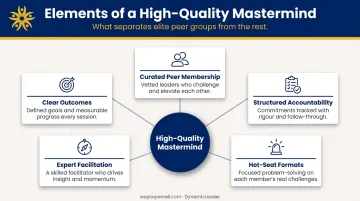
A mastermind group is a curated gathering of peers — typically 5–15 members — who meet regularly to share real challenges, offer perspective, and hold each other accountable to commitments. An experienced facilitator guides the process rather than delivers content.
That distinction from standard group coaching matters. In group coaching, a coach teaches and participants receive. In a mastermind, every member both gives and receives: the intelligence of the whole group is the primary asset.
Think of it as an informal board of advisors who genuinely understand your level of challenge — and operate at it themselves.
What high-quality mastermind formats include:
- Curated membership with relevant peer experience (non-competing industries where possible)
- Structured accountability across sessions — not just inspiration
- Hot-seat or open-discussion formats where members present real challenges
- Expert facilitation that guides without dominating
- A clear output: better decisions, faster execution, stronger leadership
The measure of a strong mastermind isn't attendance — it's how differently you lead when you leave the room.
Key Advantages of Mastermind Group Coaching
Advantage 1: Peer-Level Intelligence You Can't Get Anywhere Else
At the senior level, feedback flows in two directions: upward from direct reports, and downward from boards or bosses. Sideways — genuine peer-level challenge — is rare. A mastermind group is one of the few environments where leaders receive honest pushback from people operating at a similar altitude, without political consequences.
This matters because blind spots at the top are uniquely dangerous. A missed assumption in a junior role creates a small problem. The same blind spot in a C-suite decision can cascade across an entire organization. Direct reports won't name it. Solo reflection can't surface it. Peers will.
McKinsey research found that only 20% of executives say their organizations excel at decision-making, and 61% say most decision-making time is used ineffectively. One root cause: decisions are being tested against the same internal voices, the same assumptions, the same frameworks — repeatedly.
A well-curated mastermind breaks that pattern. When every person in the room carries real experience and has no agenda tied to your next performance review, the feedback quality changes entirely.
This advantage is highest-impact when:
- You're navigating a challenge with no internal precedent
- Your organization is in transition, rapid growth, or disruption
- Decisions need stress-testing before they cascade downstream
- You suspect there's something you're not seeing — but can't name it yet
Advantage 2: Structured Accountability That Converts Insight Into Execution
Most senior leaders don't lack information. They lack follow-through on what they already know. This is what Pfeffer and Sutton called the knowing-doing gap — the persistent distance between understanding what needs to change and actually changing it.
Mastermind accountability is not a gentle nudge. It's a public commitment made to a group of peers who will ask about it next session. The cost of non-action becomes visible. That changes behavior in ways that personal resolve rarely does.
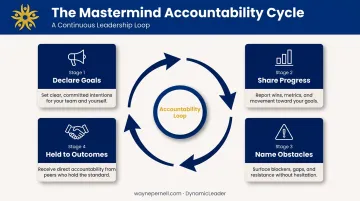
The mechanism is straightforward: members declare goals, share progress, name obstacles, and are held to specific outcomes across sessions. No one lets a vague commitment slide because the group will notice — and care enough to say so.
The ripple effect extends beyond the individual. A leader who executes consistently creates momentum that flows into their team's culture — when the person at the top demonstrates that commitments get kept, it shapes expectations at every level below.
This advantage is most powerful for leaders who:
- Have identified what needs to change but keep deprioritizing it
- Set strong intentions after learning experiences — then return to old patterns
- Need external structure because internal accountability isn't sticking
- Are responsible for organizational decisions that require consistent follow-through
Advantage 3: Accelerated Growth Through Collective Experience
Borrowed experience is one of the most practical advantages a mastermind offers. When a member presents a real challenge — a difficult board relationship, a team that isn't executing, a market pivot with no clear playbook — the group draws on combined decades of cross-industry experience.
The result: frameworks, warnings, and strategies that would take years to accumulate on your own.
The Center for Creative Leadership's 70-20-10 framework identifies that 20% of leadership development comes from developmental relationships — peers, mentors, and advisors who provide perspective unavailable through formal training. Mastermind groups concentrate that 20% into a focused, high-trust environment where the exchange is deliberate, not incidental.
There's also a network effect that compounds over time. Relationships built in a high-trust mastermind setting frequently outlast the formal program — producing referrals, partnerships, and collaborative opportunities that no directory or conference can replicate.
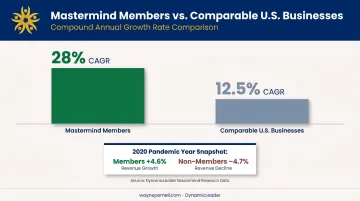
Organizations that invest in peer advisory participation see measurable returns. Vistage's analysis of Dun & Bradstreet data found that member companies grew at a 28% CAGR compared to 12.5% for comparable U.S. businesses. Even in 2020, Vistage members grew revenue 4.6% while non-members declined 4.7%. The pattern holds across years and market conditions — that's not coincidence.
Where this advantage compounds fastest:
- You're entering a new market or expanded role with limited internal reference points
- Industry disruption has made existing playbooks less reliable
- You want to learn from others' mistakes before making them yourself
- Long-term network quality matters as much as short-term skill development
What Happens When Leaders Skip the Mastermind
The pattern is predictable. Leaders without a peer-level thinking group default to the same internal voices, the same assumptions, and the same decision frameworks — well past the point where those frameworks actually work.
Over time, specific costs compound:
- Strategic stagnation — iterations happen slower because ideas aren't being stress-tested externally
- Recurring blind spots — the same errors repeat because no one in the inner circle will call them out
- Isolation-driven burnout — carrying high-stakes decisions without a trusted thinking partner is genuinely exhausting
- Widening potential gap — the leader's trajectory falls below what their capability warrants
HBR research on CEO loneliness ties the burden not to social disconnection but to the weight of consequential decisions made without adequate peer support. That's a different problem than not having friends — and it requires a different solution.
Leaders who invest in learning — books, podcasts, courses — often still stagnate because insight without accountability rarely produces behavioral change at the pace an organization needs. That's precisely what a mastermind group provides: a structured environment where insight meets pressure-testing, and where accountability closes the gap between knowing and doing.
How to Get the Most Value from Mastermind Group Coaching
The quality of a mastermind experience depends on three factors: the caliber of the members, the structure of accountability, and the skill of the facilitator. A poorly curated group with weak facilitation delivers very little. A high-trust, well-structured program with experienced peers delivers results that outlast the sessions.
Members who extract the most value tend to:
- Show up prepared with real challenges — not sanitized, leadership-ready versions
- Contribute actively to others' growth, not just receive
- Hold themselves to the commitments they make publicly
- Stay consistent across sessions rather than treating attendance as optional
For senior leaders specifically, DynamicLeader's Exponential Success Summit offers an intimate group size (a dozen people or fewer), expert facilitation by Dr. Wayne Pernell — a clinical psychologist with four decades of senior leadership experience — and a structured accountability process that converts summit insights into a 90-day execution plan.
The Summit is designed for CEOs, founders, CXOs, presidents, and managing partners who have meaningful experience behind them and are ready to break through to the next level.
Unlike a conference or standard retreat, it's a working intensive. Held at selected venues like Charleston, South Carolina, participants do real work on where they've been, where they are now, and where they genuinely want to go.

Participant H.S. Choi described the experience: "Thank you so much for everything you've done and for giving me that nudge to go to your Signature Mastermind Retreat. I am so glad I got to experience what I did."
The most important selection criterion for any mastermind: trust the curation. Evaluate who else is in the room — their experience, their willingness to engage honestly, and whether the facilitator has the credibility to hold the group accountable.
Conclusion
Most senior leaders have no shortage of advisors, direct reports, or data. What they rarely have is a room full of peers who will think alongside them, challenge their assumptions, and hold them to the growth they know is possible. That's the specific gap mastermind group coaching fills.
These are not soft benefits:
- Peer intelligence sharpens decision quality by exposing blind spots no internal team will surface
- Structured accountability drives execution speed when personal stakes are visible to the group
- Collective experience compresses the learning curve on challenges others have already navigated
When those advantages are consistent and taken seriously, they compound.
The leaders who commit to this kind of environment tend to make faster, cleaner decisions — and they build the habit of seeking peer-level input long after the formal engagement ends.
Frequently Asked Questions
How does mastermind group coaching work?
Members meet regularly in a small, curated group — often monthly or during a multi-day intensive — facilitated by an experienced leader. Each participant presents real challenges and receives structured feedback and accountability commitments from peers, not a single instructor.
What is the difference between mastermind group coaching and group coaching?
Group coaching centers on a coach delivering guidance to participants. A mastermind draws on the collective wisdom of all members, with a facilitator guiding the process rather than teaching it. The strongest formats blend both — skilled facilitation plus genuine peer intelligence.
Who should attend mastermind group coaching?
Leaders and executives who have real experience to contribute, face complex high-stakes decisions, and are ready to grow beyond what solo effort or standard training can deliver. The best candidates have some success behind them and want to break through to the next level.
Is mastermind group coaching worth it?
For leaders who commit fully, yes. The ROI shows up in decision quality, execution speed, and leadership confidence — plus peer relationships built in a high-trust environment that carry value long after the program ends.
How much does mastermind group coaching cost?
Costs range from a few hundred dollars monthly for peer-led groups to five figures annually for curated executive programs. Weigh the investment against the facilitator's credentials, member caliber, and accountability structure. Price alone is a poor filter.
How do I find the right mastermind group coaching program?
Prioritize the facilitator's experience, the peer-level fit of other members, and the strength of the accountability structure. Ask to speak with past participants, review the facilitator's track record, and confirm the group is small enough that every member gets real floor time.