Introduction
Most organizations have a strategy. What they're missing is alignment.
The strategy exists — it was built in a planning room, presented on slides, and distributed across the organization. The gap sits between executive intention and what actually happens when leaders return to their desks, their teams, and their competing priorities.
The cost of that gap is real. According to HBR, 67% of well-formulated strategies fail due to poor execution — not flawed thinking.
Senior leaders often sense something is off: initiatives stall, the same debates resurface in every meeting, and high-performing people quietly disengage. Knowing why is where most leadership teams get stuck.
This guide covers:
- What leadership alignment actually means
- How to spot misalignment before it compounds
- The four pillars required to build it
- A practical implementation framework
- How to measure whether your alignment efforts are working
Key Takeaways
- Leadership alignment means strategy, culture, resources, and behavior all move in the same direction — shared agreement in a meeting room is not enough.
- Misalignment is a people and communication problem before it's a strategy problem.
- Real implementation requires alignment at three levels: executive team, mid-level leadership, and the front line.
- Culture is either the vehicle for your strategy or the obstacle to it.
- Alignment requires concrete metrics: behavioral measures and business-outcome measures, tracked together.
What Leadership Alignment Really Means (And Why Strategies Fail Without It)
Leadership alignment is the condition in which senior leaders share a common understanding of strategic priorities, and their decisions, resource allocations, and daily behaviors consistently reflect those priorities.
That last part is where most organizations fall short. Agreement in a planning room is not alignment in action.
The Strategy-Performance Gap
The data on execution failure is striking. An Economist Intelligence Unit study cited by HBS Online found that 90% of senior executives failed to reach all strategic goals due to poor implementation — not poor strategy design. HBR and Bain separately found that organizations lose more than 40% of a strategy's potential financial value to breakdowns in planning and execution.
That's not a planning failure. It's an alignment failure.
The Psychological Dimension Most Frameworks Miss
Most strategy frameworks treat alignment as a structural problem. It isn't — or at least, not entirely. Alignment has a behavioral and psychological dimension that operates below the level the org chart can capture.
Leaders can appear fully aligned in a planning session while quietly undermining execution afterward. This happens when they:
- Feel unclear about their own role in the strategy
- Feel threatened by the direction of change
- Lack the psychological safety to voice real concerns in the room
The misalignment plays out in hallways, in one-on-ones, and in the decisions made when no one's watching.
This dimension is central to how DynamicLeader approaches alignment work. Dr. Wayne Pernell, whose PhD in clinical psychology grounds the firm's methodology, describes the work as listening for what's being said — and perhaps more importantly, what's not being said. His shadowing and observation approach goes beyond interviews and offsite facilitation to watch how leadership actually behaves in context.
Alignment is not a planning output. It's a living condition — one that erodes quietly when the structural and psychological sides of leadership aren't addressed together.
Misalignment Warning Signs to Watch For
Senior leaders usually sense misalignment before they can name it. These are the behavioral patterns that signal the problem is already in motion.
Red Flags in the Room
- The same debates repeat in leadership meetings without ever reaching resolution
- Leaders deliver conflicting priorities to their teams — each one convinced they're executing the strategy
- "Yes in the room, no in the hallway" — surface agreement that evaporates when leaders return to their functions
- Initiative fatigue sets in as employees feel whipsawed by changing direction, never able to build momentum in one place
- High-potential talent leaves without warning, often citing confusion about direction or lack of coherent leadership
Deloitte found that one-third of employees globally had gone through more than 15 major changes in the prior year — a pace that, without aligned leadership navigation, produces exhaustion rather than progress.
These warning signs are symptoms. The structural and financial damage they cause is what makes misalignment genuinely dangerous.
The Organizational Costs
Left unaddressed, misalignment compounds:
- Siloed decision-making where functions optimize for local wins at the expense of organizational outcomes
- Duplicated effort across teams solving the same problems without coordination
- Disengagement — Gallup reports U.S. employee engagement at just 32%, directly tied to leadership challenges
- Erosion of trust in leadership credibility when stated priorities don't match actual decisions
McKinsey found that less than one-third of transformations succeed in both improving performance and sustaining those improvements. Nearly a quarter of value loss occurs during initial target-setting — before execution even begins.
The Four Pillars of Strategic Leadership Alignment
Before any implementation framework can work, four conditions must exist simultaneously. These aren't sequential steps — they're interdependent pillars that must all be in place.
Pillar 1: Shared Strategic Clarity
Every member of the senior team must be able to answer three questions the same way:
- Where are we going?
- Why does this direction matter?
- What must we stop, start, or continue to get there?
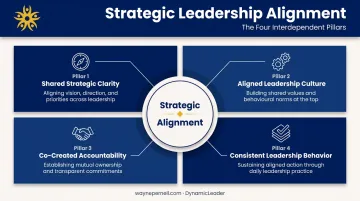
If different executives give meaningfully different answers, the organization has a clarity problem — and every decision made downstream will reflect that divergence.
This is the foundational starting point of DynamicLeader's CCB Process (Clarity. Co-strategy. Bold Action.). Clarity isn't assumed or declared — it's actively surfaced through leader interviews, stakeholder shadowing, and facilitated conversations structured to name the real issues directly and constructively.
Pillar 2: Aligned Leadership Culture
Culture is the operating system that either runs your strategy or quietly runs against it.
PwC's Global Culture Survey found that 72% of senior management agreed that culture helps successful change initiatives happen — and that organizations with a distinctive culture were 48% more likely to see revenue increases. The challenge is that most leaders manage the culture they inherited, not the culture their strategy requires.
Leaders need to audit their actual culture — the daily behaviors, unspoken norms, and real incentive structures — against what their strategy demands. If the strategy requires collaboration but the culture rewards individual heroics, culture wins every time.
Pillar 3: Co-Created Accountability Structures
Accountability handed down produces compliance. Accountability co-designed with the team produces ownership — and the difference shows up directly in execution quality.
Leaders who help shape the plan feel responsible for its outcomes. Those handed directives from above tend to manage optics rather than drive results.
The Co-strategy element of DynamicLeader's CCB Process is built on this principle: engagements are structured as co-created partnerships shaped by the client's goals, people, and path forward — not recommendations delivered from the outside in.
Pillar 4: Consistent Leadership Behavior at Every Level
The final pillar is the one most often broken. Senior leaders must model the strategy in their daily decisions — not just articulate it in quarterly town halls.
PwC found a striking behavioral gap: 73% of C-suite and board members believed leaders walk the talk on values and culture, compared with only 46% of employees below management. That 27-point perception gap is where alignment quietly collapses.
That consistency has to cascade through every layer:
- C-suite models the behavior for senior leaders
- Senior leaders reinforce it with mid-level managers
- Mid-level managers carry it to front-line teams
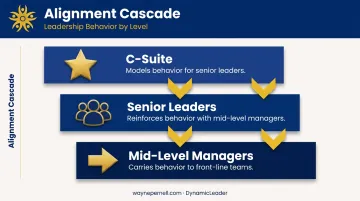
DynamicLeader engagements involve executive sponsors, department heads, and high-potential leaders for exactly this reason: changing behavior at the top without reinforcing it through the organization doesn't hold.
A Practical Framework for Strategic Implementation
Strategy implementation is not a project to launch and hand off. It's an ongoing leadership practice that requires sustained involvement at every level.
Step 1: Establish Clarity Before Cascading Direction
Before distributing strategic direction to the organization, the senior team must resolve genuine alignment among themselves. Not surface agreement — actual resolution of real disagreements and unstated assumptions.
The CCB Process begins here. Through leader interviews, stakeholder observation, and structured facilitation, the Clarity phase surfaces what's actually happening versus what leaders assume is happening. Until the executive team is genuinely aligned, cascading direction only amplifies confusion.
Step 2: Co-Design the Execution Path
Involving stakeholders in designing the strategy — not just receiving it — measurably improves execution outcomes.
McKinsey found that three-quarters of extremely successful transformations involved staff in shaping change initiatives, and that among transformations that failed to engage front-line employees and managers, only 3% succeeded. The implication for senior teams is direct: co-design is not a participation exercise — it's a predictor of whether the strategy will hold.
Moving from senior-team clarity to cross-functional co-design means structuring conversations so that each team can connect their specific work to the broader organizational mission — not just receive a summary of decisions made above them.
Step 3: Embed Strategy Into Operational Rhythms
Alignment dies between meetings. Strategy stays aspirational when it only surfaces in quarterly reviews and offsite presentations.
Embedding strategic priorities into operational cadence means:
- Referencing strategic priorities explicitly in team huddles
- Integrating strategy alignment into performance reviews and hiring decisions
- Using project prioritization and budget allocation as moments to reinforce what matters
- Making "how does this connect to our strategy?" a standard question in planning conversations
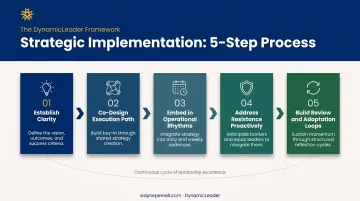
Step 4: Name and Address Resistance Proactively
Resistance to strategic change is a predictable human response to uncertainty and the loss of familiar structures — not a sign that the strategy is wrong.
Leaders who treat resistance as a data point rather than a disruption can address what's actually driving it — often legitimate concerns about workload, role clarity, or unintended consequences. Left unnamed, those concerns become organizational drag that slows execution without ever surfacing in a meeting.
Dr. Wayne's PhD in clinical psychology shapes how DynamicLeader approaches this directly. Clients describe the engagement environment as a no-judgment zone: a space where real concerns can be named, examined, and addressed at the identity and mindset level — not just managed as behavioral compliance.
Step 5: Build in Review and Adaptation Loops
Strategic implementation requires periodic recalibration, not just annual reviews.
DynamicLeader builds mid-engagement check-ins and post-engagement sustainability plans into all consulting work. These structured touchpoints serve a specific purpose: catching tactical drift before it becomes strategic drift, and making sure gains from early phases compound rather than erode.
The critical distinction here is between course-correction (adjusting tactics while staying true to strategic direction) and strategic drift (abandoning the strategy under pressure). Structured quarterly alignment reviews and after-action processes on major initiatives allow organizations to adapt without losing direction.
Communication and Culture: The Hidden Drivers of Alignment
Communication is not a downstream activity in strategic alignment. It's a primary leadership tool.
McKinsey found that transformations are 6.3 times more likely to succeed when senior leaders share aligned messages about the change effort, and 5.8 times more likely to succeed when CEOs communicate a compelling, high-level change story. The quality and consistency of how leaders communicate about strategy determines whether teams feel connected to the mission or alienated from it.
Shifting Cultural Behaviors at the Leadership Level
When culture conflicts with strategy. For example, when the culture rewards individual hero performance but the strategy requires cross-functional collaboration, culture wins.
A culture campaign won't fix this. What works is visible, consistent behavior change at the leadership level — modeled by leaders before it's expected from anyone else.
DynamicLeader's culture transformation approach directly targets this dynamic: using proprietary assessments and embedded observation to identify where behaviors conflict with strategy, then working at the identity and mindset level to shift what leaders actually do, not merely what they say.
Three Communication Practices Leaders Can Implement Immediately
- Strategy moments in existing meetings — begin or end team meetings with a brief, explicit connection between current work and strategic priorities
- Transparent sharing of setbacks — leaders who share where the strategy is struggling, not just where it's succeeding, build the credibility that sustains alignment through difficulty
- Ask, don't tell — instead of delivering strategic messages downward, ask teams to articulate how their work connects to the organizational mission. The gap between their answer and the intended message shows you exactly where communication work is needed
Measuring Whether Your Alignment Is Working
Alignment should be treated as a measurable leadership output, not an abstract ideal.
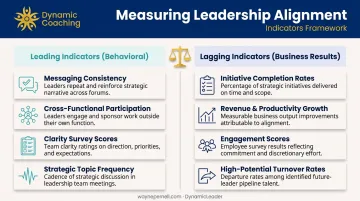
Two Categories of Alignment Metrics
Leading indicators (behavioral):
- Consistency of strategic messaging across leadership levels
- Participation rates in cross-functional planning conversations
- Clarity scores from team surveys (can teams articulate the top 3 strategic priorities?)
- Frequency of strategic topics in operational team meetings
Lagging indicators (business results):
- Strategy initiative completion rates
- Revenue growth and productivity metrics (DynamicLeader has documented 329% production and revenue increases and 300% effectiveness improvements following alignment engagements with mid-sized leadership teams)
- Team engagement scores
- Turnover rates among high-potential talent
McKinsey's Organizational Health Index reinforces this directly: organizational health — with alignment as a central dimension — is the strongest predictor of long-term financial and operational performance. That connection between measurable health and measurable results is precisely what an alignment audit is designed to surface.
Conducting a Leadership Alignment Audit
The most revealing alignment diagnostic is simple: ask the same strategy questions to leaders across different levels and functions, then map where answers diverge.
Divergence is not failure. It's diagnostic data that shows exactly where alignment work is needed. DynamicLeader's assessment process — leader interviews, stakeholder shadowing, and proprietary instruments — is built around this principle. It illuminates the gap between what leaders believe is aligned and what is actually happening on the ground.
An external perspective accelerates this process considerably. An embedded advisor who observes leadership behavior across multiple contexts — not just a one-day offsite — can surface blind spots that internal teams cannot see in themselves.
Frequently Asked Questions
What is the strategic alignment process in leadership development?
The strategic alignment process ensures leaders at all levels share a clear understanding of strategic priorities, then builds the skills, behaviors, and systems needed to execute them consistently. It works on structural and behavioral dimensions at the same time — because fixing one without the other rarely holds.
What are the 4 types of organizational strategy?
Four types are most commonly referenced:
- Corporate strategy — overall organizational direction
- Business strategy — how to compete in a specific market
- Functional strategy — how departments support the business strategy
- Operational strategy — how day-to-day execution supports all levels above it
What are the biggest barriers to leadership alignment?
The most common barriers are unresolved conflict among senior leaders, lack of psychological safety to raise real disagreements, over-complicated or unclear strategy, misaligned incentives, and the absence of structured mechanisms to cascade and reinforce strategic priorities across levels.
How do you know if your leadership team is misaligned?
Key indicators include leaders giving different answers when asked to explain strategic priorities, recurring debates about direction without resolution, teams receiving conflicting messages from different leaders, and strong siloed performance without cross-functional results.
What is the difference between strategy and strategic alignment?
Strategy is the plan: the decision about direction and priorities. Strategic alignment is the organizational condition in which leaders, resources, culture, and behavior are all oriented to execute that plan consistently. You can have a strong strategy and poor alignment — the result is execution failure.
How long does it take to achieve true leadership alignment?
Initial senior-team alignment can often be achieved within focused engagements; DynamicLeader's culture sprints begin at 90 days. Sustainable alignment, embedded in culture and operational rhythms, typically takes six to eighteen months of consistent reinforcement, behavioral modeling, and structured review — longer for larger teams with significant conflict or culture gaps.