According to DDI's 2023 Global Leadership Forecast, only 12% of companies report confidence in their leadership bench, and 50% of CEOs name developing the next generation of leaders as a top challenge. Yet organizations keep investing in training calendars, sending managers to workshops, and wondering why nothing changes.
The issue isn't intent. It's that most leadership development plans are disconnected from business strategy, designed without senior sponsorship, and treated as a one-time event rather than a living system.
A well-built plan does more than sharpen skills. It aligns culture, builds succession depth, and produces measurable business results — the kind Dr. Wayne Pernell at DynamicLeader has documented across engagements: a 329% increase in revenue for one team, a 300% improvement in effectiveness for a siloed IT division.
This guide walks through a six-step process for building a leadership development plan that performs under real-world pressure — not just in a classroom.
Key Takeaways
- Most plans fail because they're disconnected from business strategy and lack executive sponsorship
- Effective plans start with a performance gap diagnosis, not curriculum design
- The 70-20-10 model means 70% of leadership growth should come from on-the-job experience
- Plans built around 2-3 priorities outperform exhaustive competency frameworks
- Measuring behavioral change — not just participation — is what earns continued investment
What Is a Leadership Development Plan (and Why Most Fail)?
A leadership development plan is a structured, documented roadmap connecting current leadership capabilities to the behaviors, competencies, and experiences needed to drive future organizational results. That's distinct from a training program, which is just one component.
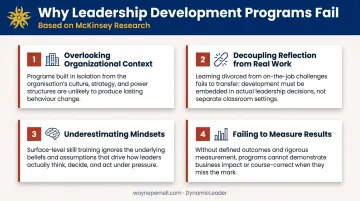
McKinsey's research on why leadership development programs fail identifies four consistent patterns:
- Overlooking organizational context — designing programs in HR isolation without accounting for the actual environment leaders operate in
- Decoupling reflection from real work — learning experiences that happen away from the real challenges and never transfer back
- Underestimating mindsets — focusing on behaviors while ignoring the identity-level beliefs that drive them
- Failing to measure results — no accountability loop, no proof the investment is working
Running through all four: missing executive ownership. A Korn Ferry study of 7,500+ executives across 107 countries found that 55% rated leadership development ROI as "fair" to "very poor" — and traced the failure back to leaders who commissioned programs but never championed them.
Who Leadership Development Plans Are For
These failure patterns show up at every level of an organization — which means effective development plans need to reach beyond the C-suite:
- Frontline managers — often promoted for individual performance, rarely prepared for leading others
- Mid-level managers — the transmission layer between strategy and execution; consistently overlooked in development budgets
- Senior and executive leaders — need ongoing challenge and identity-level growth, not just periodic onboarding support
What changes across levels is the content, complexity, and context of the plan. The underlying framework for building one stays consistent.
Step 1: Ground the Plan in Your Business Strategy First
This is the most frequently skipped step — and the most expensive mistake.
A development plan without a strategic anchor defaults to generic competency checklists. Generic plans lose executive sponsorship fast. And without visible leadership commitment, the plan becomes optional in practice, even if it's mandatory on paper.
Identify the Performance Gap First
Before touching curriculum, ask a diagnostic question: What are leaders currently doing — or not doing — that is costing the business?
This isn't a performance review conversation. It's a strategic gap analysis. Dr. Wayne Pernell's initial client work involves watching how things actually run — not just listening to what leaders say. His team conducts stakeholder shadowing and leader interviews specifically to surface the gap between stated values and actual behavior.
Two questions he returns to consistently: How do decisions get made? and What happens in a crisis?
Those answers define the plan's purpose — and set the terms for what stakeholder buy-in actually needs to secure.
Secure Stakeholder Buy-In Before Design Begins
A Harvard Business Publishing survey of 700 global business and L&D leaders found that 47% of executives wished they had spent more time aligning their top team, and 49% wished they had spent more time communicating change. Both are leadership failures that development plans should directly address — but only if those plans have senior-level ownership.
That's where design has to start. DynamicLeader's CCB Process — Clarity, Co-strategy, Bold action — builds senior ownership into the foundation. Before any development work begins, it establishes organizational clarity: where the company is going, what leadership behaviors will get it there, and how the strategy is co-created with leadership rather than delivered to them. That distinction is what separates a culture-shifting plan from a box-checking exercise.
Avoid the Trap of Over-Scoping
Resist the temptation to develop every competency at once. Focused plans built around two to three strategic priorities consistently outperform exhaustive frameworks — in both participant engagement and on-the-job behavior change. When everything is a priority, nothing is.
Step 2: Assess Your Leaders — Strengths, Gaps, and Blind Spots
You wouldn't prescribe medicine before a diagnosis — and the same logic applies to leadership development. A Gartner survey of nearly 3,200 managers found that 40% of managers with two years or less experience struggle to support their teams, and this gap often persists undetected because organizations conflate current performance with leadership potential.
Assessment Methods That Work
No single method gives you a complete picture. The most accurate view combines:
- 360-degree feedback — input from peers, direct reports, and managers that surfaces blind spots leaders can't self-identify
- Behavioral and personality assessments — structured tools that predict how leaders will perform under pressure
- Leadership simulations — realistic business challenges that generate observable behavioral data
- Stakeholder shadowing — observing how leaders actually operate in real-time situations, not just how they describe themselves
DynamicLeader's embedded methodology is built around this last point. Because leaders are often too deep in daily operations to see their own patterns, an outside observer watching how decisions get made and how teams respond surfaces what structured surveys miss.
High performance doesn't equal high potential. Most organizations miss this distinction entirely. Employees who excel as individual contributors frequently lack the mindset shifts required to lead others effectively — development resources should go to leaders who have both the capability and the coachability to grow, not just the ones with the best current results.
Assess the Environment, Not Just the Individual
One often-overlooked diagnostic question: Is the organizational environment set up to support the behaviors the plan is designed to develop?
Consider a common example: an organization invests in developing psychological safety and candid feedback. But when a manager actually gives candid upward feedback, they're sidelined in the next planning cycle. The environment is punishing the very behavior the plan is trying to build. No amount of training overcomes that without addressing the systemic issue first.
Segmenting Leaders for Targeted Development
Each leadership tier needs a tailored approach:
| Level | Key Development Focus |
|---|---|
| Frontline managers | Self-awareness, feedback skills, team trust |
| Mid-level leaders | Strategic thinking, cross-functional influence, communication |
| Senior/executive leaders | Decision-making under pressure, culture modeling, succession |
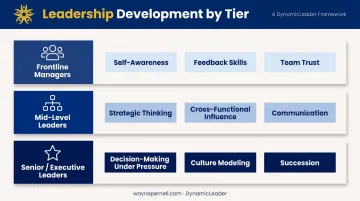
One plan cannot serve all three groups effectively — which is precisely why assessment comes before design, not after.
Step 3: Define the Competencies That Matter and Set Measurable Goals
A leadership competency framework translates abstract expectations into specific, observable behaviors that can be taught, practiced, and measured. Without one, "we need better leaders" remains wishful thinking.
Rather than building exhaustive lists, identify five to seven core competencies tied directly to the business priority you established in Step 1. Strong plans tend to draw from:
- Strategic thinking and decision-making under pressure
- Coaching and developing others
- Navigating complexity and ambiguity
- Cross-functional communication and influence
- Accountability and follow-through
CCL's research identifies self-awareness, communication, influence, and learning agility as foundational across leadership roles. Use those as a starting point — then adjust the list to reflect your organization's specific leadership challenges, not a borrowed framework.
Set Goals That Create Real Accountability
Locke and Latham's goal-setting research, built across 35 years of study, consistently shows that specific, challenging goals produce higher performance than vague directives. Leadership development is no different.
Weak goal: "Improve communication skills."
Strong goal: "Facilitate two cross-functional project briefings per quarter and achieve a stakeholder feedback score of 4+/5 by Q3."
The strong version is specific, observable, time-bound, and tied to a real business outcome. That structure is what makes goals stick — and what makes progress measurable when it's time to evaluate impact.
Build Metrics Tied to Business Outcomes
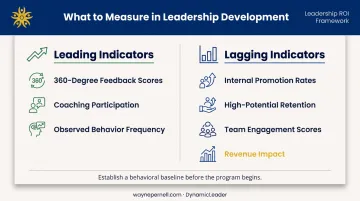
Participation rates and course completions measure activity, not impact. Build your scorecard around:
Leading indicators :
- 360-degree feedback improvement scores
- Coaching session frequency and quality ratings
- Behavior-use frequency observed by managers
Lagging indicators :
- Internal promotion rates
- Retention of high-potential employees
- Team engagement scores
- Revenue or productivity impact tied to the plan's goals
Step 4: Design Development Experiences That Build Real Leadership
The 70-20-10 model, developed through CCL research by McCall, Lombardo, and Eichinger, gives leadership planners a practical framework: approximately 70% of leadership growth comes from on-the-job experience, 20% from developmental relationships, and 10% from formal training.
Most organizations invert this ratio — defaulting to workshops and e-learning, then puzzling over why behavior never shifts once people return to their desks.
A well-designed plan reflects this distribution across three experience types:
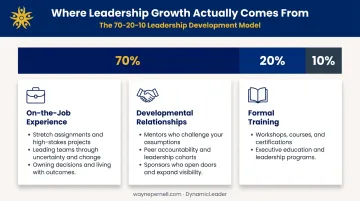
On-the-job experience (70%)
- Stretch assignments outside the leader's current comfort zone
- Cross-functional projects that require influencing without authority
- Leading through a real organizational challenge with structured reflection built in
Developmental relationships (20%)
- Executive coaching — a 2023 meta-analysis in Frontiers in Psychology found executive coaching effects were strongest for behavioral outcomes
- Peer learning cohorts where leaders challenge and support each other's growth
- Mentoring relationships with senior leaders who model target behaviors
Formal training (10%)
- Targeted workshops tied directly to identified competency gaps
- Leadership programs designed around real organizational challenges, not generic curricula
Designing experiences that honor this distribution is harder than it sounds. Most development plans get built around what's easy to schedule, not what actually changes behavior. DynamicLeader's shadowing-based consulting methodology puts development inside the actual work environment, where the real decisions and pressures live. Dr. Wayne's Dancing with Chaos system, for instance, addresses decision-making under uncertainty and organizational agility as they appear in live work — not reconstructed in a classroom after the fact.
Step 5: Build Accountability Into the Plan and Measure What Changes
Accountability is the element most development plans leave out entirely. Without it, even well-designed programs fade within 90 days of rollout.
Real accountability requires four structural components:
- Named executive sponsor — someone with organizational authority who publicly champions the plan and models the target behaviors
- Defined ownership — each leader in the plan has explicit development responsibilities, not just participation requirements
- Regular check-ins — built into the calendar, not optional, and structured around observable behavioral progress
- A feedback loop that surfaces problems early — not once a year in a performance review
Build Feedback Loops That Work
360-degree feedback should anchor the accountability structure, with cycles timed to allow meaningful behavior change between assessments. Manager check-ins and peer accountability structures reinforce the feedback between formal cycles.
Feedback works when it's timely and specific — observations delivered close to the triggering event drive behavior change in ways that annual reviews simply cannot.
DynamicLeader's engagement process includes mid-engagement check-ins and post-program evaluations, tracking metrics from individual coaching progress to company-wide engagement shifts. Follow-up sessions and sustainability plans are built in from the start, so gains hold rather than eroding once the formal program ends.
Measure What Actually Changes
DDI's Impact Evaluation survey of 1,300+ leaders found that 82% of participants were rated effective after a development program — a 24% increase from pre-program baseline. That level of precision is only possible when you establish a behavioral baseline before the program begins.
Track:
- Behavioral shifts — observable changes in leadership behaviors on the job
- Business metrics — the outcomes the plan was designed to affect (engagement scores, retention, promotion rates, revenue impact)
- Participant self-assessment — tracked at regular intervals, not just at the end
Without this data, leadership development remains a line item senior leaders question every budget cycle. With it, the program earns its place — and its next iteration.
Frequently Asked Questions
What are the five steps of leadership development?
The core stages are: assess current capability, align to a specific business strategy, define competencies and measurable goals, design development experiences across on-the-job work and coaching, and measure behavioral outcomes. Effective plans treat these as a continuous cycle rather than a one-time sequence.
What is the 70-20-10 rule for leadership development?
The 70-20-10 model holds that approximately 70% of leadership learning comes from challenging on-the-job experiences, 20% from coaching and mentoring relationships, and 10% from formal training. It's a design heuristic, not a rigid formula. Still, it should reshape how organizations allocate development time and budget.
What are the 5 C's of leadership development?
No single authoritative version exists. DDI's framework names Connection, Conscience, Creativity, Clarity, and Curiosity — but definitions vary. What matters most is that your plan addresses clarity of direction, consistent behavior, coaching accountability, and commitment at the executive level.
How do you measure the success of a leadership development plan?
Measure both leading and lagging indicators. Leading indicators include 360-degree feedback scores, coaching participation, and observed behavior frequency. Lagging indicators include internal promotion rates, high-potential retention, team engagement scores, and business outcomes tied to the plan's original strategic goals.
How long does it take to see results from a leadership development plan?
Early indicators like improved feedback scores and engagement often surface within 3–6 months. Deeper business outcomes such as retention improvements, promotion rates, and revenue impact typically require 12 months or more to measure reliably.
What is the difference between a leadership development plan and a performance improvement plan?
A leadership development plan is forward-looking and strengths-building, designed to prepare high-potential employees for greater responsibility. A performance improvement plan is a corrective tool that addresses current deficiencies. The two serve distinct purposes and should never be conflated.