Research from the Center for Creative Leadership found that only 18% of senior executives rated their leadership teams "very effective" on enterprise responsibilities — even while each leader performed well in their own function. Strong individuals don't automatically form strong teams.
This post addresses what leadership strategy coaching looks like when the team is the client — not just one executive in it. You'll understand how the methodology works, what results it produces, and what to look for when selecting the right coach for this kind of engagement.
Key Takeaways
- Leadership strategy coaching treats the full leadership team as the unit of change, not individual executives
- Strategy fails most often between leaders — in the gaps, not within any single role
- Effective team-based coaching combines diagnostic assessment, co-created strategy, and embedded accountability
- DynamicLeader's CCB Process — Clarity, Co-strategy, Bold action — converts alignment conversations into committed decisions
- The right engagement runs months, not days — combining direct observation with structured team sessions
The Case for Team-Based Leadership Strategy Coaching
Leadership strategy coaching is a structured engagement in which a coach works with a leadership team collectively — sharpening strategic clarity, aligning direction, and developing the communication and decision-making habits that drive execution. It's distinct from individual executive coaching, which focuses on one leader's personal development and growth.
The distinction matters because most strategy problems aren't individual problems.
A 2015 HBR study of 7,600 managers across 262 companies found that execution consistently breaks down between functions — not within them. Leaders may each be competent in their own domains while still operating with conflicting priorities, hidden assumptions, and communication gaps that steadily undermine shared goals. That's a team dynamic issue, not a personal development gap.
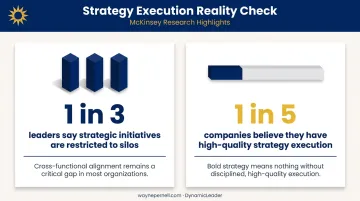
McKinsey's research compounds this: about one-third of leaders say strategic initiatives are restricted to organizational silos, and only roughly one in five companies believe they have high-quality strategy execution. The bottleneck is rarely strategy quality. It's the leadership team's ability to execute it together.
The "Team as the Client" Model
Rather than coaching the CEO and hoping insights cascade downward, team-based strategy coaching treats the leadership group's collective behaviors, blind spots, and working dynamics as the subject of development. Instead of asking "how does this executive lead better?", the work asks:
- Where does this team lose alignment?
- Whose assumptions about strategy conflict, and are those conflicts even visible to them?
- How are decisions actually made, and does that match how leaders think they're made?
- What communication patterns are slowing execution down?
Dr. Wayne Pernell of DynamicLeader has led over 120 leadership teams across organizations including Charles Schwab, Whole Foods Market, and Pfizer. Across those engagements, the limiting factor is rarely one underperforming leader — it's the unaddressed friction between them.
How Team-Based Leadership Strategy Coaching Works
The Diagnostic Phase
Before any strategy conversation begins, an effective coach conducts assessments at both the individual and team levels. DynamicLeader's process includes proprietary assessments for individuals, leadership teams, and cultural alignment — paired with leader interviews and direct stakeholder shadowing.
That baseline is critical. Formal planning processes surface what leaders say about their strategy. The diagnostic phase uncovers what's actually happening: the real decision-making patterns, the unspoken assumptions, the trust dynamics that shape how — or whether — strategy moves.
Dr. Wayne's initial assessment asks two foundational questions of every leadership team: How do decisions get made? and What happens in a crisis? The answers — and the gaps between what leaders say and what he observes — tell him more than any survey.
Building Shared Strategic Clarity
Early coaching sessions focus on bringing the full leadership team to a single, explicit understanding of organizational direction, priorities, and constraints. Not assumed alignment — but tested and verbally confirmed alignment.
Leadership teams regularly discover that what they thought was shared strategy is actually several different interpretations held politely together. Structured facilitation surfaces these competing views without blame. Dr. Wayne's approach: "listen for what's being said, and perhaps more importantly, what's not being said."
What that process typically uncovers:
- Diverging assumptions about which markets or customers matter most
- Unspoken constraints (budget, talent, risk tolerance) no one named aloud
- Conflicting priorities that explain why execution keeps stalling
- Trust gaps that surface only when pressure is applied
Moving from Conversation to Co-Strategy
The co-strategy phase is where strategy gets built with the team, not delivered to it. The coach facilitates working sessions in which team members surface strategic options, stress-test assumptions about their market and capabilities, and arrive at choices together.
The participation itself drives execution. When people help form the strategy, their commitment to implementing it measurably increases — and performance follows. Leaders who shape the plan don't need to be sold on it afterward.
DynamicLeader's CCB Process — Clarity. Co-strategy. Bold action. — structures this progression deliberately, moving teams from diagnosing the current state, through co-created strategic choices, to specific actions with owners and timelines.
Embedding Accountability and Follow-Through
Strategic decisions made in a coaching session mean nothing if execution habits don't change. Without a coaching partner holding the team accountable, most strategy efforts collapse at exactly this point.
DynamicLeader builds accountability into the engagement through:
- Mid-engagement check-ins and post-session evaluations
- Observation of how leaders actually run decision meetings
- Follow-up sessions and sustainability plans to prevent backsliding
- Measurement from individual coaching metrics to company-wide engagement shifts
Every engagement is designed to outlast the engagement itself: "We evolve. This isn't a 'one and done.' We measure impact, adjust as needed, and make the change stick."
The Core Building Blocks of a High-Impact Team Strategy Coaching Program
Psychological Safety and Productive Challenge
Team strategy coaching only works when members feel safe surfacing disagreements, admitting uncertainty, and questioning prevailing assumptions. Amy Edmondson's foundational research across 51 work teams established that psychological safety (the shared belief that the team is safe for interpersonal risk-taking) directly enables team learning and performance.
Dr. Wayne's approach is "direct-yet-compassionate," creating what he describes as a no-judgment zone while still asking the tough questions. "Comforting the afflicted and afflicting the comfortable" is how he describes the balance. Safety and productive challenge aren't opposites ; the coach's job is to hold both.
Shared Leadership Language and Communication Norms
Leaders routinely use the same words to mean different things. Consider how much variation lives in terms like:
- Accountability — who owns it vs. who's just informed
- Priority — the top item vs. one of seven "top" items
- Aligned — genuinely agreed vs. politely nodding
Woolley et al.'s research on collective intelligence found that group performance correlates more strongly with social sensitivity and equality of conversational turn-taking than with the average or maximum intelligence of group members. How the team communicates matters more than how smart its members are individually.
Team-based coaching develops consistent language for strategy, conflict, and performance and builds active listening and inquiry as team competencies, not just individual ones.
Individual Self-Awareness in Service of Team Effectiveness
This isn't pure individual coaching. In team-based work, leaders develop self-awareness specifically to understand how their behaviors and assumptions affect the collective.
DynamicLeader's proprietary assessments cover individuals, teams, and cultural alignment. They're used not to profile leaders in isolation, but to surface patterns that either accelerate or block team performance.
The question isn't "what kind of leader are you?" It's "how does your leadership style create friction or momentum for this particular team?"
Clear Roles, Decision Rights, and Accountability Structures
McKinsey's decision-making research found that 72% of senior executives said bad strategic decisions were about as frequent as good ones . A significant driver: unclear decision rights.
DynamicLeader's diagnostic work consistently surfaces ambiguity about who decides what, where authority actually sits, and how accountability is tracked. Resolving these structural issues is what separates strategy coaching from generic team-building. Stronger relationships matter — but if decision rights remain murky, execution stalls regardless of how well people get along.
A Structured Framework That Drives Bold Action
The CCB Process gives leadership teams a repeatable methodology:
- Clarity — Diagnose the current situation honestly, including what the team doesn't agree on
- Co-strategy — Surface options, stress-test assumptions, and make choices together
- Bold action — Assign specific actions with owners, timelines, and accountability checkpoints
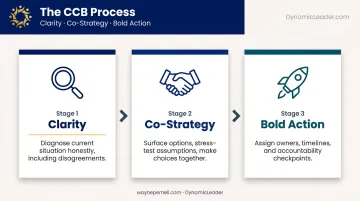
A clear framework converts coaching conversations into decisions, and decisions into movement. Teams that leave with defined owners, real timelines, and accountability checkpoints don't just intend to execute — they do.
The Measurable Impact on Team Performance and Business Growth
CCL's research found that 97% of senior executives agreed that increasing executive-team effectiveness would positively affect organizational results. The practical challenge is knowing what to measure and when to expect results.
What to Expect and When
Early indicators (first 60-90 days):
- Improved meeting quality and faster decisions
- Clearer communication of strategy to frontline teams
- Reduced conflict around priorities
Longer-term indicators (6-12 months):
- Revenue and productivity growth
- Reduced silos and improved cross-functional execution
- Stronger employee engagement scores
- More developed succession pipeline
These timelines align with broader industry benchmarks. McKinsey's organizational health data shows that top-quartile organizations achieve total shareholder returns 3x higher than middle-quartile peers — and companies prioritizing leadership development are 2.4x more likely to hit performance targets.
Documented Results from DynamicLeader Engagements
Dr. Wayne's client engagements show what shifts when the full leadership system is developed together:
- A 12-person misaligned team achieved a 329% increase in revenue and production in just over a year — driven by clarified vision, rebuilt processes, and reset expectations
- An IT division with siloed directors received a three-day facilitated retreat focused on cross-functional collaboration — resulting in a 300% improvement in effectiveness and an industry award
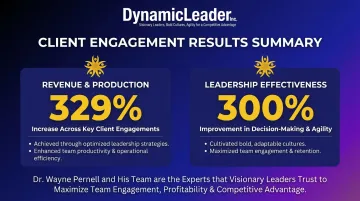
Consistent results like these don't come from coaching individuals in isolation — they come from shifting how the entire leadership team operates together. That's why measurement starts on day one.
Tracking Progress Throughout the Engagement
Meaningful measurement requires baseline data from the outset. DynamicLeader builds evaluation into every engagement:
- Proprietary individual and team assessments establish the starting point
- Mid-engagement check-ins capture progress and flag emerging issues
- Post-training evaluations measure behavioral change at the leadership level
- Business KPIs track organizational impact over the engagement arc
How to Select and Engage the Right Leadership Strategy Coach
Not every executive coach is equipped for team-based strategy work. The ICF identifies team coaching as requiring distinct skills and tasks beyond one-to-one coaching — and that distinction is real.
Key Criteria for Evaluation
When assessing a leadership strategy coach for team-based work, look for:
- Worked directly with multiple intact leadership teams, not just individual executives
- Can articulate clearly how strategy frameworks and coaching practice connect
- Willing to challenge senior leaders — a coach who defers to hierarchy can't surface what needs to surface
- Points to measurable organizational results, not just behavioral change
- Observes actual leadership interactions rather than working only from a conference room
Dr. Wayne's methodology includes direct shadowing and observation: "We don't just listen — we watch how things run." What leaders report in coaching sessions and what actually happens in executive meetings are often sharply different. A coach who only knows the reported version is working with incomplete data.
One-Time Workshop vs. Genuine Coaching Engagement
A two-day offsite can create momentum, but momentum without structure rarely creates lasting change. The difference:
| Workshop | Coaching Engagement |
|---|---|
| Fixed timeframe | Extended partnership (90 days to 1 year) |
| Delivers frameworks | Applies frameworks to real challenges |
| Coach presents content | Coach observes and adjusts in real time |
| Accountability ends when room empties | Accountability built into ongoing cadence |
| Knowledge transfer | Behavioral and cultural change |
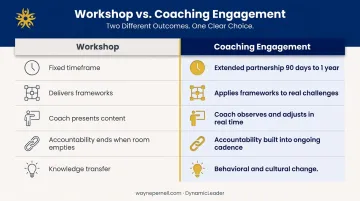
DynamicLeader's engagements are built on the embedded partnership model — combining proprietary assessments, direct observation, and structured coaching sessions across a sustained timeframe. Because strategy challenges evolve, each engagement is designed to adapt as new priorities surface.
Assessing Organizational Readiness
Selecting the right coach is only half the equation. The engagement itself succeeds or stalls based on organizational readiness. The conditions that drive results:
- Senior leadership is genuinely committed — not just nominally sponsoring it
- There is openness to honest feedback, including uncomfortable findings from the diagnostic phase
- A real strategic challenge creates urgency: rapid growth, cultural friction, succession planning, or entering new markets
One clear signal that readiness is absent: leadership wants the team to change but isn't willing to examine its own role in the current dynamic. As Dr. Wayne puts it, the work requires leaders who are "ready to shift from 'doing it all' to building strong systems and strong people."
Frequently Asked Questions
What is the difference between executive coaching and leadership strategy coaching for teams?
Executive coaching focuses on a single leader's skills, mindset, and personal development. Leadership strategy coaching for teams treats the collective leadership group as the client — working on shared alignment, decision-making norms, and co-created strategy rather than individual growth alone. Progress is measured at the team level, not the individual level.
What are the signs that a leadership team needs strategy coaching?
Key signals include persistent misalignment on priorities, recurring conflict between functions, difficulty executing on stated strategy, or low trust within the leadership group. Major transitions — growth, restructuring, or a leadership change — often surface the need for collective re-alignment rather than individual adjustment.
How is leadership strategy coaching different from a corporate training workshop?
Workshops deliver knowledge in a fixed timeframe. Coaching is an ongoing, adaptive engagement tailored to the team's real-time challenges, with the coach holding accountability over weeks or months. What separates the two is durability: coaching embeds new behaviors into how the team operates day to day, rather than delivering insights that fade after the session ends.
How long does a team-based leadership strategy coaching engagement typically last?
DynamicLeader engagements typically range from 90-day culture sprints to year-long coaching partnerships. Shorter engagements build momentum and address a specific inflection point. Sustained partnerships produce the lasting behavioral and cultural change most organizations are actually after. The depth of the organizational challenge usually determines the appropriate timeframe.
Can leadership strategy coaching work for remote or hybrid leadership teams?
Yes. While in-person sessions are ideal for trust-building and observation, skilled coaches adapt to virtual environments using structured facilitation and asynchronous reflection between sessions. DynamicLeader delivers coaching in-person, virtually, and in hybrid formats, with each engagement structured around what the team actually needs.