Introduction
Here's an uncomfortable truth most organizations avoid: as many as half of newly promoted leaders fail within their first 18 months, according to Korn Ferry — not because they lack drive, but because they lacked preparation. Meanwhile, poor CEO and C-suite succession practices destroy nearly $1 trillion in market value annually among S&P 1500 companies alone.
If you're a CEO, founder, or senior leader responsible for organizational continuity, this is the guide you've likely needed — but haven't found. Leadership pipeline development gets discussed in every boardroom and offsite agenda. It rarely gets executed with the discipline it demands.
This guide covers the structural, psychological, and ownership-level elements of building a pipeline that holds: how to identify and develop emerging leaders, how to close the preparation gap before it costs you, and what separates organizations that sustain momentum from those that scramble when key roles turn over.
Key Takeaways
- A leadership pipeline identifies, develops, and advances internal talent into leadership roles before vacancies force reactive hiring decisions.
- Without one, organizations face leadership gaps, institutional knowledge loss, and costly external hires who underperform.
- Building an effective pipeline follows five steps: define roles, assess potential, design development plans, tie to succession planning, and track outcomes.
- Most pipelines fail because they overlook the mindset and identity shifts each leadership transition demands — not just the skill gaps.
What Is a Leadership Pipeline and Why It Matters
A leadership pipeline is a systematic, internal process for identifying and developing employees to fill leadership roles at every level of the organization — from individual contributors stepping into their first management role up to enterprise executives.
The Leadership Pipeline model, developed by Ram Charan and colleagues, describes six distinct leadership passages:
- Managing self → individual contributor, accountable for their own output
- Managing others → first-time people manager, getting work done through a team
- Managing managers → leading leaders, not just doing
- Functional manager → running a business function with cross-functional impact
- Business manager → full P&L accountability
- Enterprise leader → organization-wide strategy and culture ownership
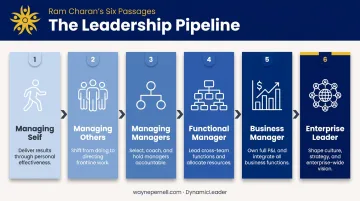
Each passage requires different skills, different use of time, and different values. Skipping deliberate development at any passage is where promotions go wrong.
Pipeline vs. Succession Planning
These two terms get used interchangeably, but they describe different things. Succession planning identifies who fills a specific seat when it becomes vacant. A leadership pipeline builds readiness across the entire organization continuously — regardless of whether a departure is imminent. The pipeline feeds the succession plan, not the other way around.
The Business Case
The numbers make this urgent:
- Only 20% of companies have a strong leadership bench, according to DDI's Global Leadership Forecast
- 57% of employees have left at least one job because of a bad manager
- External CEO hires are 84% more likely to leave within three years than internally promoted counterparts — and cost 15% more
- Companies focused on people performance are 4.2x more likely to outperform peers, with 30% higher revenue growth
Turnover, lost deals, stalled strategy, and gradual cultural erosion — these are what a depleted leadership bench actually costs.
How to Build Your Leadership Pipeline
A leadership pipeline is not a one-time HR project. It's a living system that requires intentionality, senior commitment, and regular maintenance. Here are the five steps that make it work.
Step 1: Define Critical Leadership Roles and Competency Profiles
Start by identifying which leadership roles are essential — not just executive seats, but the mid-level positions that serve as proving grounds for future senior leaders. A VP of Sales who consistently produces individually is valuable. A VP of Sales who consistently develops the next generation of sales leaders is irreplaceable.
For each critical role, define:
- The specific skills required at that level (not the level below)
- The leadership behaviors that distinguish effective from ineffective performance
- The values and decision-making orientation the role demands
This step often surfaces a gap: most organizations have job descriptions that describe tasks, not leadership expectations.
Step 2: Identify and Assess High-Potential Talent
High performance and high potential are not the same thing. A strong individual contributor may lack the motivation, temperament, or adaptability to lead others effectively. Relying on gut instinct or performance reviews alone creates blind spots — and DDI reports that high-potential employees are 3.7x more likely to leave if they're not given development opportunities.
Effective identification uses objective criteria:
- Behavioral assessments and structured observation
- Demonstrated adaptability under pressure
- Initiative beyond their current scope
- Emotional intelligence and ability to influence without authority
- Willingness to shift from individual achievement to enabling others
Organizations like DynamicLeader use proprietary individual and team assessments as part of their embedded consulting process — combining assessment data with leader interviews and direct shadowing to surface candidates that traditional review processes often miss.
Step 3: Design Personalized Development Plans
One-size-fits-all programs fail because leadership readiness is uneven across a pipeline. Some individuals need confidence and strategic exposure. Others need to close specific skill gaps. Others need identity-level coaching to let go of behaviors that made them successful as individual contributors.
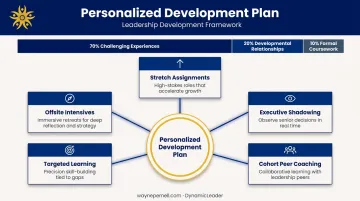
CCL's 70-20-10 framework provides a useful structure: 70% challenging experiences, 20% developmental relationships, and 10% formal coursework. A strong individual development plan reflects this balance.
Concrete development elements include:
- Stretch assignments that expose leaders to unfamiliar business contexts
- Executive shadowing to observe senior decision-making firsthand
- Cohort or peer coaching for structured accountability and trust-building
- Targeted learning tied directly to identified competency gaps
- Offsite intensives for strategic thinking and cross-functional exposure
DynamicLeader's CCB Process takes a different approach: it starts by diagnosing what's actually happening beneath the surface — not just the presenting symptoms, but the identity-level and cultural dynamics shaping leadership behavior. From there, Clarity gives way to Co-strategy, where a prioritized leadership growth plan is built collaboratively.
Bold action is the final phase — translating that plan into concrete development experiences, with accountability built in from the start rather than bolted on at the end.
Step 4: Integrate the Pipeline with Succession Planning and Internal Mobility
A pipeline that isn't connected to succession planning is just a list of promising names with no clear destination. The integration requires matching high-potential employees to projected future openings — not based purely on skillset, but on cultural fit, personal ambition, and strategic timing.
Visible career pathways matter just as much. Gartner research shows only 46% of employees feel supported in growing their careers at their organization — meaning the majority of your high-potential employees can't see a clear path forward. When rising leaders can't see their trajectory, they start looking elsewhere.
Internal mobility should be treated as a retention and development strategy, not an administrative process. That mindset shift sets the stage for Step 5: measuring whether any of this is actually working.
Step 5: Measure, Review, and Evolve the Pipeline
An unmeasured pipeline becomes stagnant. Track metrics that tell you whether the system is working:
| Metric | What It Reveals |
|---|---|
| Promotion rate from within | Whether the pipeline is producing ready leaders |
| Time-to-readiness for key roles | Development velocity |
| Retention of high-potential employees | Whether investment is reducing flight risk |
| Development milestone completion | Engagement with the process |
| Manager effectiveness scores | Whether transitions are sticking |
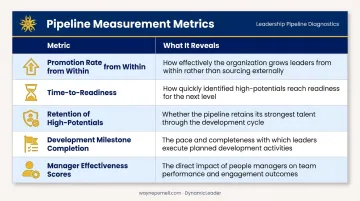
Formal pipeline reviews should happen at least annually — tied to strategic planning cycles — with informal reviews whenever organizational structure or talent conditions shift significantly.
Why Leadership Transitions Often Fail — and How to Prevent It
Most newly promoted leaders don't struggle because they're incompetent. They struggle because they're applying the skills, time allocation, and values that made them successful at the previous level — and promotion doesn't automatically trigger the shifts needed to succeed at the next one.
The Three Critical Shifts
1. Skills: Each level requires genuinely new competencies. A strong individual contributor must learn to develop others, not just perform. A people manager moving to manage managers must stop doing the work and start selecting, coaching, and holding their direct reports accountable.
2. Time: Where a leader allocates attention must change at every passage. The trap is time getting pulled toward familiar tactical work rather than redirected toward the strategic and relational demands of the new role. According to the Center for Creative Leadership, 26% of first-time managers say they weren't ready to lead others — and nearly 60% never received formal training before the transition.
3. Mindset: This is where most development programs fall short. The values and identity frameworks that drove success at one level can actively obstruct success at the next.
A leader who defines their worth through personal output will struggle to delegate. One whose identity is tied to being the expert will resist building a team that outgrows them.
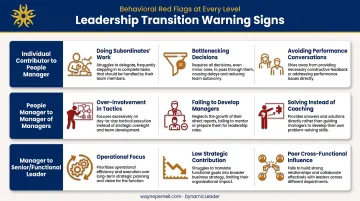
Warning Signs to Watch For
| Level | Common Behavioral Signals |
|---|---|
| Individual contributor → people manager | Doing subordinates' work, bottlenecking decisions, avoiding performance conversations |
| People manager → manager of managers | Over-involvement in tactical details, failing to develop first-line managers, solving rather than coaching |
| Manager → senior/functional leader | Spending most time on operational issues, limited strategic contribution, poor cross-functional influence |
The Psychological Dimension
Dr. Wayne Pernell — whose background sits at the intersection of clinical psychology and four decades of leadership experience — works with organizations specifically on the identity-level barriers that derail transitions. The blocks he encounters most often aren't about knowledge. They're about leaders whose sense of relevance is tied to doing, not enabling. Whose confidence is rooted in expertise, not judgment. Whose reluctance to delegate is really a reluctance to be seen as less valuable.
Effective pipeline development must create psychological safety for leaders navigating this identity shift — not just hand them a new skill curriculum.
Key Factors That Shape Pipeline Strength
Three variables, more than any others, determine whether a pipeline thrives or stalls.
Senior Leader Ownership
A pipeline driven only by HR will plateau. It requires visible investment, mentoring, and sponsorship from the existing C-suite. When senior leaders actively coach their successors — and treat that coaching as a leadership accountability rather than a courtesy — ready candidates emerge at every level.
ATD research shows that 66% of organizations mandate leadership development for people managers, but mandates without modeled behavior rarely stick.
Cultural Alignment
If the organization rewards individual heroics over team development, the pipeline is being undermined from inside. A culture that doesn't treat developing others as a core leadership responsibility produces leaders who hoard knowledge, protect turf, and deprioritize their people's growth.
ATD data shows 79% of organizations report improved culture when leadership development extends to all employees. The pipeline and the culture are not separate problems — they move together.
Transparency and Feedback
High-potential employees need to know where they stand, what they're being developed for, and what the path ahead looks like. Without honest, consistent feedback, development stalls and flight risk climbs.
This is where most organizations fall short — not in identifying high-potentials, but in building the feedback infrastructure to develop them. DynamicLeader addresses this directly through direct shadowing, structured assessments, and ongoing coaching woven into the engagement itself.
Conclusion
A leadership pipeline is one of the most consequential strategic investments an organization can make — and one of the most consistently underfunded ones.
The strongest pipelines are built with intention, maintained with discipline, and grounded in a culture where developing others carries the same weight as individual performance. Getting the three transitions right — skills, time, and mindset — determines whether your organization grows because of its people or in spite of leadership gaps that were never addressed.
For senior leaders and organizations ready to move from reactive succession to a proactive leadership culture, DynamicLeader works with senior leadership teams through executive and cohort coaching, proprietary assessments, and embedded consulting engagements — all grounded in Dr. Wayne Pernell's CCB Process (Clarity, Co-strategy, Bold action) and over four decades of real-world leadership experience.
Frequently Asked Questions
What is the difference between a leadership pipeline and succession planning?
Succession planning identifies who fills specific roles when they become vacant. A leadership pipeline builds readiness across the entire organization continuously — at every level, not just the top. Think of the pipeline as the ongoing work; succession planning is what you activate when that work has paid off.
How do you identify high-potential employees for a leadership pipeline?
Use objective criteria — behavioral assessments, structured observation, and leadership potential models — rather than performance reviews or managers' instincts alone. High performance in a current role does not predict leadership readiness, and gut-instinct identification consistently overlooks non-traditional talent.
How long does it take to build a leadership pipeline?
Pipeline development is continuous, not a project with an end date. Initial groundwork — defining roles, assessing talent, and launching development plans — typically takes several months. Real pipeline value compounds over years of consistent investment and review.
What are the biggest mistakes organizations make when building a leadership pipeline?
Three failures show up repeatedly:
- Promoting based on past performance rather than future potential
- Focusing on skill development while ignoring mindset and identity-level shifts
- Treating the pipeline as an HR initiative instead of a leadership-owned organizational priority
How often should a leadership pipeline be reviewed?
Formal reviews should happen at least annually, tied to strategic planning cycles. Informal reviews are warranted whenever the business landscape, organizational structure, or talent pool shifts significantly — don't wait for the calendar.
Can smaller or mid-sized organizations build an effective leadership pipeline?
Pipeline development is not reserved for large enterprises. Organizations with even a handful of senior leaders benefit from intentional development planning — the core principles scale to any size. DynamicLeader works with founder-led companies and mid-market organizations using the same structured approach that has driven results at Schwab, Whole Foods Market, and Pfizer.