The instinct is usually to send leaders to more training or plan another offsite. But according to Harvard Business School research, only about 10% of training programs are effective at changing organizational performance — because the dysfunction lives in the system between leaders, not within any single individual.
This guide explains what leadership team coaching actually delivers: the specific benefits, what deteriorates without it, and how to extract the most value from the engagement.
Key Takeaways
- Leadership team coaching treats the team as one client, developing how leaders think, decide, and operate together.
- Core benefits: sharper strategic alignment, rebuilt trust, and measurable gains in revenue, productivity, and retention.
- Without it, teams drift into silos, relitigate decisions, and erode morale at every layer below them.
- Sustained coaching tied to real business challenges delivers compounding returns — not a one-time lift.
- DynamicLeader has led 120+ leadership teams across firms like Schwab, Whole Foods, and Pfizer — with documented results including a 329% increase in revenue and production.
What Is Leadership Team Coaching?
Leadership team coaching is a structured, ongoing process that develops the collective effectiveness of a senior team — how they align, communicate, decide, and lead together. It is not a series of individual sessions, a one-day offsite, or a team-building exercise.
The distinction from individual executive coaching matters. One-on-one coaching improves each leader in isolation. Leadership team coaching addresses the patterns, dynamics, and relational gaps that exist between leaders — which is where most organizational dysfunction actually lives.
Coaching the System, Not Just the People
Think of a leadership team as a system with its own behaviors, blindspots, and habits. Individual coaching can make each component stronger without changing how the system functions. Team coaching changes the system itself.
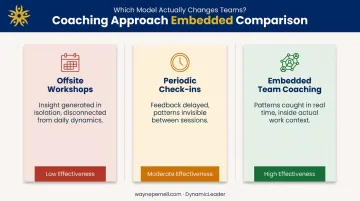
That difference shows up clearly in how DynamicLeader approaches engagements. Rather than running periodic workshops, Dr. Wayne Pernell's embedded partnership model places his team inside the organization: shadowing leaders, observing actual meetings, and identifying the gap between what leaders say in sessions and what happens in the hallways. That observational layer is what traditional offsite models consistently miss.
The contrast with conventional approaches is stark:
- Offsite workshops: Insight generated in isolation, disconnected from daily team dynamics
- Periodic check-ins: Feedback delayed, patterns invisible between sessions
- Embedded team coaching: Patterns caught in real time, inside the actual work context
The measure of success isn't how the team feels after a session. It's whether they execute strategy with alignment, make decisions that hold, and show up as the leadership the rest of the organization can follow.
Key Benefits of Leadership Team Coaching
The benefits below show up in the metrics organizations already track — revenue, decision speed, retention, and organizational health. Each compounds when coaching is applied consistently over time.
Strategic Alignment and Faster, More Decisive Leadership
Misaligned leadership teams don't just feel frustrating — they're operationally expensive. McKinsey research found that 61% of executives say most decision-making time is used ineffectively, and that fast-moving organizations report 2.5x higher financial performance than slower peers. The bottleneck is rarely a lack of intelligence or effort. It's the absence of shared decision-making architecture.
Leadership team coaching builds that architecture — common priorities, clear protocols, and accountability structures that prevent strategy from being reinterpreted silo by silo after every meeting.
KPIs most impacted:
- Decision cycle time
- Initiative completion rates
- Reduction in re-litigation of settled decisions
- Cross-functional project delivery timelines
When this matters most: Teams navigating rapid growth, post-merger integration, or any environment where execution lag has a visible cost.
McKinsey also found that companies with a shared and meaningful vision at the top team level are almost twice as likely to achieve above-median financial performance. That's not a soft outcome — it's a strategic advantage that compounds over time.
Trust, Collaboration, and Breaking Down Silos
Trust erosion rarely looks like open conflict. It looks like information hoarding, passive noncompliance, and leaders protecting territory rather than solving problems together. By the time it's visible, it's already expensive.
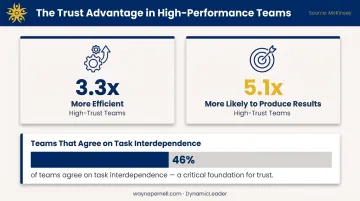
McKinsey's team effectiveness research found that teams scoring above average on trust were 3.3x more efficient and 5.1x more likely to produce results than low-trust teams. The same research found that only 46% of teams agree on their levels of task and outcome interdependence — meaning most teams are operating with fundamentally different assumptions about who owns what.
Leadership team coaching creates the psychological safety and relational infrastructure that allows leaders to disagree productively, surface problems early, and collaborate across functional lines.
When the leadership team models trust and open collaboration, those behaviors cascade downward — culture shifts through observable team-level behavior change, not proclamations. DynamicLeader has documented this directly: when an SVP in an IT organization noticed his directors drifting apart and struggling with inefficiency, Dr. Wayne facilitated a three-day retreat focused on cross-functional collaboration. The result was a 300% improvement in effectiveness, validated by an industry award.
KPIs most impacted:
- Employee engagement scores
- Cross-functional project collaboration rates
- Voluntary turnover in senior and mid-level roles
- Psychological safety assessments
Measurable Business Performance: Revenue, Productivity, and Accountability
One of DynamicLeader's most cited outcomes involves a team of twelve high-potential employees who were talented but misaligned. After Dr. Wayne worked with them for just over a year — clarifying vision, establishing processes, and redefining expectations — the team achieved a 329% increase in revenue and production. What changed: how the team set direction, how they allocated focus, and how they held each other accountable as peers rather than waiting for top-down enforcement.
HBR's research on high-performing teams shows why peer accountability drives more sustained results than managerial enforcement — top teams have members who immediately and respectfully confront problems when they arise. Coaching shifts the team from individual scorecards to shared ownership of outcomes.
KPIs most impacted:
- Revenue growth and profitability margins
- Team productivity metrics
- Reduction in owner dependency
- Leadership succession readiness
- Employee retention rates
What Happens When Leadership Team Coaching Is Absent
Without deliberate work on collective effectiveness, leadership teams don't stay neutral. They drift in predictable, compounding directions — each one measurable, each one expensive.
Common patterns that emerge:
- Each function executes against its own version of the plan, creating redundant effort and competing priorities. HBR research found 66–75% of large organizations struggle to implement their strategies, with cross-functional breakdown as a primary driver.
- Decisions made in meetings get relitigated in hallways. Leaders protect territory. Change initiatives stall through quiet noncompliance rather than open resistance.
- Without shared decision-making structures, teams spend disproportionate time managing symptoms. McKinsey found decision-making consumes up to 70% of time for some C-suite executives.
- The behaviors a leadership team models — even unintentionally — ripple through the organization. A politically charged team at the top reliably produces a politically charged culture at every level below.
- 72% of transformations fail (McKinsey), with unsupportive management behavior cited as a primary factor. Teams attempting to grow while misaligned consistently hit ceilings they can't explain and can't break through.
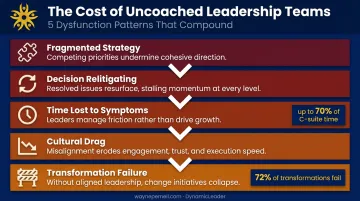
These patterns don't develop in isolation — they compound. Fragmented strategy accelerates trust erosion; trust erosion fuels reactive firefighting; reactive firefighting entrenches the cultural drag that kills transformation efforts. Left unaddressed, the cost isn't just inefficiency. It's capped growth.
How to Get the Most Value from Leadership Team Coaching
Coaching delivers compounding returns when three conditions are in place:
- Applied to real business challenges — not simulated exercises or hypotheticals. The learning has to connect to the actual decisions, frictions, and pressures the team is navigating right now.
- Sustained beyond the formal engagement — behavioral change requires repeated cycles of practice, feedback, and real-world application. One-off events don't hold.
- Translated into changed behaviors — insights documented in a slide deck are not outcomes. The test is whether meetings run differently, decisions hold, and accountability operates differently than before.
What a Strong Methodology Looks Like in Practice
A structured methodology is what converts those three conditions into actual results. DynamicLeader's CCB Process provides a direct model for how that works in practice:
- Clarity — identify the real priorities, gaps, and dynamics the team is operating with
- Co-strategy — build the path forward collaboratively so buy-in is built into the plan
- Bold action — implement decisively, with accountability structures that hold between sessions
The embedded partnership model drives this in practice. Dr. Wayne and his team work inside the organization — shadowing leaders, observing real operations, and identifying what's actually happening versus what leaders report in formal sessions. That gap between intention and behavior is usually where the work needs to happen.
What to Look for in a Leadership Team Coach
Not every executive coach is equipped to work with a team as a system. Key criteria:
- Combines behavioral science grounding with real business experience — both matter
- Uses proven frameworks that connect team dynamics to measurable business outcomes
- Works inside the organization, not just in offsite sessions — context drives behavior
- Has sustained results across multiple team types and industries, not just strong workshop reviews
Conclusion
Leadership team coaching's value shows up where it counts: in strategy that actually gets executed, in cultures that hold under pressure, and in performance that can be measured and sustained.
The benefits outlined here — strategic clarity, rebuilt trust, and documented gains in both revenue and productivity — don't operate in isolation. They reinforce each other. Teams that develop shared decision-making architecture also trust each other more, which drives accountability, which improves execution, which creates the organizational health that makes growth possible.
Organizations that invest in this work don't just improve their leadership team. They build a competitive advantage that's hard to replicate, because it's embedded in how people think, decide, and operate together — not in any tool, process, or single hire.
DynamicLeader's track record across 120+ leadership teams, 2,500+ leaders impacted, and four decades of experience with organizations from early-stage companies to Fortune 50s demonstrates what becomes achievable when the commitment to leadership development is both serious and sustained.
Frequently Asked Questions
What is the difference between leadership team coaching and individual executive coaching?
Individual executive coaching develops each leader separately in a private, personalized format. Leadership team coaching treats the team as a single client, addressing the patterns, dynamics, and relational gaps between leaders — which individual coaching cannot reach because it never observes the team as a functioning system.
How long does a leadership team coaching engagement typically take?
Most effective engagements run six to twelve months. DynamicLeader's engagements range from 90-day culture sprints to year-long partnerships, with sustained reinforcement built in — because meaningful behavioral change requires repeated cycles of practice and feedback, not a single offsite event.
What measurable outcomes can organizations expect from leadership team coaching?
Expect improvements in decision speed, cross-functional collaboration, employee retention, and revenue growth. DynamicLeader has documented outcomes including a 329% increase in revenue and production and a 300% improvement in effectiveness for previously siloed divisions.
When does a leadership team actually need coaching?
Three clear trigger conditions: strategic misalignment (decisions aren't holding after meetings), trust erosion (political behavior, silos, and information hoarding), and team transition (new leadership structure, post-merger integration, or rapid growth that has outpaced how the team operates together).
How do you measure whether leadership team coaching is working?
Track quantitative indicators — decision cycle time, retention rates, engagement scores, revenue metrics — alongside qualitative signals like changed meeting behaviors, more direct conflict resolution, and clearer shared priorities. Both matter; the qualitative shifts typically precede the quantitative ones.
What causes leadership team coaching to fail?
The most common failure modes are lack of executive buy-in, treating coaching as a one-off event rather than a sustained practice, and selecting a coach who works with individuals rather than the team as a system. Without organizational embedding experience, a coach will miss the relational dynamics that drive team behavior.