Introduction
Most organizations don't fail because their strategy was wrong. They fail because the strategy never made it past the conference room.
According to Harvard Business Review, an estimated 67% of well-formulated strategies fail due to poor execution. The gap isn't in the planning. It's in the leadership that follows it.
Senior leaders know this pain well. They invested months in planning, built alignment in the boardroom, launched the initiative with energy — and then watched momentum erode under the weight of daily fires, competing priorities, and the next urgent thing.
The strategy didn't fail loudly. It just faded.
This article covers what strategy execution actually is (and what it isn't), why leaders are uniquely positioned to make or break it, and the five disciplines that separate organizations that execute from those that merely plan.
Key Takeaways
- 67% of well-formulated strategies fail due to execution breakdowns, not poor planning
- Strategy execution is an ongoing leadership discipline that demands consistent attention — not a one-time rollout leaders hand off and walk away from
- Five disciplines drive execution: radical clarity, fewer bolder goals, shared accountability, relentless communication, and built-in agility
- Culture either enables or kills execution — and leaders build that culture through daily behavior, not policy
- Diagnosing the specific patterns blocking your team's execution is often the fastest path to a breakthrough
What Strategy Execution Really Means (and What It's Not)
Strategy execution is the disciplined process of translating strategic intent into measurable outcomes. It's how goals become owned, resources get allocated, and daily action connects to long-term results.
If strategy formulation answers what the organization wants to achieve, execution answers the harder questions: How? Who? By when?
Common Misconceptions
Three things strategy execution is not:
- Broader than project management — it spans the entire organization, not a single defined deliverable
- Ongoing, not a launch event — the discipline continues long after the rollout meeting ends
- A leadership responsibility, not a delegated one — once the plan is approved, active stewardship is where most teams fail
The mistake most leadership teams make is treating execution as the implementation team's problem. Once the boardroom presentation is over, leaders shift attention to the next strategic question — and the current one dies in the gap.
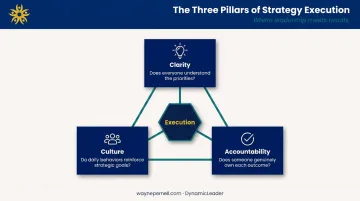
Execution lives at the intersection of three things: clarity (does everyone understand the priorities?), culture (do daily behaviors reinforce strategic goals?), and accountability (does someone genuinely own each outcome?). Miss any one of the three, and the strategy stalls — regardless of how strong the plan looked on paper.
Why Leaders Keep Failing at Strategy Execution
Most strategy execution problems aren't mysterious. The same five failure modes show up across industries, company sizes, and leadership styles.
The Urgent vs. Important Trap
Operational fires are immediate. Strategic work is important but not urgent — which means, without intentional structure, it gets pushed. Dr. Wayne Pernell, who has worked with 120+ leadership teams across organizations like Schwab, Whole Foods Market, and Pfizer, sees this pattern constantly: leaders stuck in firefighting mode, working in the business rather than on it.
Building that structure is itself a strategic act — one most leaders keep deferring.
Over-Prioritization
Research from HBR's Sull, Homkes, and Sull study found that middle managers were four times more likely to cite too many priorities as an obstacle to understanding strategy than to cite unclear communication. Everyone at the leadership table wants their initiative included — the result is a diffuse strategy with no real focal point.
When everything is a priority, teams default to whatever feels most urgent — not what actually moves the strategy forward.
The Accountability Vacuum
Shared ownership without defined decision rights means no one is truly responsible. When accountability is distributed across a group, it effectively belongs to no one — and execution stalls predictably. The same HBR research found that 84% of managers could rely on their boss and direct reports — but only 9% could rely on colleagues in other functions all the time.
The Communication Gap
Nearly 90% of middle managers in that same study believed top leaders communicated strategy frequently enough. Yet only 55% could name even one of the company's top five priorities. Frequency isn't comprehension — and assuming the message landed is one of the quieter ways strategy fails.
The Fixed-Plan Fallacy
Many organizations treat the approved strategic plan as a static document. When conditions change and the plan doesn't, execution becomes disconnected from reality — and teams either execute the wrong things or stop executing altogether.
Five Disciplines That Drive Real Strategy Execution
Discipline 1: Start With Radical Clarity
Execution without clarity is just activity. Before any team can execute, leaders must translate strategic vision into specific, understandable priorities — not aspirational language, but concrete answers to one question: What are we trying to achieve, and what does my work have to do with it?
This is where Dr. Wayne Pernell's CCB Process begins. The first stage, Clarity, isn't a communication exercise. It's the foundational act of leadership.
It involves leader interviews, stakeholder shadowing, and proprietary assessments for individuals, leadership teams, and cultural alignment. The goal is to surface what's actually happening in the organization, not just what's being reported.
Clarity also means defining what the organization is not pursuing. Without deliberate constraint, attention and resources fragment. Gallup research shows only about half of employees strongly agree they know what is expected of them at work — a number that doesn't improve by adding more initiatives to the list.
Discipline 2: Focus on Fewer, Bolder Goals
Strategic restraint is a discipline most leadership teams resist. The principle: limit enterprise-level goals to the three or four that will have the highest impact, require cross-functional effort, and genuinely need leadership-level oversight.
A useful filter for what qualifies as a true strategic priority:
- Does it require trade-offs across functions or business units?
- Would failure to achieve it materially affect the organization's competitive position?
- Does it require active leadership sponsorship to succeed?
- Is it impossible to achieve within a single department's existing budget and authority?
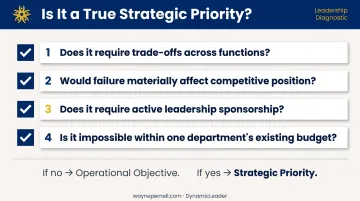
If an initiative can be owned entirely within one department, it's an operational objective — not a strategic priority. The distinction matters because mixing the two dilutes focus on both.
This requires leaders to have honest, sometimes difficult conversations about which initiatives need to wait — and to hold that line even when every team leader wants their project on the list.
Discipline 3: Build Shared Accountability Structures
Real accountability requires three things: a named person (not a team) who owns each strategic priority, explicit decision rights that define who can resolve cross-functional conflicts, and a governance process for how resource reallocation gets approved.
HBR research found that more than 80% of companies had formal systems for managing cross-silo commitments, yet only 20% of managers believed those systems worked well. Having a system isn't enough. It has to function.
A simple, visible strategy scorecard reviewed at every leadership meeting does two things: it tracks progress on strategic goals and creates shared focus across the team. What gets measured creates alignment. What gets ignored signals that the goal wasn't real.
DynamicLeader's Exponential Success Summit format demonstrates this in action — structured working sessions combined with a 90-day execution plan and built-in accountability designed to convert insights into follow-through.
Discipline 4: Communicate the Strategy Relentlessly
Strategic communication is not a quarterly town hall. It's a recurring leadership behavior — using team meetings, one-on-ones, visual scorecards, and informal conversations to continuously connect daily work to strategic goals.
Communication frequency wasn't the problem for those middle managers. Frequent communication wasn't producing comprehension. That gap closes through multiple channels and consistent reinforcement, not just more all-hands emails.
Informal communication matters as much as formal channels. People build shared understanding through conversation, not dashboards. Leaders who create regular touchpoints across functions — not just within their direct teams — accelerate alignment faster than any reporting structure can.
That alignment, however, only holds value if the strategy itself stays current. When conditions shift, even the most aligned team can execute the wrong things with great discipline.
Discipline 5: Build Agility Into the Execution Process
Treating the strategic plan as a fixed document is the fastest way to turn disciplined execution into organized irrelevance.
The solution is quarterly reassessment moments built into the execution process — structured time for leadership to ask: What has changed? What have we learned? What needs to shift? This isn't strategic inconsistency. It's disciplined responsiveness.
Dr. Wayne Pernell's Dancing with Chaos leadership training addresses exactly this challenge: how to stay agile when the beat keeps changing. The framework teaches leaders when to lead, when to follow, and when to step out of the way — along with the decision-making tools needed to adapt without losing organizational stability.
Reactive pivoting is driven by distraction and pressure. Intentional adaptation is driven by learning and changing conditions. Effective execution systems are designed to eliminate the first and institutionalize the second — so leaders can respond to what's real without losing the thread of what matters.
How Leaders Shape a Culture That Actually Executes
No execution system survives a culture that isn't built for it.
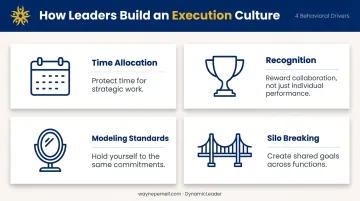
Leaders build execution culture through daily behavior — not policy documents. Specifically:
- How they allocate their own time: Leaders who protect time for strategic work signal that it matters. Leaders whose calendars are permanently consumed by operational activity signal the opposite.
- What they recognize and reward: The HBR 2015 research found that past individual performance was two to three times more likely to be rewarded in promotion decisions than a track record of collaboration — a structural signal that undermines cross-functional execution.
- Whether they hold themselves to the same standards: Teams take behavioral cues from the top. A leadership team that consistently allows urgent distractions to override strategic commitments trains the organization to treat strategy as theater.
- Whether they actively break down silos: Cross-functional trust doesn't emerge from org-chart changes. It comes from shared goals, joint accountability, and regular touchpoints that connect departments to the strategy.
Dr. Wayne Pernell's Culture of Caring™ framework is built around this exact principle: culture is a leadership responsibility, not something to delegate. The framework has produced measurable results — including a 300%+ increase in productivity in one client engagement — by building the daily habits and leadership behaviors that make execution possible rather than leaving them to chance.
For senior leaders looking to assess and reshape their team's execution culture, Dr. Wayne's CCB process (Clarity, Co-strategy, Bold Action) provides a structured path to surface the specific cultural patterns blocking execution and build the behavioral foundation that strategy requires.
Frequently Asked Questions
What are the 5 pillars of strategy execution?
Most frameworks converge on: clarity of vision and goals, aligned resource allocation, defined accountability and governance, consistent communication, and ongoing monitoring with adaptation. Dr. Wayne Pernell's CCB Process — Clarity, Co-strategy, Bold Action — addresses each of these through an embedded, co-created engagement rather than a checklist approach.
What are the 5 C's of strategy?
The 5 C's represent: Clarity (clear direction and goals), Commitment (leadership and team buy-in), Communication (consistent messaging), Coordination (cross-functional alignment), and Continuity (sustained follow-through over time). These five conditions determine whether strategy gets executed or just planned.
What is the difference between strategy formulation and strategy execution?
Strategy formulation defines what the organization wants to achieve and why. Strategy execution is the disciplined practice of turning those decisions into action — through ownership assignment, resource allocation, communication, and accountability systems.
Why do most strategic plans fail during execution?
The most common failure points: unclear ownership of strategic goals, too many competing priorities, strategy that never travels past the leadership team, and treating the plan as a fixed document rather than an adaptive framework. The execution gap is a leadership behavior problem — and closing it starts with how leaders show up, not how the plan is written.
What is the leader's primary role in strategy execution?
The leader's role is both architect and activator — designing the accountability structures and priorities that make execution possible, while also modeling the behaviors (focus, follow-through, adaptability) that shape a culture capable of sustained execution. What leaders do matters more than what they approve.
How do you measure whether strategy execution is working?
Track a combination of leading indicators (milestones hit, decisions made on time, resource alignment) and lagging indicators (revenue growth, team engagement, customer outcomes), reviewed consistently via a shared scorecard at the leadership level. Leading indicators are especially valuable: they show whether the process is on track before results appear in the numbers.