Introduction
Your executive team just left a two-hour strategy meeting. Everyone nodded. Everyone agreed. And within 48 hours, every leader walked back to their department and did something slightly different.
What happened between the room and the result? That's leadership misalignment — and it's rarely dramatic. It compounds through stalled initiatives, competing departmental priorities, and cultural drift that no one can quite name.
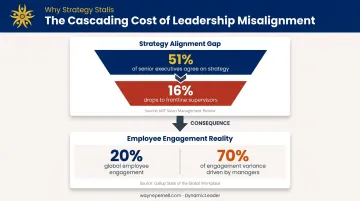
Research from MIT Sloan Management Review found that only 51% of senior executives could agree on the same strategic objectives — and alignment dropped to just 16% among frontline supervisors. The strategy exists. The understanding doesn't.
This article breaks down what leadership alignment retreats are and why they work differently than standard offsites. It covers the specific benefits, what actually happens during one, and the practices that separate high-impact retreats from expensive time away from the office.
Key Takeaways
- Leadership alignment retreats are structured, facilitated offsites designed to close the gaps in how an executive team aligns on strategy, decisions, and direction
- They differ from standard offsites by centering specifically on alignment — not planning, presentations, or activities
- Core benefits: strategic clarity, broken silos, rebuilt trust, reinforced values, and embedded leadership development
- Effective retreats depend on pre-work, skilled external facilitation, and built-in accountability after the room clears
- When misalignment is visible, the cost of doing nothing consistently exceeds the cost of the retreat
What Is Leadership Alignment — And Why Does It Break Down?
Leadership alignment is not agreement in a conference room. It's the degree to which an executive team shares a unified understanding of organizational direction, priorities, decision-making authority, and cultural expectations. What separates genuine alignment from surface consensus is what happens after the meeting ends — whether leaders actually act on what they agreed.
Surface-level consensus is common. Genuine alignment is rare.
What Misalignment Looks Like
The symptoms are recognizable once you know what to watch for:
- Strategic initiatives launch with enthusiasm, then quietly die within weeks
- Leaders agree in meetings and pull in different directions immediately after
- Departments operate as independent silos with competing resource agendas
- Cross-functional requests slow to a crawl because nobody trusts their counterparts
That last point has data behind it. HBR research found that only 9% of managers could rely on colleagues in other functions all the time — while 84% could rely on their direct bosses. The horizontal trust layer, which is exactly where cross-functional execution lives, is where alignment collapses most often.
Why Alignment Breaks Down
Root causes are structural and situational — not personal failures:
- Rapid growth that outpaces communication systems. As Dr. Wayne Pernell puts it after leading 120+ leadership teams: hypergrowth silently breaks alignment as organizations scale faster than their processes can support.
- Leadership transitions or reorganizations that reshuffle relationships without rebuilding shared context
- Accumulated unspoken tensions between leaders who've learned to coexist rather than collaborate
- Operational pace that leaves no structured time for leaders to recalibrate together
The downstream cost shows up in engagement numbers. Gallup's 2021 State of the Global Workplace reported 20% global employee engagement — the lowest since 2020 — and found that managers account for 70% of variance in team engagement. When leaders are misaligned at the top, disengagement radiates downward through every layer.
Team dinners and strategy decks don't close that gap. An alignment retreat is built differently — working at the level of mindset, communication, values, and shared direction rather than surface agreement.
The Real Purpose of a Leadership Alignment Retreat
The primary purpose is straightforward: give the people who set the vision uninterrupted, structured time to actually work on the vision — not manage their inboxes, not respond to the dashboard, not put out the next fire.
That sounds simple. It's rare.
Three core outcomes define a purposeful retreat:
- Strategic alignment — the team leaves with a unified, specific understanding of where the organization is going and why, built together rather than consumed through filtered summaries
- Surfaced tensions and blind spots — the friction that slows execution gets named, addressed, and resolved rather than carried back to the office unspoken
- Reinforced cultural norms — values get re-anchored at the leadership level so they cascade more authentically through the organization
The Leadership Renewal Dimension
There's a fourth outcome that gets discussed less: recovery and recalibration for leaders under sustained pressure.
Deloitte and Workplace Intelligence's survey of 2,100 executives and employees found that 76% of C-suite executives said the pandemic negatively affected their well-being, and nearly 70% were seriously considering leaving their roles for better well-being support. More telling: 73% said their job kept them from taking the time off they needed.
Burned-out leaders make fatigued decisions. Peer-reviewed research directly links occupational burnout to deficits in memory and executive function — the exact capabilities required for strategic thinking and sound judgment.
Why Environment Matters
Removing leaders from their habitual environment isn't a luxury — it's a design choice with direct cognitive effects. Research by Atchley, Strayer, and Atchley found participants performed 50% better on creative reasoning tasks after four days immersed in nature and disconnected from technology. Separate research showed that even psychological distance — framing a problem as happening somewhere else — improved creative cognition.
What this means practically:
- A new environment interrupts habitual thinking and removes the pressure cues tied to the office
- Physical separation creates permission for more honest, expansive conversations
- The cognitive shift isn't incidental — it's why design and setting are strategic decisions, not afterthoughts
Key Benefits of Leadership Alignment Retreats
Strategic Clarity and Faster Execution
Retreats produce sharper decisions because leaders build shared context in real time, together, rather than receiving summaries filtered through layers of communication. When everyone leaves understanding exactly where the organization is going — and, crucially, why — downstream execution accelerates.
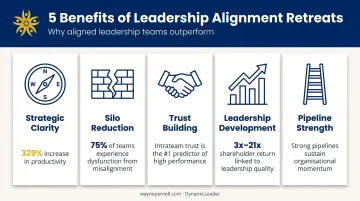
DynamicLeader has documented this directly: a 12-person team that aligned around vision, process, and purpose saw a 329% increase in productivity and revenue in under a year. The work wasn't magic — it was alignment that removed the friction slowing execution.
Breaking Down Silos and Rebuilding Trust
HBR's study of 95 cross-functional teams across 25 leading corporations found that nearly 75% were dysfunctional, failing on at least three of five measures including budget, schedule, and alignment with corporate goals. Silos aren't a personality problem — they're a structural one, and they compound fast.
Cross-functional trust is built through shared experience and candid dialogue, not org charts. When executives understand each other's real pressures, priorities, and communication styles, coordination improves. A 2016 meta-analysis in the Journal of Applied Psychology confirmed the mechanism: intrateam trust is directly and positively related to team performance.
DynamicLeader's three-day retreat with a siloed IT division, where directors were visibly drifting apart, produced a 300% improvement in effectiveness — a result significant enough to earn an industry award.
Values and Culture Reinforcement
Values drift without deliberate reinforcement at the top. An alignment retreat closes the gap between what an organization says it stands for and how its leaders actually behave under pressure and at the moments that matter.
When values are re-anchored at the leadership level, they cascade more authentically through the organization. DynamicLeader's Culture of Caring™ framework addresses this directly — helping leaders examine the gap between stated values and actual behavior as a core component of the alignment work.
Leadership Development Embedded in Context
A well-designed retreat is a compressed development environment. Leaders build skills in communication, conflict resolution, and decision-making within the context of their real team dynamics — not through hypothetical scenarios in a workshop.
This is one of the highest-ROI leadership investments available. McKinsey found organizations with top-quartile managers produced 3x to 21x greater total shareholder returns over five years compared to those with average managers. That kind of return starts with developing the specific people who are already in the room — together, on the real challenges they face.
Surfaced Potential and Long-Term Pipeline Strength
Retreats consistently reveal hidden strengths. The quieter leader with exceptional strategic instincts. The emerging voice waiting for the right environment to step forward. The standard workday suppresses these signals — the pace, hierarchy, and habitual dynamics of the office make it difficult for talent to show up fully.
A shift in setting changes what's possible. When those capabilities surface in a retreat setting, leadership teams leave with a clearer picture of their bench strength — and a head start on building the pipeline that future growth depends on.
What Actually Happens at a Leadership Alignment Retreat?
Three phases separate effective retreats from ad hoc offsites. Most organizations skip at least one — and that's usually where alignment breaks down.
Phase 1: Pre-Retreat Preparation
Alignment work starts before anyone enters the room. Effective pre-retreat preparation includes:
- Individual interviews to surface tensions, blind spots, and divergent priorities
- Proprietary assessments covering individual leadership styles, team dynamics, and cultural alignment gaps
- Identification of the highest-leverage issues to focus the retreat agenda
DynamicLeader uses proprietary assessment instruments — distinct from off-the-shelf tools — to ensure the retreat addresses what's actually driving misalignment, not just what's visible on the surface. Dr. Wayne listens "for what's being said and, perhaps more importantly, what's not being said."
Phase 2: In-Retreat Facilitation
A well-designed agenda balances structured work with genuine dialogue. Typical session types include:
- Vision and values alignment exercises
- Strategic prioritization with explicit decision checkpoints
- Structured conversation formats that surface tension without letting it collapse into dysfunction
- Relationship-building moments designed for genuine professional connection — not trust falls or ropes courses
- Breakout sessions on cross-functional priorities
DynamicLeader's CCB Process (Clarity, Co-strategy, Bold action) provides the structural sequence. The team moves from surfacing misalignment (Clarity), to co-creating solutions together (Co-strategy), to committing to specific, accountable next steps (Bold action). Each stage ends with a tangible output — a decision log, a ranked initiative list, or signed ownership commitments — not just a summary of what was discussed.
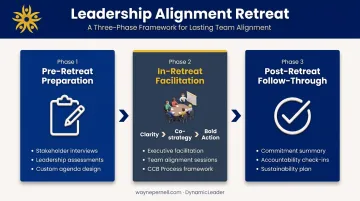
Phase 3: Post-Retreat Follow-Through
This is where most retreats fail. Without structured follow-through, pre-retreat dynamics return within 30 days.
Effective post-retreat accountability includes:
- A documented summary of commitments with named owners
- A defined cadence for tracking progress — weekly check-ins or mid-engagement reviews
- Sustainability plans built into the engagement, not bolted on afterward
Dr. Wayne's approach makes this explicit: "The work doesn't stop at done." Follow-up sessions and sustainability structures are built in, measuring both individual coaching metrics and organization-wide engagement shifts.
Best Practices for Running an Effective Leadership Alignment Retreat
Start with a Specific Purpose
Don't hold a retreat because it's been a while. Define the desired outcomes first — whether that's resolving a fractured executive team, rebuilding alignment after a leadership transition, or creating a unified strategic plan. The "why" should drive every element of the design, including venue selection, session structure, and who needs to be in the room.
Get Environment and Facilitation Right
A new physical setting removes habitual thinking patterns and signals that this time is genuinely different. Pair that with a skilled external facilitator — someone who can hold space for honest tension without letting it collapse into dysfunction or avoidance.
An external facilitator brings what internal HR or L&D leaders cannot: no political stake in the outcome, the credibility to ask uncomfortable questions, and the skill to work with senior executives who are accustomed to controlling the room.
Ground rules, structured dialogue, and the willingness to adjust the agenda in real time matter more than the venue itself. What happens in the room sets the direction — what happens after determines whether it sticks.
Follow Through Relentlessly
The retreat creates alignment. The follow-up converts it into results. Before anyone leaves, lock in the accountability structure:
- Distribute a clear action summary immediately after the retreat closes
- Build accountability check-ins into the weeks that follow
- Schedule the first follow-up before everyone leaves the room
Retreats that lack structured follow-through revert to pre-retreat dynamics within a month. The investment in the offsite is only as good as the systems that reinforce it.
Signs Your Leadership Team Needs an Alignment Retreat
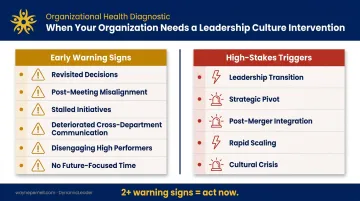
The warning signals are usually visible before organizations act on them:
- Strategic decisions get revisited instead of executed
- Leaders agree in meetings and act differently afterward
- New initiatives stall within weeks of launch
- Cross-departmental communication has noticeably deteriorated
- High performers are quietly disengaging or leaving
- The last time the full leadership team focused on the future — not the operational grind — was months ago, or longer
If two or more of these are true, the cost of doing nothing is almost certainly higher than the cost of the retreat.
Higher-stakes triggers that signal urgency:
- Leadership transition (new CEO, president, or major C-suite change)
- Significant organizational pivot or strategy shift
- Post-merger integration
- Rapid scaling where culture hasn't kept pace with growth
- Cultural crisis that has surfaced publicly or internally
These inflection points demand deliberate realignment before they compound into structural dysfunction. Waiting until the damage is visible is waiting too long.
That's precisely where structured facilitation makes the difference. Dr. Wayne Pernell has led 120+ leadership teams through these exact inflection points — with documented results including a 300% improvement in effectiveness for siloed leadership divisions. DynamicLeader's offsite mastermind engagements are designed specifically for senior teams that need more than an off-site agenda — they need a reset. If that's where your team is, the next step is a direct conversation.
Frequently Asked Questions
What is leadership alignment?
Leadership alignment is the degree to which an executive team shares a unified understanding of organizational direction, priorities, decision-making norms, and cultural values — and then acts consistently with that understanding. It goes well beyond agreement in a meeting to behavioral consistency across the team in daily decisions and actions.
What do you do at a leadership retreat?
A well-designed retreat includes pre-work interviews or assessments, facilitated sessions on vision and strategy, values and culture alignment discussions, structured decision-making exercises, and relationship-building designed for genuine professional connection. The retreat closes with documented commitments and a post-retreat accountability plan.
What are the 7 C's of leadership?
The specific C's vary by framework, but a common executive-focused version includes Character, Competence, Communication, Courage, Commitment, Clarity, and Collaboration. Leadership alignment retreats are structured to strengthen several of these simultaneously — particularly clarity, commitment, and how the team communicates and decides together.
What are the 5 P's of leadership?
The 5 P's — Person, Position, Process, Purpose, and Product — map well to what a leadership alignment retreat actually does. Leaders get structured time to recalibrate who they are, how they operate, what decision-making processes govern the team, why the organization exists, and what outcomes they're accountable for.
How often should an executive team hold a leadership alignment retreat?
Most high-performing teams benefit from at least one alignment retreat annually, with additional sessions during high-stakes transitions, strategic pivots, or when early warning signals of misalignment appear. The right cadence depends on company stage, growth rate, and context — a rapidly scaling organization may need more frequent recalibration than a stable one.
How is a leadership alignment retreat different from a regular team offsite?
Standard offsites typically focus on planning, presentations, or team activities. An alignment retreat is specifically structured to diagnose and close gaps in how the leadership team thinks, decides, and communicates as a unit — with facilitation, pre-work assessments, and post-retreat accountability built into the design from the start.