Here is what the research keeps confirming: when teams fail, the culprit is rarely a shortage of talent. It is broken dynamics. Unclear roles, eroded trust, leaders who manage headcount instead of building a team — these are the real performance killers.
According to McKinsey, 17 team behaviors explain between 69% and 76% of the performance variance between high- and low-performing teams. That is not a marginal difference — it is the difference between a team that compounds its gains and one that slowly falls apart.
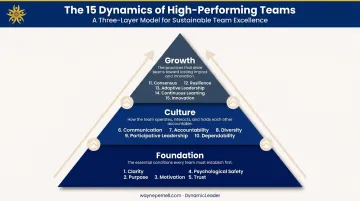
This article breaks down 15 proven team dynamics, organized into three layers every leader can act on: Foundation, Culture, and Growth. Whether you lead a startup or a Fortune 50 division, these dynamics apply — and mastering them is one of the highest-leverage investments you can make.
Key Takeaways
- Foundation dynamics — clarity, purpose, psychological safety, and trust — are non-negotiable. Everything else collapses without them.
- Culture dynamics determine whether your team operates as a unit or a collection of individuals — and the difference shows up daily.
- Growth dynamics separate teams that evolve from those that stagnate — and most teams underinvest here.
- Leadership is the common thread — each dynamic rises or falls based on how intentionally the leader builds and sustains it.
- These are living conditions, not checkboxes. They demand consistent, deliberate attention from the top.
Why Team Dynamics Define Leadership Success in 2026
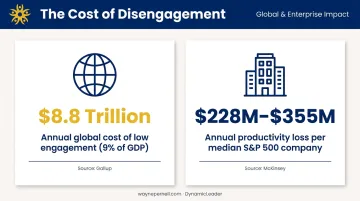
The context for leadership has changed structurally. Hybrid work fragmented the informal trust-building that used to happen in hallways. AI tools are reshaping job functions faster than most organizations can reskill. And Gallup found that low engagement costs the global economy $8.8 trillion annually — roughly 9% of global GDP — with only 23% of the global workforce actively engaged.
The cost is not abstract. McKinsey estimated that disengagement and attrition drain a median S&P 500 company between $228 million and $355 million per year in lost productivity. These numbers trace directly back to team dynamics.
Managing a Group vs. Leading a Team
There is a meaningful difference between a manager coordinating individual contributors and a leader building a genuine team. Dr. Wayne Pernell, who has led 120+ leadership teams across organizations including Schwab, Whole Foods Market, and Pfizer, consistently observes the same patterns in struggling organizations:
- Leaders stuck in firefighting mode, reacting instead of building
- Culture delegated to HR rather than shaped from the top
- Silos forming faster than solutions
- High-potential talent leaving without warning
These are symptoms of absent dynamics, not absent talent. When a team lacks shared direction, trust, and accountability, individual skill becomes irrelevant — people stop contributing beyond their lane, and the collective underperforms.
What "Dynamics" Actually Means
Team dynamics are not personality profiles or team-building activities. They are the ongoing patterns of interaction, communication, accountability, and adaptation that a leader intentionally shapes. Some dynamics accelerate results; others erode results over time. The difference almost always comes down to whether the leader builds these conditions deliberately or leaves them to chance.
Dynamics 1–5: The Foundation Layer
Without these five dynamics, the remaining ten cannot take hold. Teams that lack foundational clarity and safety operate in reactive mode — solving today's fires instead of building tomorrow's capability.
Dynamic 1 – Structural Clarity
Every team member needs to understand not just their tasks, but why they are on the team, what the collective goal is, and how their individual contribution connects to organizational outcomes.
Gallup reported that only 50% of on-site workers clearly know what is expected of them — down from 59% in 2020. McKinsey found that 54% of teams disagree on whether their work is task- or outcome-interdependent, creating misaligned execution from day one.
Clarity in practice means:
- Shared agreements on roles and decision-making authority
- Defined success metrics established at the start of the work
- Regular revisitation of those agreements as the team or project evolves
Dynamic 2 – Shared Purpose
Shared purpose is not a mission statement. It is the emotional and strategic alignment that gives a team a reason to push through difficulty together. McKinsey found that 70% of employees say their sense of purpose is defined by their work. When leaders fail to connect the work to a larger meaning, they leave one of their most powerful motivational levers untouched.
Leaders who invest time helping team members find personal meaning within the collective mission build more durable cohesion. Purpose creates pull; directives only create compliance.
Dynamic 3 – Meaning and Motivation
Individual meaning (why this work matters to me) is distinct from shared purpose (why this work matters to us). Leaders who address only one miss half the equation.
Meaning drives discretionary effort — the engagement that shows up before and after hours, not just during them. A 2024 meta-analytic review confirmed this sequence directly:
- Motivation predicts performance — work motivation at a given point significantly predicts later job performance
- Performance does not predict motivation — prior results do not drive future engagement
- The practical implication: leaders who wait for results before investing in meaning are solving the problem in reverse
Dynamic 4 – Psychological Safety
Psychological safety is the team-level belief that it is safe to speak up, challenge assumptions, ask questions, and admit mistakes without fear of punishment or judgment.
Google's Project Aristotle, which studied 180 Google teams, identified psychological safety as the single most important dynamic for team effectiveness. Teams in high-safety environments were rated effective twice as often by executives.
Amy Edmondson's foundational research defined it as a shared belief that the team is safe for interpersonal risk-taking — and found it directly predicts team learning behavior, which in turn mediates performance.
Leaders create or destroy psychological safety through daily micro-behaviors:
- How they respond when someone delivers bad news
- Whether disagreement is welcomed or punished
- How they react when someone admits a mistake
Psychological safety is not a culture initiative. It is built or eroded one interaction at a time — and the leader sets the standard with every response.
Dynamic 5 – Trust as the Bedrock
When psychological safety accumulates over time, it becomes trust. Trust operates on two levels: trust in the leader (do they have our backs?) and trust among peers (can I count on you?).
Trust is not built through retreats. It is built through consistent follow-through, honest communication, and accountability modeled from the top. Edelman's 2024 Trust at Work survey of nearly 8,000 respondents found that when employees perceive a lack of executive trust, only 25% trust their CEO and 43% trust their direct manager. Trust, or the absence of it, cascades downward through the organization.
Dynamics 6–10: The Culture Layer
Once the foundation exists, these five dynamics determine whether the team operates as a high-performing unit or a group of individuals working in proximity.
Dynamic 6 – Open Communication
Open communication is not how many meetings your team holds. It is the quality of dialogue: information flows freely, hard conversations happen early, and no one is left guessing about direction or intent.
The leader's role in communication is often misunderstood. It is not broadcasting clarity; it is creating conditions for honest exchange.
Dr. Wayne's consulting work regularly surfaces organizations where "communication is muddled" — leaders speaking in directives, teams interpreting gaps as signals, and silos forming along the fault lines of what goes unsaid.
Practical markers of open communication:
- Leaders ask more questions than they issue directives
- Unwelcome updates are delivered promptly, not withheld
- Decisions are communicated with context, not just outcomes
- Disagreement is treated as a contribution, not a threat
Dynamic 7 – Accountability
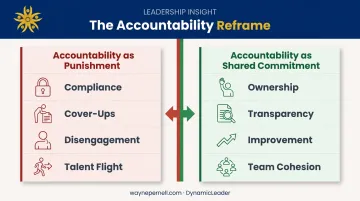
Accountability framed as punishment produces compliance, cover-ups, and disengagement. Accountability framed as shared commitment produces ownership, transparency, and improvement.
The distinction matters. A 2021 team-accountability study (Journal of Applied Psychology) found that shared accountability strongly predicted collective effort and team viability, but only when paired with trust and commitment. The leader's role is to:
- Establish clear measurement so people know what success looks like
- Create regular, honest check-ins on progress (not performance theater)
- Treat missed targets as learning opportunities rather than occasions for blame
Dr. Wayne describes this as "friendly accountability" : not soft, but not punitive. The goal is an environment where people own their results because they believe in the mission, not because they fear the consequences.
Dynamic 8 – Diversity and Balance
High-performing teams intentionally leverage differences in thinking styles, strengths, backgrounds, and experience. A 2024 meta-analysis of 615 studies confirmed a statistically significant positive relationship between cognitive diversity and team performance, with stronger effects for complex tasks that require innovation.
The critical condition: diversity without psychological safety (Dynamic 4) underperforms. When team members do not feel safe contributing unconventional ideas, diverse perspectives stay hidden. Within a psychologically safe, high-trust culture, diversity becomes a genuine problem-solving advantage.
Dynamic 9 – Participative Leadership
Participative leadership is the shift from controlling to enabling. Leaders provide direction, resources, and accountability, then step back so team members can own their work.
Participative leaders stay fully engaged. They monitor outcomes without micromanaging process. Two things happen as a result: team confidence grows through genuine ownership, and bottlenecks reduce because decisions no longer funnel through a single point of authority.
Leaders who struggle to make this shift often confuse control with competence. Letting capable people lead their work is not a loss of authority : it is how authority compounds.
Dynamic 10 – Dependability
Dependability is the team's lived experience of reliability: deadlines are met, commitments are honored, and no one carries someone else's weight indefinitely.
When leaders tolerate chronic under-performance without addressing it, they send a clear message that accountability is optional. This corrodes team cohesion faster than most other failures. High performers disengage when they watch poor performers coast. The leader who avoids the difficult conversation is not keeping the peace; they are gradually dismantling it.
Dynamics 11–15: The Growth Layer
These dynamics transform a functional team into a forward-moving, adaptive one. In 2026, teams that cannot learn and recalibrate together get left behind — not by competitors alone, but by the accelerating pace of their own industry.
Dynamic 11 – Consensus Decision-Making
Consensus is not unanimous agreement. It is a deliberate process that invites multiple perspectives before key decisions are made, ensuring team members feel heard and invested in outcomes — even when they do not get their preferred result.
McKinsey found that teams with above-average decision-making scores were 2.8x more innovative. The decision quality gap between high- and low-performing teams is largely a process gap, not a talent gap.
The leader's role is to design the process: who contributes, when, and how — rather than defaulting to top-down mandates or allowing decisions to dissolve into endless discussion. Clear decision rights paired with inclusive input is the formula.
Dynamic 12 – Resilience
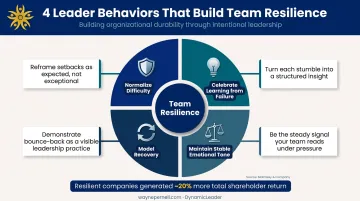
Team resilience is the collective ability to absorb setbacks, recalibrate quickly, and keep moving without losing confidence or fracturing trust. It is not natural — it is cultivated.
Leaders build resilience by:
- Normalizing difficulty rather than catastrophizing it
- Celebrating learning from failure, not just success
- Maintaining a stable emotional tone during high-pressure periods
- Modeling recovery rather than denial
McKinsey's State of Organizations research found that resilient companies generated roughly 20% more total shareholder return than peers during periods of disruption. Resilience is not a soft skill — it is a competitive differentiator.
Dynamic 13 – Adaptive Leadership Style
In 2026, the ability to read the team and situation — then flex approach accordingly — separates effective leaders from rigid ones.
- Direct and decisive when the team needs clarity
- Collaborative and open when the work calls for new thinking
- Slower, steadier, and more attuned when the team is running on empty
Static leadership styles are a growing liability. DDI's Global Leadership Forecast 2025, drawing on nearly 11,000 leaders, identifies accelerating change, AI disruption, and rising stakeholder expectations as requiring greater agility from leaders.
Dr. Wayne's observation from coaching across industries — from finance to retail to healthcare — is consistent: the most effective leaders develop genuine range. They are not experts in one style who occasionally deviate. They are fluent in several approaches and disciplined about choosing the right one.
Dynamic 14 – Continuous Learning
Leaders who adapt their style naturally create the conditions for another dynamic to take root: continuous learning. High-performing teams build it into their operating rhythm — not as an annual initiative, but as a behavioral norm. Debriefs after major projects. Curiosity about what competitors are doing. Openness to feedback at every level.
LinkedIn's 2025 Workplace Learning Report, based on nearly 1,600 professionals, found that 91% of L&D professionals say continuous learning is more critical than ever for career success, and 49% identify an active skills crisis inside their organizations.
The leader sets the norm. Teams that watch their leader learning visibly — asking questions, updating assumptions, seeking feedback — are far more likely to embrace growth themselves. Learning culture is not created by training programs. It is modeled from the top.
Dynamic 15 – Status Quo Disruption and Innovation Mindset
This is the capstone dynamic. Teams that have built the other 14 develop the confidence and creative capacity to challenge existing processes, reframe problems as opportunities, and pursue solutions that have not been tried before.
This is what separates competitive teams from complacent ones. Dr. Wayne's keynote "The Power of Being Unreasonable" frames this directly: the most impactful leaders stop following outdated rules and start creating bold new standards. When trust, safety, and clear purpose are already in place, bold thinking stops feeling reckless — it feels like the natural next step.
Innovation does not require a separate program or a mandate from above. It emerges when the culture is ready — when psychological safety, clear direction, and resilient habits are already built in. That is the real payoff of the growth layer.
Activating These Dynamics: The Leader's Role in 2026
Awareness of these 15 dynamics is the starting point — not the finish line. The real work is activation.
Start with an honest audit: which dynamics are strong, which are absent, and which are actively working against the team? Rather than trying to fix everything at once, identify the two or three dynamics most visibly missing and focus there first.
Progress on foundational dynamics — clarity, trust, psychological safety — tends to unlock adjacent dynamics faster than isolated improvements anywhere else.
The CCB Process in Practice
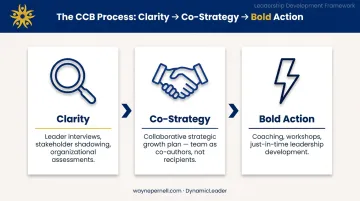
Dr. Wayne's proprietary CCB Process — Clarity, Co-strategy, and Bold Action — provides a structured framework for activation:
- Clarity establishes the foundation dynamics. Leader interviews, stakeholder shadowing, and organizational assessments surface what is actually happening versus what leaders believe is happening.
- Co-strategy aligns the culture dynamics through shared ownership. The strategic growth plan is built collaboratively, not handed down — which means team members arrive as co-authors of the direction, not recipients of a memo.
- Bold Action drives the growth layer through decisive, visible leadership. Execution happens through coaching, workshops, and just-in-time leadership development aligned to the strategic plan.
This process has been applied across 120+ leadership teams at organizations ranging from Whole Foods Market and Charles Schwab to Pfizer. Results have included a 329% increase in revenue and production for a disconnected 12-person team that aligned around vision, process, and purpose — and a 300% improvement in effectiveness for a siloed IT leadership division that rebuilt trust through facilitated retreats.
Across every engagement, the pattern holds: teams don't underperform because of talent shortages. They stall because the conditions for high performance were never deliberately built. These 15 dynamics are those conditions.
Leaders ready to move from awareness to activation can explore DynamicLeader's executive coaching, team leadership consulting, and CCB Process engagements — designed to embed directly into your organization and drive measurable culture and performance outcomes.
Frequently Asked Questions
What are team dynamic strategies?
Team dynamic strategies are deliberate actions leaders take to shape how a team interacts, communicates, and performs — covering shared goals, psychological safety, accountability structures, and the conditions for open, collaborative decision-making.
What are 5 examples of team dynamics?
Psychological safety (members feel safe speaking up), open communication (information flows without silos), shared accountability (the team owns collective results), dependability (members follow through on commitments), and participative leadership (everyone contributes beyond their defined role).
What are the signs of poor team dynamics?
Key warning signs include frequent miscommunication or misalignment, visible tension between team members, chronic missed deadlines, disengagement in meetings, withheld ideas or unspoken concerns, and a pattern of blame rather than accountability when things go wrong.
How does a leader improve team dynamics?
Start by diagnosing which dynamics are weakest, then take targeted action: clarify role expectations, model the behaviors you want to see, and build regular rituals for communication, feedback, and reflection. Psychological safety is usually the highest-leverage starting point.
What is the difference between team dynamics and team culture?
Team culture is the broader set of values, norms, and shared beliefs that define how a team operates over time. Team dynamics are the active, real-time patterns of interaction and behavior within that culture.