Introduction
Most executives earn their seat at the table through individual brilliance. They hit their numbers, solved hard problems, and outperformed peers. Then they get promoted — and suddenly, their entire impact depends not on what they do, but on what their team can do.
Gallup research found that companies fail to choose the right management talent 82% of the time. McKinsey reports that 27–46% of executives are viewed as failures or disappointments within two years of a leadership transition. The gap between individual performance and team leadership capability is real, costly — and entirely predictable.
Coaching can close that gap. The problem is that many well-intentioned engagements fail because they start with solutions instead of diagnosis, focus on mindset without building behavior, or treat the executive as an island separate from the team they're supposed to lead.
What follows is a practical breakdown of how to do it right — from what to assess first to the decisions that separate impactful coaching from expensive conversation.
Key Takeaways
- Start with a diagnostic — never lead with advice or a development plan
- Build the executive's capacity to create conditions where teams thrive — the coach's role is not to fix the team directly
- Self-awareness, psychological safety, and strategic alignment are non-negotiable foundations
- Sustained behavior change demands consistent coaching cadence and real accountability structures
- Structural or cultural dysfunction requires more than executive coaching to resolve
How to Coach Executives to Build High-Performing Teams
Step 1: Run a Diagnostic Assessment
Effective coaching never begins with advice. It begins with understanding.
Before any development work starts, the coach must assess both the executive's leadership patterns and the team's current state. Skipping this phase is the most predictable way to solve the wrong problem with high confidence.
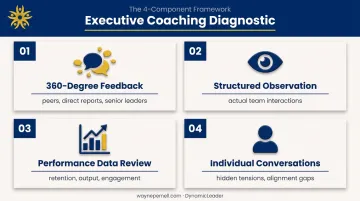
A comprehensive diagnostic typically includes:
- 360-degree feedback — surfacing how peers, direct reports, and senior leaders experience the executive
- Structured observation of actual team interactions, not just self-reported accounts
- Performance data review — looking for patterns in retention, output, and engagement metrics
- Individual conversations with key team members to surface hidden tensions or alignment gaps
At DynamicLeader, Dr. Wayne Pernell uses proprietary assessments for individuals, leadership teams, and cultural alignment — combined with direct shadowing and observation embedded within the client's organization. As he puts it: "We don't just listen — we watch how things run." That observational layer surfaces dynamics that no survey or interview would catch on its own.
The diagnostic answers a critical question before anything else: is the issue the executive's behavior, the team's structure, the culture, or misalignment coming from above?
Step 2: Develop the Executive's Self-Awareness
High-performing teams don't form around executives who don't know their own blind spots. This phase of coaching surfaces the gap between leadership intent and actual impact.
Common blind spots to address:
- Communication style under pressure (directive vs. collaborative)
- Delegation patterns — whether the executive holds too much or assigns without support
- Trust behaviors — whether follow-through matches stated commitments
- Conflict responses — avoidance, escalation, or productive tension
Coaching conversations in this phase use diagnostic evidence to challenge assumptions. The coach introduces "mirror moments" — showing the executive what their behavior actually produces in others, not what they intend it to produce.
An executive can believe they're transparent while their team experiences them as unpredictable. They can believe they encourage debate while their team has learned that dissent isn't safe. Without surfacing these gaps, no team strategy will land.
Step 3: Co-Create a Team Strategy
Once the executive has genuine self-awareness, coaching shifts outward — from internal reflection to team strategy.
This phase helps the executive define three things clearly:
- The team's purpose — outcomes it must deliver, not just activities it performs
- Role clarity — who owns what, with accountability that holds under pressure
- Alignment mechanisms — how the team stays coherent when priorities shift
DynamicLeader's CCB Process — Clarity, Co-strategy, Bold Action provides the structural framework for this phase. Rather than handing the executive a pre-built plan, it creates a co-developed roadmap tied to the organization's actual context, vision, and culture. The result is a team development plan the executive owns, not one prescribed from outside.
The output of this phase should include clear milestones, defined decision rights, and an explicit picture of what "high performance" looks like for this specific team — not a generic framework.
Step 4: Coach the Executive to Build Trust and Psychological Safety
Team-building exercises don't create trust. Repeated, observable behavior does — and it accumulates slowly, then all at once.
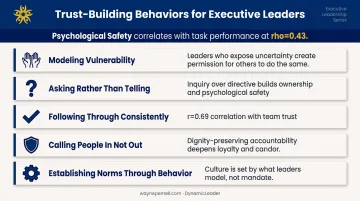
Research from Frazier et al.'s 2017 meta-analysis of over 22,000 individuals found that psychological safety correlates with task performance at rho = 0.43, learning behavior at rho = 0.62, and work engagement at rho = 0.45. Google's Project Aristotle, which studied 180 teams, identified psychological safety as the single most important factor in team effectiveness.
Specific behaviors to coach executives to build:
- Modeling vulnerability — naming uncertainty, acknowledging mistakes publicly
- Asking rather than telling — creating space for team input rather than broadcasting answers
- Following through consistently — behavioral integrity research shows a r = 0.69 correlation between a leader's word-deed alignment and team trust
- Calling people in, not out — addressing performance in ways that preserve dignity and safety
- Establishing norms through behavior — not policy documents
The coach's job here is to help the executive understand that psychological safety is not softness. It's the structural condition that makes disagreement, learning, and bold execution possible.
Step 5: Establish Accountability and Measure Progress
Without accountability built into the engagement, behavioral change stalls. Executives revert. Momentum dissolves.
Sustainable accountability at the executive level includes:
- Regular coaching check-ins — weekly or bi-weekly, depending on engagement intensity
- Team retrospectives — structured reviews where the executive and team assess what's working and what isn't
- Tracked behavioral change indicators — specific, observable behaviors identified in the diagnostic phase
- A clearly defined definition of success — what does this team look like at high performance, and how will you know when you're there?
Mid-engagement evaluations, like those built into DynamicLeader's consulting engagements, matter because they catch drift early. Without measurement, executives often revert to default patterns under stress — not because they don't care, but because pressure activates old habits.
What to Assess Before Coaching Executives on Team Building
What coaches discover before the first development session dramatically changes the coaching approach.
The Executive's Coachability
Genuine coachability has specific signals:
- Curiosity about their own impact on team dynamics
- Willingness to hear hard feedback without deflecting or explaining it away
- History of acting on development input — not just receiving it
Resistant or ego-protective executives require a different entry point. The coach may need to start with business outcomes rather than behavioral feedback — connecting leadership patterns to results the executive already cares about before introducing developmental language.
Coachability isn't fixed. Pre-coaching discovery work — structured conversations that surface the executive's current frustrations, aspirations, and openness — can shift an executive from compliance to genuine engagement before the coaching formally begins.
The Team's Current State
What to assess in the team:
- Trust levels between members and toward the executive
- Communication patterns — who speaks, who stays silent, and what topics get avoided
- Clarity of roles and decision rights
- Cross-functional friction or silo formation
- Whether the executive is aware of the above
Team dysfunction is often invisible from the top. The executive sees outputs and interprets behavior through their own lens. Shadowing and observation — being present in actual meetings and workflows — gives coaches information no survey will surface.
What does the room feel like when the executive enters? Who looks at whom before speaking? Which conversations stop when the leader arrives?
Organizational Readiness
Coaching an executive in isolation from the organizational environment rarely produces lasting change. The system shapes the behavior.
Assess whether:
- Senior leadership above the executive actively supports the coaching goals
- Cultural norms reinforce or actively undermine the behaviors being developed
- Structural barriers — misaligned incentives, unclear decision rights, competing priorities from above — will work against the coaching outcomes
If those conditions are working against the coaching goals, address them directly — or build them explicitly into the engagement plan from day one. Ignoring systemic barriers doesn't make them disappear; it just makes the coaching less effective.
Key Variables That Determine Executive Coaching Outcomes
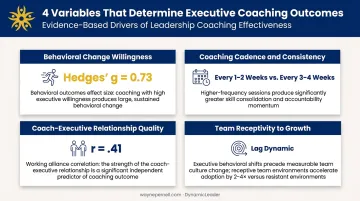
Two executives, similar organizations, similar coaches — dramatically different outcomes. These four variables explain most of that variance.
Variable 1: Willingness to Change Behavior (Not Just Mindset)
Executives frequently develop intellectual understanding of what great leadership looks like. Under pressure, they revert to default patterns anyway.
A 2023 meta-analysis in Frontiers in Psychology found that executive coaching produced the largest effect on behavioral outcomes (Hedges' g = 0.73) compared to attitudes or personal characteristics. The implication is clear: coaching that builds behavioral practice — repeated application in real situations — outperforms coaching focused on awareness alone.
Variable 2: Coaching Cadence and Consistency
Sporadic sessions create disconnected conversations, not cumulative development.
ICF research studying 332 coaching cases across 14 countries found that sessions every 1–2 weeks produced higher effectiveness scores on 35 of 40 measured items compared to sessions spaced 3–4 weeks apart. The executive needs enough coaching contact to process what's happening in real time — not reconstruct events in retrospect.
Consistency also signals something to the team: that development is ongoing, not a one-time event.
Variable 3: Quality of the Coach-Executive Relationship
Executives will not be vulnerable with a coach they don't trust.
A meta-analysis of 27 samples and 3,563 coaching processes found a working alliance correlation with client outcomes of r = .41. The same research found that weak alliance is associated with negative coaching effects. A strong alliance is what makes the challenge-and-support dynamic possible — without it, the deepest work never happens.
Executives disengage quickly from coaches they perceive as theorists. Credibility in this context requires both:
- Grounding in leadership psychology and behavioral science
- Real-world organizational experience the executive actually respects
Variable 4: Team Receptivity to the Executive's Growth
Even when an executive changes significantly, teams that have been burned by previous behavior are slow to recalibrate.
Team dynamics carry memory. Coaches must prepare executives for this: team behavior change lags leadership behavior change, sometimes by months. The strategy: name the shift publicly. Invite team members explicitly into the new dynamic. Behavioral integrity research confirms that consistency over time is what rebuilds trust — not announcements.
Common Mistakes When Coaching Executives on Team Building
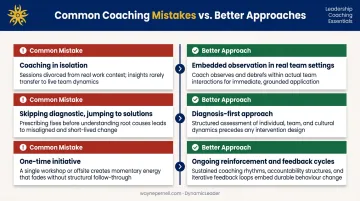
Three patterns consistently derail coaching engagements before meaningful change takes hold:
1. Coaching the executive in isolation from team dynamics. Coaching focused entirely on individual development — without engaging the team's actual experience — creates a feedback vacuum. The executive changes in the coaching room but never receives real-time data from the environment where that change must land. DynamicLeader's embedded observation approach addresses this directly by being present in actual team settings, not only in debrief conversations.
2. Skipping the diagnostic and starting with solutions. Well-intentioned coaches move too quickly to frameworks and development plans. The result is solving the wrong problem with complete confidence. An executive might need structural clarity more than communication coaching, or vice versa. The diagnostic determines which intervention actually fits.
3. Treating team building as a one-time initiative. An offsite, a workshop, or a series of sessions is the beginning — not the destination. Transfer-of-training research consistently shows that behavior change without reinforcement, practice, and post-learning support does not stick.
McKinsey's research on leadership development makes the case for embedding development into daily job behavior, not isolating it in classroom events. High-performing teams require ongoing coaching, regular feedback cycles, and consistent leadership behavior to hold the gains over time.
When Executive Coaching Alone Isn't Enough
When the Problem Is Structural, Not Behavioral
Coaching addresses leadership behavior. If the team is failing due to misaligned incentives, unclear organizational roles, or competing priorities handed down from above, no amount of executive coaching will fix it.
A skilled coach identifies this early and transitions the engagement from individual coaching to organizational consulting. At DynamicLeader, this shift means moving from 1:1 executive work into a broader consulting partnership that addresses strategy, culture, and structure simultaneously.
Engagements range from 90-day culture sprints to year-long embedded partnerships, depending on the depth of structural work required.
When the Executive Is Not Coachable
Some executives engage in coaching as a compliance exercise with no genuine intention to change. Signals of surface-level engagement include:
- Consistent deflection — attributing team problems entirely to others
- Nodding at feedback without any corresponding behavioral shift
- Showing up to sessions but not acting on commitments between them
Options here include pausing the engagement until genuine readiness develops, recommending pre-work that surfaces the executive's own dissatisfaction with current outcomes, or recommending an alternative intervention.
When Cultural Toxicity Runs Deeper Than One Leader
When dysfunction is systemic — when trust has been chronically eroded across multiple layers, when the reward system actively punishes the behaviors coaching is trying to build — individual executive coaching must be accompanied by broader cultural intervention.
This is where DynamicLeader's Culture of Caring™ framework becomes relevant. Instead of treating culture as a downstream effect of leadership change, this approach targets the organizational conditions directly — building the structures, incentives, and norms that make trust and bold performance the default, not the exception.
Key conditions the framework addresses:
- Reward systems that reinforce the behaviors leaders are trying to build
- Cross-level trust repair, not just top-down modeling
- Accountability structures that outlast any single coaching engagement
Frequently Asked Questions
What are the key characteristics of high-performing teams that coaches and executives should focus on?
Google's Project Aristotle identified psychological safety, dependability, structure and clarity, meaning, and impact as the five foundations of effective teams — with psychological safety as the most critical. The coach's role is to develop executives who actively build these conditions through their daily behavior, not just their stated intentions.
What are the common coaching principles like the 70/20/10 and 80/20 rules for executive coaching?
The 70/20/10 model from the Center for Creative Leadership holds that leaders develop through 70% on-the-job experience, 20% coaching and feedback, and 10% formal training. The complementary 80/20 heuristic — executive talks 80%, coach listens and asks 20% — reflects the ICF's emphasis on inquiry over instruction. Both frameworks place the executive's own thinking at the center of development.
How long does it take for executive coaching to produce measurable team performance improvements?
A 2024 randomized controlled trial found measurable improvement in goal achievement after just four weekly coaching sessions. Team-level outcomes — engagement shifts, retention changes, productivity improvements — take longer and should be tracked across multiple operating cycles rather than measured as a single endpoint. Cadence and organizational support significantly affect both timelines.
What is the difference between coaching executives and coaching their teams?
Executive coaching develops the leader's capacity to create conditions where team performance becomes possible. Team coaching addresses group dynamics, shared norms, and collective effectiveness directly. The most impactful engagements combine both — 1:1 work for the executive, facilitated group sessions for the team.
What are the most common mistakes executives make when building high-performing teams without coaching?
The same patterns surface repeatedly: promoting high performers without developing their team leadership skills, confusing activity with accountability, and assuming talent density alone drives team performance. Without deliberate investment in culture, communication, and psychological safety, even strong individuals fail to perform as a cohesive unit.
How do you know if an executive is ready to be coached to lead a high-performing team?
Key readiness signals include acknowledging a gap between current and desired team performance, expressing genuine curiosity about their own role in team dynamics, and demonstrating willingness to receive and act on direct feedback. A pre-coaching discovery process can also build readiness by connecting the executive's own goals to the development work ahead.