
Introduction
Picture a leadership team that looks exceptional on paper. Smart people. Deep experience. Real commitment.
And yet decisions get revisited in every meeting, work falls through the gaps between functions, and each leader optimizes for their own domain while the collective result suffers. Nobody's slacking. Everyone's working hard. So what's actually wrong?
What's missing is a shared mental model: the invisible architecture that determines whether a group of talented individuals functions as a team or just a collection of parallel efforts.
This article explains what shared mental models are, why their absence is so costly, and what leaders can do to build them on purpose.
Key Takeaways
- Shared mental models (SMMs) are the overlapping understanding team members hold about goals, roles, processes, and how they work together
- Missing SMMs cause misalignment, duplicated effort, and slow decisions — not lack of talent or effort
- Four core types exist: equipment, task, team interaction, and team member knowledge (skills and working styles)
- Performance benefits include role clarity, implicit coordination under pressure, and stronger decision quality
- Leaders build SMMs by getting clear themselves, then creating shared dialogue and consistent reinforcement
What Is a Shared Mental Model?
Most teams assume that shared understanding develops naturally over time. It rarely does, and the gap between assumed alignment and actual alignment is where performance quietly breaks down.
DeChurch and Mesmer-Magnus (2010) define shared mental models as "knowledge structures held by members of a team that enable them to form accurate explanations and expectations for the task, and in turn, to coordinate their actions and adapt their behavior to demands of the task and other team members." In practice, this means your team isn't just familiar with the same goals — they share compatible assumptions about how decisions get made, what trade-offs are acceptable, and what "done well" actually looks like.
Individual vs. Shared Mental Models
Every person carries their own mental model — their personal map of how things work, what matters, and what "good" looks like. Shared mental models are the compatible, overlapping subset that lets a group coordinate.
A critical nuance that gets missed: complete uniformity is not the goal. Teams need compatible knowledge distributed across roles — not identical knowledge across every member. The CFO and the CMO should think differently. What they can't afford is to hold incompatible assumptions about priorities, decision rights, or what success means.
Beyond Norms and Job Descriptions
That compatible-knowledge foundation is harder to build than most leaders expect. Shared mental models run deeper than a list of team agreements or a roles-and-responsibilities chart — they encode shared understanding of:
- Why things are done a certain way
- How people prefer to work together
- What success actually looks like across the whole system
That depth is what enables teams to coordinate fluidly under pressure, without needing to relitigate every decision in real time.
The Hidden Cost of Operating Without One
The performance cost of misalignment is well-documented. According to Sull, Homkes, and Sull in Harvard Business Review, only 55% of middle managers could name even one of their company's top five priorities. In the same research, 30% of managers cited failure to coordinate across units as the greatest obstacle to execution — and managers were three times more likely to miss performance commitments because of insufficient cross-unit support than because their own teams failed to deliver.
The gap isn't capability. It's the absence of a shared mental model — a common map of goals, priorities, and how decisions actually get made.
The Effort-to-Impact Gap
Teams can be full of committed, capable people and still underperform when their mental models of goals, priorities, and roles diverge. The issue isn't effort — it's integration. Each person pulls from their own version of what matters most, and the collective output suffers at the handoffs.
Common signs a team is operating without shared mental models:
- Responsibilities are unclear or duplicated across functions
- The same decisions get relitigated in every meeting
- Work falls through the cracks between teams
- Each leader optimizes for their domain, not the whole
The Leadership-Level Problem
Those symptoms point upstream. Misalignment rarely starts at the front line — when the leadership team itself lacks a shared mental model of strategy, priorities, and decision rights, that fragmentation cascades downward. Every team below takes its cues from those gaps.
Fixing team coordination without first aligning the senior team is a short-term patch. The structure changes; the underlying divergence doesn't.
How Shared Mental Models Drive Team Performance
Role Clarity Reduces Friction and Builds Accountability
One of the most direct performance benefits of SMMs is role clarity. When team members share an understanding of who does what, when, and why, dropped handoffs and duplicated effort decrease sharply.
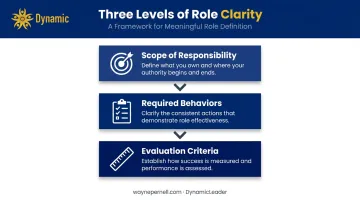
Meaningful role clarity operates on three levels:
- Scope of responsibility — what each person owns
- Required behaviors — how they're expected to operate
- Evaluation criteria — how performance will be judged
The research consequence of getting this wrong is significant. Manas et al. (2018) found that role ambiguity climate correlated negatively with affective engagement (r = -.34) and extra-role performance (r = -.20) in work teams. When people are unclear on their accountability, they default to doing less, deferring to others, and disengaging — and cohesion follows downward.
Teams Coordinate Implicitly Under Pressure
SMMs give teams something no organizational chart can: the ability to act without needing to communicate first.
Entin and Serfaty (1999) demonstrated that highly effective teams adapt to high-stress conditions by shifting from explicit to implicit coordination — drawing on shared mental models of the situation and task environment. Expert teams can anticipate teammates' needs and actions without verbal cues because the cognitive foundation is already in place.
For senior leadership teams, this is the difference between a controlled response and a scramble. During a product pivot, a market shift, or a crisis, leaders cannot stop to re-explain strategy or re-clarify decision rights.
Teams that already share a mental model of what the organization is optimizing for act faster and with far less coordination overhead.
This is the principle behind Dr. Wayne Pernell's Dancing with Chaos framework at DynamicLeader — the idea that staying agile when "you don't know the music and the beat keeps changing" requires knowing in advance when to lead, when to follow, and when to step aside. That kind of fluid coordination doesn't emerge from structure alone. It emerges from shared understanding.
Shared Models Improve Decision Quality and Team Cohesion
SMMs improve decision quality because team members draw on a richer, more integrated pool of knowledge. Rather than filtering every decision through only their own frame, people can reason about the collective situation — anticipating downstream effects and catching blind spots that individual models would miss.
Better decisions, in turn, build trust — and trust builds cohesion. Research by Tenenbaum, Filho, and colleagues (2015) found that team mental models and collective efficacy were positively related to perceived performance potential, and that cohesion predicted team mental models. The reinforcing cycle works like this:
- Aligned teams build cohesion through consistent, coordinated action
- Cohesion reinforces shared models by strengthening mutual understanding
- Shared models sustain performance by enabling faster, better decisions
Each element strengthens the next. Organizations that invest in building shared mental models aren't just improving coordination — they're compounding the conditions for sustained high performance.
The 4 Types of Team Mental Models
Cannon-Bowers, Salas, and Converse (1993) identified four content domains within team mental models, each addressing a different layer of shared understanding:
| Type | What It Covers |
|---|---|
| Equipment | Tools, systems, and technology the team uses |
| Task | Objectives, procedures, and what "done" looks like |
| Team Interaction | Communication channels, decision protocols, how the team coordinates |
| Team | Teammates' skills, strengths, preferences, and working styles |
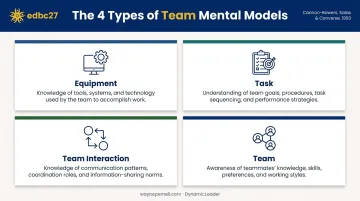
These four types aren't equally weighted in practice. Mathieu et al. (2000) later grouped them into two broader domains: task mental models (what the team is doing and how) and team mental models (who the people are and how they work together). High-performing teams have accuracy and alignment in both. A gap in either creates friction.
The Strategic Dimension
There's a third dimension that receives less attention in the academic taxonomy but carries the highest organizational stakes at the executive level: strategic mental models — shared understanding of priorities and trade-offs.
Senior leadership teams don't just need to agree on goals. They need to agree on what to optimize for when those goals come into tension.
When the head of sales and the head of product hold different assumptions about which customer segment matters most, or which metric takes precedence in a trade-off, the misalignment traces directly to a missing strategic mental model. Executive-level fragmentation most commonly starts here — and its effects cascade through every layer below.
How Leaders Build Shared Mental Models
Start with Clarity at the Leadership Level
Building shared mental models begins with the leader's own clarity. Before co-constructing understanding with a team, a leader must be able to articulate a coherent vision of how the team should operate, what it's optimizing for, and how members' roles interconnect.
This is the "alpha version" — the leader's initial mental model that becomes the starting point for shared construction. Without it, team dialogue generates activity without alignment.
DynamicLeader's CCB Process — Clarity. Co-strategy. Bold action. — is grounded in this sequence. The process starts with Clarity, and for good reason: you cannot co-create strategy around a vision that hasn't been clearly defined. In Dr. Wayne's work with leadership teams, this first phase involves surfacing what's actually happening in the organization — through leader interviews, stakeholder shadowing, and proprietary assessments for individuals, leadership teams, and cultural alignment — before any shared direction is built.
Co-Construct Through Dialogue, Not Decree
The most durable SMMs are built collaboratively. Handing down a strategy document and expecting a team to internalize it as a shared mental model is like sending someone a map and assuming they know the terrain.
Practical methods that work:
- Role clarity workshops where team members articulate their own responsibilities and surface overlaps
- "What does good look like here?" conversations facilitated across functions
- Structured retreats where teams examine not just what they're working toward, but how they'll make decisions when priorities compete
DynamicLeader's engagements use exactly this model. In one documented case, an SVP in IT whose directors were drifting apart and struggling with inefficiency brought Dr. Wayne in to facilitate a three-day retreat focused on cross-functional collaboration. The result was a 300% boost in effectiveness — significant enough that the division received an industry award.
Psychological safety is the prerequisite for all of this. Team members will only surface their real mental models — including where they're confused or misaligned — in an environment where candor is welcomed. As Amy Edmondson's research demonstrated, psychological safety enables the learning behaviors that surface gaps: seeking feedback, sharing information, raising concerns, and acknowledging errors.
Leaders build this by modeling it themselves: asking questions, naming uncertainty, and treating misalignment as a problem to solve rather than a failure to punish.
Reinforce Through Reflection and Shared Language
SMMs erode. New team members arrive with their own mental models. Priorities shift. Roles evolve. Without deliberate reinforcement, the shared understanding that was built starts to fragment.
The mechanism that does the most work here is structured reflection. Tannenbaum and Cerasoli (2013) meta-analyzed 46 samples and found that debriefs improved team effectiveness over controls by approximately 25%. Regular after-action reviews, team retrospectives, and mid-engagement check-ins don't just improve the immediate work — they recalibrate the shared mental model itself.
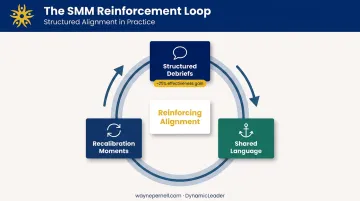
Shared language is the other practical tool. When a leadership team agrees on a specific definition of "priority" or a shared standard for what "done" means, those definitions become anchors that reduce rework and decision cycling. Teams that speak the same language move faster — not because they're smarter, but because they spend less cognitive energy translating between individual frames.
DynamicLeader's intact team coaching and offsite mastermind formats are specifically designed for these recalibration moments. The trigger varies — rapid growth, post-merger integration, a leadership transition — but the need is the same: a structured reset that rebuilds the shared understanding teams require to move with confidence.
Frequently Asked Questions
What is a shared mental model?
A shared mental model is the overlapping cognitive representation team members hold about tasks, roles, goals, and how the team operates together. It's what allows a group to coordinate effectively, particularly under pressure, without needing to re-establish understanding each time.
What role do shared mental models play in team effectiveness?
SMMs improve team effectiveness by enabling role clarity, implicit coordination, better decision quality, and stronger cohesion. They're especially valuable in fast-paced or high-stakes environments where there isn't time for explicit communication at every decision point.
What are the 4 types of team mental models?
The four types, identified by Cannon-Bowers, Salas, and Converse (1993), are: equipment (tools and systems), task (objectives and processes), team interaction (communication and coordination patterns), and team (teammates' skills and working styles).
How do you build shared mental models in a team?
Start with the leader's own clarity, then co-construct shared understanding through structured dialogue: role clarity conversations, facilitated workshops, and team retreats. Reinforce alignment over time through regular debriefs and shared language that reduces interpretive gaps.
What are the 5 C's of teamwork?
Several frameworks use "C" structures for teamwork. Salas et al. (2015) identify seven: cooperation, conflict, coordination, communication, coaching, cognition, and conditions. SMMs most directly support cognition and coordination — the two dimensions where alignment gaps show up most visibly in team performance.