
Introduction
The biggest obstacles most senior leaders face aren't strategic or operational. They're psychological.
The internal narratives, assumptions, and habitual thought patterns accumulated over decades of achievement quietly constrain decision-making, limit what risks get authorized, and set invisible performance ceilings for entire teams.
Imposter syndrome in the C-suite. Perfectionism that stalls bold decisions. The self-doubt that surfaces mid-presentation after 25 years of proven results.
These aren't character flaws. They're patterns. And patterns can be changed.
According to Gallup, managers account for at least 70% of variance in employee engagement across business units — which means a leader's internal belief system isn't just a personal matter. It's an organizational performance variable.
The five coaching techniques below are drawn from evidence-based psychology and applied leadership practice. Each builds on the last, and used consistently, they reshape not just how you think — but the culture you build around you.
Key Takeaways
- Limiting beliefs quietly cap leadership growth — naming them precisely is what makes them breakable
- Challenging assumptions interrupts reactive decision-making and opens the door to more strategic choices
- Reframing negative thought patterns is a learnable skill that directly shapes team culture
- Possibility thinking and outside perspective surface solutions that internal pressure tends to obscure
- Mindset mastery is a practiced discipline — the results build on themselves with each deliberate repetition
Why Mindset Mastery Is Non-Negotiable for Leaders
Most senior leaders spend years developing strategic, financial, and operational competence. Mindset work rarely gets the same investment — which is exactly why it becomes the limiting factor.
A leader's internal belief system shapes the questions they ask, the risks they authorize, the conversations they avoid, and the performance ceilings they unconsciously communicate to their teams. This isn't soft-skills territory — it's an operational variable.
The Trap of Accumulated Success
Here's what makes this particularly difficult at the senior level: decades of external achievement can actually reinforce fixed thinking. When you've succeeded using a certain set of mental models, those models feel like facts. They get harder to question precisely because they've worked.
As HBR reported in 2025, senior leaders often avoid development because they believe they should already have the answers. The higher the role, the more invisible the mental block.
This dynamic is why psychology-informed coaching outlasts willpower or positional authority when it comes to lasting mindset change. Understanding how belief patterns form — and why they resist disruption — is foundational work.
Dr. Wayne Pernell, PhD in clinical psychology and founder of DynamicLeader, applies exactly this lens to every senior engagement: not just leadership development methodology, but a clinical understanding of how the mind holds on to what it knows. That distinction shapes every technique that follows.
5 Coaching Techniques to Transform Your Thinking
These techniques are grounded in both coaching methodology and applied psychology. They're designed to be used by leaders — not just coached to them — and each one builds on the last.
Technique 1: Identify Your Limiting Beliefs
A limiting belief is a thought a leader holds as absolute truth that constrains their decisions, actions, or sense of what's possible. Common examples in senior leadership:
- "I have to have all the answers before I can lead decisively."
- "If I show vulnerability, I'll lose authority."
- "At my level, asking for help signals weakness."
These beliefs don't feel like beliefs. They feel like reality.
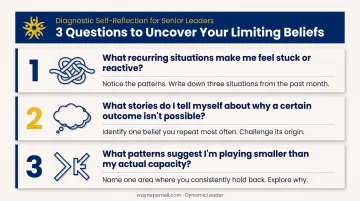
Three diagnostic questions to surface hidden limiting beliefs:
- What recurring situations make me feel stuck or reactive?
- What stories do I tell myself about why a certain outcome isn't possible?
- What patterns in my behavior suggest I'm playing smaller than my actual capacity?
Limiting beliefs in senior leaders are often deeply reinforced by past success. They worked once, which makes them much harder to question. A belief that helped you get promoted at 35 may be the same belief actively limiting your impact at 55.
This is why external reflection — journaling, coaching, 360-degree feedback — is often necessary to see what internal filters have made invisible. Dr. Wayne's Elite Mindstate Coaching specifically addresses transformation at the level of identity, not just behavior, because that's where these patterns live.
Technique 2: Challenge Your Assumptions
Once a limiting belief is identified, the next step is to interrogate what's holding it in place. Assumptions are the invisible scaffolding beneath limiting beliefs — they feel like facts but are actually interpretations.
Consider this example: "Public disagreement means I'm losing control of the room." That's an assumption, not a fact. It may never have been tested. And it's quietly shaping how every difficult conversation gets navigated.
Organizational psychologist Chris Argyris called this distinction critical. In his framework of double-loop learning, real growth requires questioning the governing variables — the underlying assumptions — not just correcting errors within existing beliefs. High-performing leaders, he noted, are often the worst at this because they've built so much success on not being wrong.
Two high-leverage questions leaders can use in real time:
- "What evidence actually supports this assumption?"
- "What if the opposite were true — what would that open up?"
These questions create cognitive flexibility, which research links directly to better decision-making quality under uncertainty. The discomfort that arises when long-held assumptions get challenged is real. Expect it. That resistance is a signal that the work is reaching something meaningful.
Technique 3: Reframe Negative Thinking
Reframing is the practiced skill of deliberately choosing a different, more constructive interpretation of a situation. This isn't wishful thinking. It's genuine cognitive flexibility applied in real time.
A concrete example:
| Before | After |
|---|---|
| "This team is resistant to change." | "This team needs a clearer line of sight to the goal before they'll commit." |
The second framing doesn't deny reality — it expands the range of responses available. One interpretation produces frustration and pressure. The other produces a conversation worth having.
That shift in interpretation matters beyond a single conversation. When a leader can see a setback as data rather than defeat, or a difficult conversation as a trust-building opportunity rather than a threat, they make better decisions. Just as critically, they model the behavior their team needs.
This is the aspect of reframing that gets underestimated at the organizational level. Teams internalize the interpretive frameworks their leaders model. Social learning theory is clear on this: leaders shape team norms through visible behavior, not policy documents.
A leader who reframes publicly — naming the shift out loud — teaches their team to do the same.
Dr. Wayne's Culture of Caring framework builds on exactly this principle. One of its core elements involves helping leaders "rewrite the stories keeping you and your team stuck" — moving from limiting narratives to ones that open up possibility.
Technique 4: Nurture Possibility Thinking
Possibility thinking is the deliberate practice of orienting the mind toward what could work, what hasn't been tried, and what might be achievable — rather than anchoring to constraints, precedents, or risk.
This is genuinely difficult for senior leaders. Most have been trained, rewarded, and promoted for identifying risk and protecting existing systems. That cognitive habit is valuable. It's also exactly what makes genuine innovation hard.
Three practical approaches to activate possibility thinking:
- Ask "What if?" questions without premature judgment — in strategy sessions, in one-on-ones, even internally
- Expose yourself to success stories outside your industry, where unfamiliar solutions to familiar problems are easier to see
- Dedicate protected time to visioning that isn't tethered to current operational constraints
The organizational stakes here are significant. A 2017 meta-analysis of 136 independent samples and over 22,000 individuals found that psychological safety — the belief that one can speak up, take risks, and try new things without punishment — is directly linked to learning behavior, information sharing, and team performance.
When leaders model possibility thinking, they signal psychological safety to their teams. That signal, more than any stated values or culture initiative, determines whether people bring their best thinking to work.
Technique 5: Seek Outside Perspective
There's a phenomenon worth naming directly: the echo chamber of expertise.
As leaders rise in seniority, direct reports increasingly defer to them. Candid challenge becomes rare. The feedback that reaches the top gets filtered through layers of organizational politics.
Over time, leaders lose access to the genuine friction that sharpens thinking — and most don't notice it's happening.
The Stanford Graduate School of Business documented this gap clearly: nearly 66% of CEOs do not receive outside coaching or leadership advice, while nearly 100% say they'd be receptive to changes based on feedback. The gap isn't willingness — it's access.
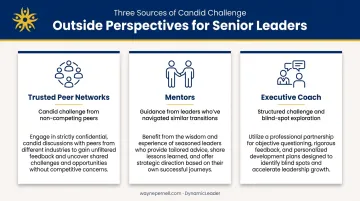
The three most effective sources of outside perspective for senior leaders:
- Trusted peer networks — small groups of non-competing leaders navigating similar transitions, where candor is possible because the stakes are different
- Mentors who have navigated the specific leadership transitions you're in, not just those who've achieved general success
- An executive coach who can provide structured challenge and the psychological safety to explore blind spots honestly
DynamicLeader's Exponential Success Summit brings together small cohorts — a dozen people or fewer — from deliberately diverse industries for exactly this purpose. Executives from finance, healthcare, and retail share frameworks and challenges they can't surface inside their own organizations. The cross-industry mix matters: it's harder to fall back on industry-specific assumptions when someone from a completely different sector is asking you to explain your logic.
Seeking outside perspective isn't weakness — it's how the best leaders stay sharp. The question isn't whether you need it. It's whether you've built the access to get it.
What Leaders Get Wrong About Mindset Work
Two common mistakes derail leaders before this work takes hold.
Mistake 1: Treating mindset work as a one-time reset. A workshop, a book, or a single powerful coaching conversation can generate real insight — but insight alone doesn't rewire anything. The brain forms and sustains belief patterns through repetition. Transformation requires consistent practice over time, not a single breakthrough event. Automaticity develops over months of daily repetition, not days.
Mistake 2: Separating mindset work from leadership performance. These five techniques are not personal development add-ons. They sit directly upstream of every strategic decision, team interaction, and cultural signal a leader sends. A leader who reframes more constructively makes different calls in crisis — and over time, that difference compounds across an entire team's behavior.
Beyond those two mistakes, there's a third trap — and it's the most insidious. Leaders who resist this work often do so because they hold a fixed belief that their thinking is already sound. "I've succeeded this far, haven't I?" That belief is itself the exact pattern these techniques are designed to address.
Turning Mindset Insights Into Leadership Action
The simplest daily practice is a single reflection question at the end of each day, tied to one of the five techniques. Brief and consistent beats elaborate and sporadic every time. Harvard Business School research found that 15 minutes of daily reflection improved job performance by 22.8% compared to spending that same time working. Small practice, compounding results.
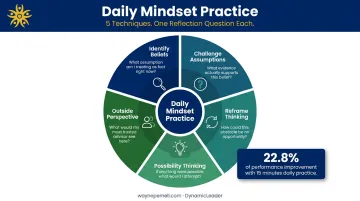
Example daily reflection questions:
- "What assumption did I act on today without questioning it?"
- "Where did I close down possibility before the conversation even started?"
- "What did I model publicly today — and what did my team learn from it?"
Individual reflection is only one layer. Leaders can extend these same techniques into team culture without lecturing about mindset. Ask "What if?" out loud in strategy meetings. Name your own reframes when you make them. Bring in voices that challenge the room — guest experts, external advisors, cross-functional perspectives unavailable internally.
For leaders navigating high-complexity environments — organizational change, rapid growth, or cultural friction — working through these techniques with an experienced executive coach accelerates the process. DynamicLeader's one-on-one coaching engagements use the proprietary CCB Process (Clarity. Co-strategy. Bold action.) to move senior leaders from mindset insight to measurable behavioral and cultural change — operating at the level of identity, not surface-level habit adjustment.
Frequently Asked Questions
What are the 5 coaching techniques for mindset mastery?
The five techniques are: identify your limiting beliefs, challenge your assumptions, reframe negative thinking, nurture possibility thinking, and seek outside perspective. They're designed to be used sequentially and consistently — each one builds the foundation for the next.
How long does it take to see results from mindset coaching techniques?
Many leaders notice shifts in reactivity and decision-making within weeks of consistent practice. Deeper belief restructuring (changing patterns reinforced over decades) typically emerges over several months of intentional work with qualified support.
Can these mindset techniques be used by leaders with their own teams?
Several techniques transfer directly to team settings. Reframing and possibility thinking are especially powerful when modeled publicly — teams adopt the thinking patterns their leaders demonstrate. The ripple effect on team performance is often larger than any individual shift.
What is the difference between mindset coaching and therapy?
Mindset coaching is forward-focused and action-oriented, centering on beliefs, behaviors, and goal achievement in a leadership context. Therapy addresses deeper psychological needs and clinical concerns. The two serve different purposes, though they can be complementary. DynamicLeader's coaching is explicitly not therapy, even when it draws on psychological principles.
How do limiting beliefs affect leadership performance?
Limiting beliefs constrain a leader's strategic range — shaping which risks they'll authorize, which conversations they'll initiate, and what performance ceilings they unconsciously signal to their teams. Those signals ripple through hiring decisions, team ambition, and the pace of execution.
Is mindset coaching effective for already high-performing executives?
High performers often benefit most. Existing success can mask the mental patterns preventing the next level of growth. The stakes of their decisions make precise thinking especially valuable, and the techniques in this article are designed specifically for leaders at the top of their game.