
What separates leaders who consistently elevate their teams from those who stall isn't what they know how to do. It's how they think.
Research from HBR suggests that while most people believe they're self-aware, only 10–15% actually meet meaningful self-awareness criteria — and self-awareness is just one layer of the mindset problem. Dr. Wayne Pernell, founder of DynamicLeader and a clinical psychologist with 83,000+ hours of leadership experience, consistently finds that the leaders who produce breakthrough results — like the 12-person team that achieved a 329% revenue increase in just over a year — are those who address their internal thinking patterns first.
This article covers what a leadership mindset actually is and 7 practical, psychologically grounded tips for developing it — whether you're a seasoned executive or stepping into a leadership role for the first time.
Key Takeaways
- A leadership mindset shapes how you respond to complexity, setbacks, and people — not just what you do.
- Deliberate practice builds it. It's not a trait you're born with.
- The 7 tips: self-awareness, growth mindset, emotional courage, strategic thinking, resilience, accountability, and empowering others.
- The biggest barrier is internal "mind traps" — beliefs that feel like facts until you challenge them.
What Is a Leadership Mindset (and Why Most Leaders Get It Wrong)?
A leadership mindset is the internal operating system that shapes how you perceive situations, process challenges, and respond to people. It sits beneath both leadership style and skills — the invisible layer that determines whether those capabilities actually get applied well under pressure.
The most common mistake leaders make? Confusing positional authority with leadership thinking. Having a title means you have influence over outcomes. It doesn't mean your thinking is calibrated to lead effectively. As researchers at Harvard T.H. Chan have noted, the assumption that leadership flows from authority actually hinders organizations operating in complex, dynamic environments.
Why Mindset Is the Multiplier
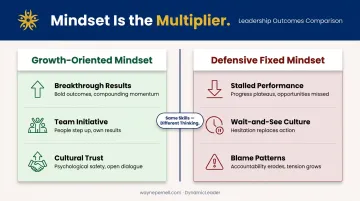
Two leaders with identical skill sets will produce vastly different outcomes — one operating from a growth-oriented, accountable mindset, the other from a defensive, fixed one. Same tools, opposite results.
Dr. Wayne Pernell's work across 2,500+ leaders confirms this. The leaders who generate consistent breakthroughs — not just one good quarter, but sustained performance — are those who address how they think, not just what they do. That's the foundation of his coaching work with senior leaders: transformation at the level of identity and decision-making, not incremental behavior adjustment.
A leader's mindset is also contagious. It shapes the cultural norms a team operates by, how people respond to failure, and whether they take initiative or wait to be told. That transmission happens whether the leader intends it or not.
7 Tips for Developing a Leadership Mindset
Tip 1: Anchor in Self-Awareness Before Anything Else
Self-awareness isn't just one useful leadership trait. It's the prerequisite for every other tip on this list. You can't change what you can't see.
Leaders with low self-awareness attribute problems externally — "the team doesn't get it," "the strategy was sound" — without examining their own role in the dynamic.
Genuine self-awareness means knowing your default stress responses, recognizing your blind spots, and understanding the gap between your intended impact and your actual impact on others.
What self-awareness looks like in practice:
- Reviewing your decisions after high-stakes situations, not just outcomes
- Seeking honest feedback from direct reports and peers (not just mentors who already agree with you)
- Tracking patterns in how you show up when things are uncertain or difficult
- Using brief structured reflection after important conversations — even 5 minutes builds compounding insight over time
This is where clinical psychology intersects with leadership development. Your thought patterns, not just your behaviors, are the unit of change. Journaling or structured self-audit practices help leaders identify recurring patterns — the triggers, the assumptions, and the defaults that operate below conscious awareness.
Tip 2: Shift from a Fixed Mindset to a Growth Mindset
Stanford's foundational research on mindset draws a clear line: a fixed mindset treats ability as static, while a growth mindset treats it as developable through effort and persistence. For leaders, the distinction is consequential.
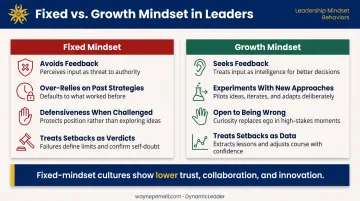
Fixed mindset shows up as:
- Avoiding feedback that might reveal weakness
- Over-relying on past strategies rather than experimenting
- Defensiveness when challenged or wrong
- Interpreting setbacks as verdicts on capability
A 2019 study published in Personality and Social Psychology Bulletin found that organizational mindsets directly predict cultural norms, trust, and commitment. Fixed-mindset cultures were perceived as less collaborative, less innovative, and more prone to unethical behavior. That's not just an individual problem — it's a cultural one.
A useful signal to watch for: If you find yourself avoiding situations where you might look uncertain or wrong, that's a fixed mindset at work. The reframe isn't to force optimism. It's to ask a genuinely different question: What would I attempt if I knew failure was data, not a verdict?
Tip 3: Lead with Emotional Courage, Not Emotional Avoidance
Most leadership failures aren't strategic. They're failures of emotional courage — leaders who don't give hard feedback, don't acknowledge uncertainty, don't confront the dysfunction sitting in the room because it feels too risky.
Emotional avoidance is itself a mindset trap. The short-term relief of staying comfortable creates long-term dysfunction. Research cited by HBS indicates that 70% of employees avoid difficult conversations — and that pattern typically starts at the top.
Emotional courage in practice looks like:
- Naming what's actually happening in a meeting instead of working around it
- Saying "I don't have the answer to that" when you don't
- Creating genuine space for your team to be honest with you — not just appearing open while signaling it's unsafe to disagree
Susan David and Christina Congleton's HBR work on emotional agility frames this precisely: the capacity to recognize and work with your internal emotional state rather than be controlled by it. The goal isn't to suppress difficult emotions — it's to hold them without being held by them, so your responses are deliberate rather than reflexive.
Leaders who develop emotional agility stay clear-headed under pressure not because they feel nothing, but because they've learned to create a pause between stimulus and response.
Tip 4: Think Strategically, Not Just Tactically
High-performing operators get promoted into leadership roles and then struggle. Not for lack of capability — but because they stay in tactical mode. Doing instead of directing. Fixing instead of building systems.
The shift to a leadership mindset requires practicing the long view: stepping back from execution regularly to ask where are we going, and are these actions taking us there?
The Center for Creative Leadership treats strategic thinking as a trainable capability, not an innate trait. That's important. It means the leaders who feel most stuck in tactical mode can deliberately build this skill.
Practices that build strategic thinking habits:
- Schedule weekly time specifically for reflection — not planning, reflection
- Ask "second-order" questions: not just what will this solve? but what will this make possible or prevent six months from now?
- Read broadly outside your immediate industry
- Practice horizon scanning: what's changing in the environment your organization operates in, and what does that mean for your next decision?
Tip 5: Build Resilience as a Deliberate Practice
Resilience is a trainable skill — closer to strength training for the mind than a fixed characteristic. Leaders aren't born with it; they build it.
Resilient leaders aren't unaffected by setbacks. What distinguishes them is the speed and quality of their recovery, and the fact that recovery itself is a practiced skill rather than an accidental outcome. Dr. Wayne Pernell's coaching work with DynamicLeader centers on exactly this — helping leaders raise their baseline capacity for handling pressure before a crisis hits, not just reacting once they're in one.
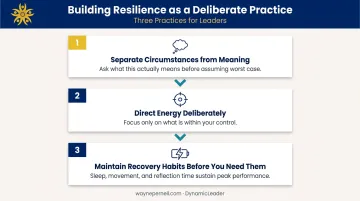
Three concrete resilience-building practices:
- Separate circumstances from meaning. When something goes wrong, ask what does this actually mean? rather than jumping to the worst-case interpretation. Most setbacks aren't as permanent or pervasive as they feel in the moment.
- Direct energy deliberately. Identify what's within your control versus what isn't, then focus exclusively on the former. Spending energy on things outside your control isn't persistence — it's depletion.
- Maintain recovery habits before you need them. Physical and mental recovery practices — sleep, movement, time for thinking — raise your baseline. Leaders who neglect these find that their capacity for pressure diminishes exactly when they need it most.
Tip 6: Own Your Outcomes — Practice Radical Accountability
Radical accountability means treating your results — professional and interpersonal — as products of your choices, not your circumstances. This isn't about ignoring real constraints or absorbing blame for things outside your control. It's about consistently asking: What part did I play in this outcome, and what would I do differently?
Gallup's research found that fewer than half of leaders rate themselves as outstanding or exceptional at creating accountability — making it the lowest-rated of seven core leadership competencies. The gap is significant, and it starts with the leader's own relationship to accountability before it becomes a team norm.
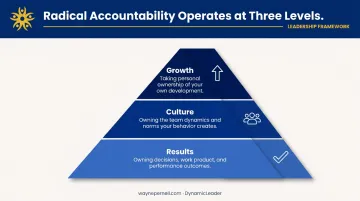
Accountability operates at three levels:
- Results — owning your work product, decisions, and performance outcomes
- Culture — owning the dynamics and norms your behavior creates on your team
- Growth — not waiting for someone else to develop you; treating your own development as your responsibility
Leaders who practice this consistently tend to be the most trusted — because their teams know that when something goes wrong, accountability flows up before it flows down. That posture is what makes psychological safety real, not aspirational.
Tip 7: Lift as You Lead — Empower Others Through Your Mindset
A developed leadership mindset shows up most clearly in what happens to the people around you. Do they get sharper, more confident, more capable — or do they shrink and wait for direction?
This is the "lift as you lead" principle that drives DynamicLeader's work — and it's operationally different from simply managing people well. It means actively developing the mindset and capability of the people you lead, not just managing their outputs.
What this looks like in practice:
- Asking questions that build self-awareness in others: What do you think is getting in the way? rather than immediately providing the answer
- Publicly modeling a growth mindset by acknowledging your own development edges
- Delegating with genuine trust, not as a test
- Structuring feedback as a two-way practice rather than a top-down evaluation
- Celebrating growth over perfection — making it safe to be in process
Only 43% of employees report that their leaders have created a positive team climate, according to McKinsey's organizational research. The gap between leaders who intend to empower and those who actually create the conditions for it comes down to mindset consistency, not occasional gestures.
These habits become organizational norms only when leaders model them under pressure — not just in low-stakes moments. DynamicLeader's consulting engagements and Dancing with Chaos leadership training system are built to create exactly that: culture-level change embedded in leadership teams, not dependent on any single leader's good intentions.
Mind Traps That Silently Derail Leadership Mindset Development
Even leaders who understand these seven tips intellectually often struggle to sustain them. Not because of external barriers, but because of deeply conditioned internal belief patterns that feel like reality rather than beliefs.
The most common mind traps:
- "I'm not ready yet" — perpetual preparation that never converts to action
- "I need to have all the answers" — the belief that uncertainty signals incompetence
- "Showing vulnerability will undermine my authority" — leading to the emotional avoidance described in Tip 3
- "Things will change once the environment or team changes" — outsourcing the source of the problem
Recognizing your own trap starts with noticing where it shows up. Look for recurring patterns — situations where you consistently hold back, over-explain, avoid conflict, or feel inexplicably resentful. The pattern points to the belief underneath.
Awareness alone doesn't dissolve a mind trap. But it changes your relationship to it — and that shift opens a real choice where none seemed to exist before.
There's also a counterintuitive truth here: leaders who openly acknowledge struggling with these traps tend to be more effective long-term. They're doing the actual work of mindset development, not just performing confidence.
How to Keep Your Leadership Mindset Sharp Over Time
A leadership mindset isn't built once. Default patterns have a way of resurfacing during high-stress periods, rapid growth, or major transitions — exactly when consistent thinking matters most.
Consistency matters more than intensity. Small daily practices compound more powerfully over time than intensive one-time retreats:
- A brief morning reflection before the day's demands set the tone
- A post-conversation check-in after high-stakes interactions
- A weekly review of where your thinking served you — or limited you
A coaching or mentoring relationship that specifically challenges your thinking patterns accelerates this work considerably. A 2023 study found that leadership coaching enhances effectiveness through authentic and change-oriented leadership behaviors — the relationship itself is part of the mechanism, not just the content discussed.
Coaching addresses internal patterns — but external exposure is equally important. Insular thinking is a real risk for any leader who operates in one world too long. Reading broadly, engaging with leaders from different industries, and building advisory relationships outside your immediate context all prevent the narrowing that happens when smart people only talk to each other. That echo chamber is comfortable. It's also where sharp thinking goes to stall.
Frequently Asked Questions
How do you establish a leadership mindset?
Start by examining the beliefs and thinking patterns currently driving your decisions. From there, it's built through intentional daily practice: seeking honest feedback, reframing setbacks as data, and consistently choosing accountability over blame.
What are the key traits of a leadership mindset?
The core traits are self-awareness, a growth orientation, emotional courage, strategic thinking, resilience, accountability, and the drive to develop others. These traits are mutually reinforcing: progress in one area consistently accelerates development in the others.
Can a leadership mindset be learned, or is it innate?
It's absolutely learnable. Research on neuroplasticity and decades of leadership development practice confirm that thinking patterns change with deliberate effort — regardless of where someone started.
What is the difference between a leadership mindset and a management mindset?
A management mindset optimizes existing systems and maintains performance. A leadership mindset is oriented toward vision, people development, and navigating change. Great leaders need both — but the leadership mindset is what drives transformation, not just maintenance.
How does a leadership mindset impact team performance?
A leader's mindset sets the psychological tone for the entire team, shaping how people respond to failure, whether they take initiative, and how invested they are in their own growth. Leaders who cultivate this mindset consistently see higher engagement, stronger resilience, and measurably better output from their teams.