Key Takeaways
- Guest quality signals your show's credibility — and compounds as a growth strategy
- Start with audience fit, not credentials — the right guest serves your listeners first
- Your existing network is the highest-conversion sourcing channel most hosts ignore
- Personalized, specific pitches outperform generic outreach every time
- How you promote after the episode decides whether guests become long-term advocates
Why Guest Speakers Are the Backbone of a Leadership Podcast
A leadership podcast lives or dies by the quality of its conversations. Listeners don't tune in for production value — they show up for access to people who've navigated real challenges at a level they haven't yet reached.
The numbers bear this out. According to research from Sounds Profitable and Signal Hill Insights, business podcast listeners prioritize self-improvement, inspiration, and having their thinking challenged above entertainment. These are people with high expectations. They will drop a show that wastes their time.
Guest selection is also an audience development decision, not just a content one. 86% of business podcast consumers say they're likely to listen to a show recommended by someone in their social circle, according to Sounds Profitable's Business Podcast Consumer report. Every guest you feature carries their own credibility signal into your audience — and into their own network.
One risk is hard to ignore in this space: many shows recycle the same recognizable voices. Listeners who follow leadership content have already heard Simon Sinek's TED talk and Brené Brown's vulnerability framework. Shows that keep booking familiar names offer diminishing returns.
The hosts who build real authority — like Dr. Wayne Pernell does with the One Sharp Sword podcast — find guests who have operated at high levels but haven't been overexposed: people with real organizational stories still worth telling.
The question worth asking before every booking: does this guest bring your listeners somewhere they couldn't get from a YouTube search?
Defining Your Ideal Leadership Podcast Guest
Start With Audience-Guest Alignment
The most important filter isn't the guest's résumé. It's the match between what your listeners are grappling with and what the guest has actually lived through.
A CHRO audience needs someone who has rebuilt trust after a restructure. A founder audience needs someone who navigated the operator-to-CEO shift — ideally the hard way. For a high-performing individual contributor audience, the right guest is the person who made their first people-management transition, got it badly wrong, and figured out why.
The guest who looks impressive on paper but speaks to a different set of challenges serves no one well.
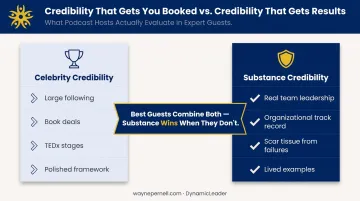
Substance Credibility vs. Celebrity Credibility
There's a meaningful difference between:
- Celebrity credibility: large following, book deals, TEDx stages, media features — but often a polished framework with no grit behind it
- Substance credibility: a track record of leading real teams through real challenges, with the scar tissue to prove it
The best guests combine both. When they don't, substance without celebrity beats celebrity without substance. A mid-level operations leader who rebuilt a broken culture after a merger will generate better listener engagement than a well-known speaker delivering the same framework they give at every conference.
Guests who have worked through structured leadership development — the kind that happens inside real organizations — tend to arrive with both a language for what happened and the lived examples to back it up. They've named the mess. That translates directly into compelling interview content.
Thematic Fit and Diversity
Two more factors that shape whether a guest elevates your show or just fills an episode slot:
- Thematic fit: The guest's story should deepen a question your show is already exploring, not scatter the show's intellectual identity. One Sharp Sword, for example, consistently gravitates toward guests who can speak to decision-making under pressure and identity-level leadership — which reinforces the show's editorial focus rather than diluting it.
- Diversity of context: Guests from different industries, organizational sizes, and career stages signal to your audience that leadership is not a single-context skill. A show that only features Fortune 500 executives misses the insight available from a founder who built and sold a company, a military leader who managed 200 people in a crisis, or a culture transformation consultant who has seen the same dysfunction across dozens of organizations.
Where to Find Guest Speakers for Your Leadership Podcast
Your Existing Network (The Most Underused Source)
Most hosts jump straight to databases and platforms. The highest-conversion channel is the one they already have.
Start by systematically auditing:
- LinkedIn connections filtered by title, industry, and career stage
- Alumni networks from universities, programs, and past employers
- Clients, former colleagues, and collaborators whose leadership stories match your guest profile
- Conference attendee lists from events you've spoken at or attended
The people you already have some relationship with will respond to your outreach — cold sources convert at a fraction of the rate.
The Referral Chain
Every guest you record with is a warm door to three or four more. Make asking for introductions a standard part of your post-interview conversation — not an awkward one-time ask.
Something direct works: "Who else in your network has done something similar? I'd love an introduction if you think it's a good fit." Most guests who had a positive experience will help without hesitation.
Other Effective Sourcing Channels
| Channel | Best Use | Watch Out For |
|---|---|---|
| Leadership conferences and associations | Finding under-the-radar voices before they're overexposed | Takes time; relationship-building, not transactional |
| Other podcasts' guest rosters | Identifying guests who gave substantive, non-promotional episodes | Cross-reference against your guest criteria, not just name recognition |
| Booking platforms (PodMatch, MatchMaker.fm, Guestio) | Surface availability and interest | These show who's looking to be booked, not who's best for your show |
| Speaker bureaus (BigSpeak, Washington Speakers Bureau) | Access to established speakers with agent relationships | Gatekeepers add friction; better for outreach than discovery |
| Inbound pitches | Passive pipeline once you have show momentum | Needs a simple intake process to evaluate against your criteria |
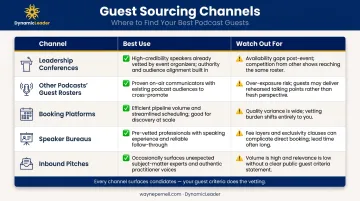
Every channel above surfaces candidates — none of them does the vetting for you. That filter is your guest criteria, and it needs to be applied regardless of where the name came from.
How to Pitch Guests and Secure Confirmations
What Gets Ignored (And Why)
Most pitch emails fail for a single reason: they're generic. The guest can tell within the first sentence that the same email went to 50 other people. High-caliber leaders — especially those managed by PR teams or speaking agents — have a finely tuned filter for this.
A vendor case study from Respona tracked 1,000 cold outreach emails across 13 months and found a 10% booking rate — meaning 90% of outreach went nowhere. The difference between a booked guest and a deleted email almost always comes down to one thing: whether the pitch felt written for them specifically.
The Components of a Pitch That Works
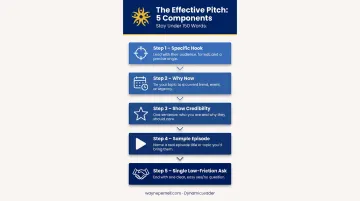
Keep it short. OnePitch recommends staying under 150 words for initial outreach. Use that space for:
- A specific hook — one sentence showing you've engaged with their actual work, not their bio
- Why now — why their experience or perspective is relevant to your current audience and editorial focus
- Show credibility — a brief line on your audience, caliber of past guests, or editorial focus (not vanity metrics)
- A sample episode — the clearest proof of how you treat guests
- A single, low-friction ask — a 15-minute exploratory call, not a commitment to record
Navigating Gatekeepers
Senior leaders are often pitched through assistants, PR contacts, or speaking agents. A few adjustments:
- Research who actually manages their calendar and outreach
- Address gatekeepers professionally — they influence the decision
- For PR-managed guests, frame the show's editorial credibility (not just audience size)
- For agent-managed speakers, ask about availability windows before pitching specifics
Follow-Up Without Being Annoying
Most confirmations come after two or three touches. Each follow-up should add context or value — a relevant episode, a recent development in their field, a mutual connection who can vouch for the show. After three attempts with no response, move on. Restating the original pitch is just noise.
Featuring Guests Effectively: Before, During, and After the Recording
Preparing the Guest Experience
How you prepare for an interview signals whether you'll respect the guest's time. The minimum standard:
- Read or listen to their recent work, not just their Wikipedia page
- Send a brief pre-call or questionnaire to align on focus areas
- Share a clear episode direction — not a rigid script, but an orientation to where the conversation is headed
The best leadership interview questions are situational, not factual. A guest has answered "what is your leadership philosophy?" a hundred times. They haven't answered "take me back to the moment you realized the team you'd built wasn't working. What did you actually do?"
Questions that return the guest to a specific moment — a decision point, a failure, a culture inflection — produce the most honest and useful conversations.
During and After the Interview
During recording, your job is to create the conditions for the guest's best thinking:
- Follow unexpected threads rather than sticking rigidly to your outline
- Ask the clarifying question the audience would ask but wouldn't feel comfortable voicing
- Resist the urge to fill silence — the pause often precedes the most valuable answer
After recording, treat guest promotion as a system, not an afterthought:
- Send a thank-you within 24-48 hours
- Provide shareable assets — Spotify for Creators recommends giving guests a mini press kit with suggested copy and cover art
- Tag guests across platforms and create clip-worthy moments for social distribution
- Check in at the three to four week mark when the episode is live and performing
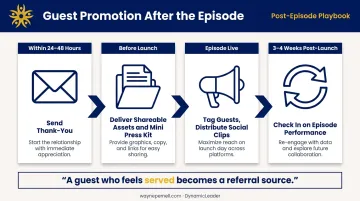
The post-episode relationship has a long tail. A guest who felt genuinely served becomes a referral source — someone who recommends your show in their own network. A guest who felt processed quietly moves on and takes that audience with them.
Frequently Asked Questions
What are the top leadership podcasts?
Well-regarded options include HBR IdeaCast (management, interview-based), WorkLife with Adam Grant (culture and organizational psychology), Coaching for Leaders (practical, running since 2011), and Craig Groeschel Leadership Podcast (accessible, 30-minute episodes). The best fit depends on what leadership challenge you're currently navigating.
Who are the best speakers on leadership?
It depends on your audience's industry, career stage, and specific challenges. Prioritize speakers with real organizational experience, a transferable framework, and a track record of producing insight rather than just inspiration.
How do I get guests for my leadership podcast if I'm just starting out?
Start with warm network connections — people who know and trust you will say yes when strangers won't. Be transparent about where the show is in its growth, and lead with your editorial vision. A clearly defined audience and a compelling reason for the conversation will get you further than inflated download numbers.
How many guests should a leadership podcast feature per month?
Consistency and depth matter more than frequency. One well-prepared guest interview per episode, released on a reliable schedule, will build more loyal listenership than rushed conversations produced to fill a calendar.
Should leadership podcast guests be paid or compensated?
The norm across most podcasting is no monetary compensation. The real value exchange is professional treatment, genuine audience exposure, and useful content assets the guest can share with their own network. For very high-profile guests, a formal written introduction or cross-promotion arrangement may be appropriate.
How do I make my leadership podcast stand out in a crowded market?
Start with a clearly defined audience — not "leaders" broadly, but a specific type of leader facing a specific challenge. Build a consistent editorial identity your guests and listeners can articulate. Then commit to finding guests with real applied experience rather than booking familiar names because they're easy to book.