
Introduction
Most senior leaders already know what they need to do. The gap isn't knowledge — it's execution. They set the priority, map the plan, and still find themselves three months later explaining why that initiative stalled or why the same leadership pattern keeps showing up.
That's not a motivation failure. It's a support structure problem.
When leaders look for support, they typically land on two options: find an accountability partner or hire an accountability coach. These aren't interchangeable. An accountability partner checks in on your progress. An accountability coach diagnoses why progress keeps stalling — and rebuilds the conditions around it. For leaders whose decisions affect teams, culture, and revenue, picking the wrong option doesn't just delay results. It quietly reinforces the patterns behind every missed goal.
This article breaks down what separates the two, where each one earns its place, and how to decide which level of support matches what you're up against.
Key Takeaways
- An accountability partner is peer-based, informal, and free — no structured methodology, just mutual check-ins
- An accountability coach is a trained professional who uses structured frameworks to turn intention into consistent action
- Partners work for early-stage habits and lower-stakes goals; coaches are built for behavior-level change at high stakes
- The critical difference is expertise: a partner can remind you; a coach can diagnose why you keep missing the mark
- For senior leaders, the ripple effect of stalled goals almost always tips the decision toward professional coaching
Accountability Coach vs. Partner: Quick Comparison
| Dimension | Accountability Partner | Accountability Coach |
|---|---|---|
| Cost | Free or reciprocal time investment | Paid; avg. ~$272/hr in North America (ICF, 2025); higher for senior engagements |
| Structure | Informal check-ins and peer conversation; no set framework | Structured agendas, goal-setting models, and behavior change methodology |
| Training | No formal training required; support depends on the individual's experience | Professionally trained; may hold credentials in coaching, psychology, or behavioral science |
| Relationship Dynamic | Mutual: both parties hold each other accountable, which divides focus | One-directional — the coach's full attention stays on the client's goals and obstacles |
| Long-Term Impact | Variable; depends on both parties' consistency and willingness to push back | Designed for measurable, sustainable behavior change and goal execution over time |
What Is an Accountability Coach?
Accountability coaching is a professional engagement where a trained coach uses structured methodology to close the gap between what you intend to do and what you consistently follow through on. It goes well past reminders and calendar nudges: it's active diagnosis of what's actually blocking execution.
The Core Functions
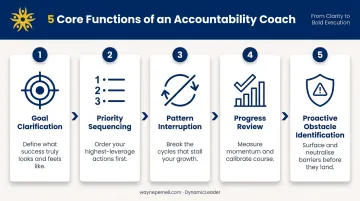
A skilled accountability coach doesn't just ask "did you do it?" They work through:
- Goal clarification — ensuring the goal itself is specific and worth pursuing
- Priority sequencing — identifying what needs to happen first and in what order
- Pattern interruption — recognizing the recurring behaviors that derail follow-through
- Progress review — evaluating what worked, what didn't, and why
- Proactive obstacle identification — anticipating friction before it becomes a stall
The distinction that matters most: a trained coach can differentiate between a clarity gap (you don't actually know what the goal requires), a motivation gap (you know but can't sustain the drive), and a skills gap (you lack a specific capability needed to execute). Each requires a different intervention. Without that diagnostic lens, accountability stays surface-level.
The Psychological Foundation
Research supports why structured accountability works at a deeper level. Gail Matthews' goal achievement study at Dominican University found that participants who wrote goals, committed to action steps, and sent weekly progress reports to another person achieved significantly higher goal scores than those who simply thought about their goals — a mean score of 7.6 out of 10 versus 4.28 for the unwritten-goal group.
A coach with clinical or behavioral training brings additional depth to this dynamic. Dr. Wayne Pernell at DynamicLeader holds a PhD in clinical psychology, and his 1:1 executive coaching is built around the proprietary CCB Process: Clarity. Co-strategy. Bold action.
That process moves clients from vague intentions through collaborative strategy into executable, measurable steps. It's co-created around each leader's specific vision and the obstacles unique to their context — not applied as a generic template.
Why This Matters at the Leadership Level
That kind of co-created structure matters most at the top. Senior leaders operate in an accountability vacuum — the higher you go, the fewer people around you will challenge you directly.
Organizational blind spots go unaddressed. Peers self-censor. And stalled goals don't just affect a performance review. They slow teams, erode morale, and bleed real revenue over time.
Use cases where an accountability coach is the right fit:
- Scaling a team through complexity without losing execution momentum
- Breaking a recurring performance plateau that self-directed methods haven't moved
- Leading through significant organizational change
- Navigating competing priorities that consistently crowd out the most important work
- When informal accountability structures have repeatedly failed to hold
What Is an Accountability Partner?
An accountability partner is a peer, colleague, or fellow professional who agrees to regular check-ins around shared or parallel goals. The arrangement is informal and reciprocal — both parties hold each other accountable, which is also its primary structural limitation.
The appeal is real: it's accessible, relationship-based, and costs nothing but time. For the right use case, it delivers genuine value.
Where a Partner Adds Value
- Building initial momentum on a clearly defined new project
- Early-stage habit formation where consistency, not complexity, is the challenge
- Maintaining lower-stakes personal goals with a peer who shares the same context
- As a supplemental layer alongside professional coaching for specific side goals
The Structural Ceiling
Peer accountability has a documented ceiling. Research on organizational dynamics consistently shows that people working collectively exert less individual accountability pressure — and the social relationship at stake makes candid feedback harder to sustain. For senior leaders, three specific limitations compound this problem:
- Peers often operate in the same organizational environment and carry the same blind spots, making it unlikely either party will surface an assumption neither questions
- The relationship dynamic tends to soften hard feedback; when one party pushes back, the social cost frequently outweighs the professional one
- Without training in behavioral science or coaching methodology, a partner can observe that you missed the mark but can't reliably diagnose why or what needs to change at the behavioral level
Use cases where a partner is a reasonable starting point:
- Bootstrapping a side project with a trusted peer
- Working on a clearly defined personal habit
- When budget is a genuine constraint and you need a starting point, not a final answer
An accountability partner is a valid entry point — not a failure. It just wasn't designed to handle the diagnostic depth, behavioral nuance, or high-stakes decisions that senior leadership goals actually demand.
Which One Actually Moves the Needle?
The right choice comes down to four factors: the stakes of the goal, the complexity of the challenge, your history of follow-through, and how deeply the obstacle is behavioral versus tactical.
The Decision Framework
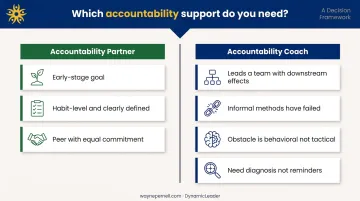
Choose an accountability partner if:
- You're early in your development on a specific goal
- The goal is habit-level and clearly defined
- You have a peer with equal commitment and a demonstrated willingness to push back honestly
Choose a professional accountability coach if:
- You lead a team or organization where your goals have downstream effects
- You've tried informal accountability methods that haven't held over time
- Your obstacle is behavioral, not just tactical — the pattern keeps repeating
- You need someone who can diagnose, not just remind
Reframing the Cost Conversation
The "cheaper" option may carry the highest actual price tag. McKinsey research estimates that inefficient decision-making costs a typical Fortune 500 company approximately $250 million per year (roughly 530,000 days of managers' time).
Gallup data sharpens the picture: managers account for at least 70% of the variance in employee engagement. A leader who isn't executing at full capacity isn't just underperforming personally. They're pulling down the people around them.
For a leader whose decisions affect team productivity, culture, and revenue, the cost of a stalled quarter typically exceeds the cost of professional coaching. That's not a marketing claim — it's arithmetic. The real question is what it's costing you to leave the problem in place.
Real-World Impact: When the Right Choice Makes All the Difference
Dr. Etienne Lacrampe, a board-certified periodontist and DynamicLeader client, came to coaching not because things were falling apart — but because success had created its own ceiling. Despite professional achievement, he was operating reactively: his schedule controlled him, not the other way around. He knew what he needed to do. He wasn't consistently doing it.
Through coaching with Dr. Wayne, the engagement focused on reclaiming agency over time and energy, redesigning his practice around peak performance principles, and building a team culture that supported delegation rather than requiring his constant presence. The outcomes were concrete:
- Restructured schedule that put him back in control
- Stronger team trust and delegation without constant oversight
- A shift from reactive firefighting to intentional leadership
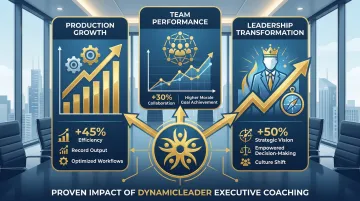
The pattern here mirrors what shows up across DynamicLeader's client work — including a 12-person team that achieved a 329% increase in production and revenue in just over a year after Dr. Wayne helped clarify vision, establish processes, and reset expectations. In each case, the gap wasn't personality, work ethic, or intent. It was the absence of an accountability structure built for the level of leadership they were actually operating at.
That's the real distinction. Peer accountability keeps you aware of the gap. Professional coaching closes it: by identifying what's actually creating it.
For senior leaders who recognize this pattern: Dr. Wayne Pernell's 1:1 executive coaching at DynamicLeader offers the structured, psychologically grounded engagement that peer accountability can't replicate. The proprietary CCB Process (Clarity, Co-strategy, Bold action) provides the framework, while Dr. Wayne's clinical psychology background enables root-cause diagnosis rather than surface-level habit fixes.
If you're ready to explore what that partnership looks like, the next step is a conversation with Dr. Wayne's team.
Conclusion
Accountability partners and coaches both serve a purpose. Partners are relational and accessible — they keep the goal visible. Coaches work structurally, addressing the underlying patterns that generate the same problems on repeat.
The real question is whether your current level of support matches the complexity and stakes of what you're navigating. That alignment matters more than preference.
Leaders who sustain performance over time don't rely on intention alone. They build the right infrastructure around their goals — and they invest in that support before the gap becomes a crisis.
Frequently Asked Questions
What does an accountability coach do?
An accountability coach uses a structured process to help clients clarify goals, surface the behavioral patterns blocking consistent execution, and build sustainable follow-through. Unlike informal check-ins, this process diagnoses whether you're facing a clarity gap, motivation gap, or skills gap — and addresses each differently.
How much does an accountability coach cost?
ICF data puts the global average at roughly $234 per hour, with North American rates around $272. Senior executive coaching engagements — especially those involving experienced coaches with clinical or organizational expertise — typically start at five figures and are scoped as monthly retainers or multi-month packages rather than hourly sessions.
Can I have both an accountability partner and an accountability coach at the same time?
Yes — the two serve complementary functions. A coach handles deep behavioral work and high-stakes professional goals; a partner can add peer-level support for specific habits or lower-stakes projects on the side. They don't compete; they operate at different depths.
What is the difference between an executive coach and an accountability coach?
Executive coaches typically focus on leadership development, strategy, and organizational effectiveness. Accountability coaches focus specifically on execution and consistent follow-through. The most effective senior-leader engagements integrate both — which is the model Dr. Wayne Pernell uses at DynamicLeader, combining clinical psychology with decades of hands-on leadership experience.
Is an accountability coach worth it for senior leaders?
For leaders whose decisions affect teams and revenue, the cost of stalled goals typically far exceeds the cost of coaching. It's an asymmetric investment: a relatively contained expense that protects against the cost of delayed decisions and missed targets across a quarter or a year.
How often should I meet with an accountability coach?
Weekly sessions are standard for active goal pursuit. Some coaches also offer mid-week check-ins or embedded observation for leaders navigating complex, fast-moving environments — the format should match the pace and stakes of the work.