
Introduction
You've done the work. You have the data, the rationale, a clear plan — and you still walk out of the boardroom without a yes.
It's a frustrating experience that plays out across organizations every day. Leaders with genuinely strong initiatives fail to gain traction not because their ideas are weak, but because they're playing by different rules than the executives across the table.
This is not a presentation skills problem. Getting C-suite buy-in is a strategic challenge that requires understanding how executives think, what they're protecting, and what finally moves them to act.
Research from Strategy+Business found that 64% of executives say their companies have too many conflicting priorities. Your initiative is competing in a crowded, high-stakes environment before you even open your mouth.
This article covers why the barrier exists, how to decode executive priorities by role, how to build your case before the formal meeting, and how to make an ask that actually lands — and holds.
Key Takeaways
- C-suite leaders filter every request through risk, resource trade-offs, and strategic fit — not merit alone.
- Role-specific framing matters: a CEO, CFO, and COO each need to hear a different version of the same initiative.
- The real work happens before the meeting — through coalition-building and targeted pre-conversations.
- Lead with the problem, not your solution — then anchor your case with both data and a concrete story.
- Buy-in requires ongoing maintenance — not just a one-time yes.
Why Getting C-Suite Buy-In Is Harder Than It Looks
Most leaders assume executive resistance means the idea needs more polish. It usually doesn't. The resistance is about something else entirely.
Executives Are Filtering, Not Evaluating
C-suite leaders field dozens of competing initiatives simultaneously. Their default is to filter — looking for anything that could create organizational exposure, drain resources without clear return, or disrupt work already underway. When your initiative gets pushed aside, it's rarely personal. It's prioritization.
The language mismatch makes this worse. Most leaders pitch in functional terms — team morale, process improvements, culture — while executives respond to business terms: margin impact, retention cost, competitive positioning. That translation gap creates an invisible wall even when the initiative is genuinely valuable.
A quick comparison shows how stark this disconnect can be:
- Functional framing: "This will improve team morale and collaboration."
- Executive framing: "This reduces voluntary turnover by an estimated 15%, saving $400K annually in replacement costs."
- Functional framing: "We need better processes."
- Executive framing: "This closes a workflow gap costing us 20 hours per week across the team."
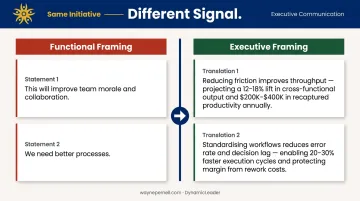
Same initiative. Completely different signal to the room.
The Psychology Behind "We've Always Done It This Way"
The language gap is the surface problem. Underneath it is something more entrenched.
Samuelson and Zeckhauser's foundational research on status quo bias established that decision-makers disproportionately stick with prior choices. Staw's research on escalation of commitment went further: when leaders feel personally responsible for a prior decision, negative outcomes can actually increase their commitment to it, not decrease it.
What this means in practice: executives aren't just risk-averse about new ideas. They're actively protecting existing decisions and the identity that came with making them. Kahan's research on identity-protective cognition confirms that more analytically capable individuals can actually use reasoning to defend identity-consistent conclusions rather than update them.
The implication: Give executives a way to say yes without threatening what they've already committed to. Logic is necessary — but it's rarely sufficient.
Dr. Wayne Pernell, whose work inside organizations like Schwab, Pfizer, and Whole Foods spans four decades, grounds this observation in clinical psychology: leaders are not purely rational actors. Identity, status, and organizational narrative shape how they evaluate proposals — and understanding that dynamic is the first step to working with it rather than against it.
Decode What Actually Moves the Executives in the Room
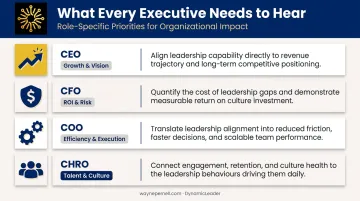
Pitching the same message to every executive is one of the most common and costly mistakes leaders make. A CEO and a CFO sit in the same room, but they're listening for entirely different things.
Role-Specific Priorities
| Role | Primary Lens | What They Need to Hear |
|---|---|---|
| CEO | Growth, competitive differentiation, resilience | How this initiative positions the company ahead of competitors or reduces strategic risk |
| CFO | ROI, capital allocation, risk mitigation | Expected return, cost of inaction, measurable payback timeline |
| COO | Operational efficiency, scalability | How this integrates with existing operations without creating friction |
| CHRO | Culture, talent pipeline, change adoption | How this improves retention, performance, and organizational readiness |
Deloitte's 2025 COO research found that 22% of COOs name operational efficiency as their top strategic focus — making any initiative that adds complexity without a clear efficiency payoff a hard sell before the conversation begins.
The Same Initiative, Three Different Pitches
Consider a leadership development program. Here's how the framing shifts by role:
- To the CEO: "Competitor talent is moving faster because their leadership bench is stronger. This program closes that gap — and Gallup's research ties higher leadership capability directly to 23% better profitability."
- To the CFO: "Replacing a mid-level manager costs between 50% and 200% of their annual salary, according to SHRM. This program reduces voluntary turnover and builds the pipeline, making it cheaper to grow than to backfill."
- To the CHRO: "Forty-four percent of organizations are increasing emphasis on upskilling leaders specifically for change readiness, per Harvard Business Impact. This positions us ahead of that curve."
Same initiative. Three different business cases. Getting there, though, requires knowing what each executive is carrying into the room before you walk in.
Listen Before You Pitch
The most effective leaders don't start with a deck. They start with questions. Before building any formal proposal, spend time in 1:1 conversations with the executives who will be in the room. Ask:
- What are they most worried about this quarter?
- What initiative are they already trying to protect?
- What would make a "yes" politically complicated for them?
This intelligence-gathering shapes a far more resonant proposal. DynamicLeader's Initial Assessment phase — which includes leader interviews and stakeholder shadowing — is built around exactly this kind of listening, surfacing what's said openly and what's left unspoken.
Build Your Case Before You Walk Into the Room
Here's the mindset shift that changes everything: the meeting is where you confirm a decision, not where you make one.
By the time you're standing in front of the C-suite, the groundwork should already be laid.
Build Internal Coalition Before the Big Room
McKinsey research shows that change efforts are approximately four times more likely to succeed when influencers support them. Four times. That's not a rounding error — most initiatives stall on slide three because no one outside the presenter believed in them first.
Identify internal champions whose functions are directly affected by your initiative: peers, VPs, and directors who have standing in the room or whose concerns carry weight with executives. Cross-functional support tells the C-suite that someone else has already stress-tested the idea — and found it worth backing.
Pre-meetings matter here too. A brief, informal conversation with one or two C-suite members before the formal presentation changes the dynamic significantly. These conversations let you gauge resistance early and refine your message. More importantly, they make the executive feel like they helped shape the solution — not just evaluate one. That shift from evaluator to co-creator reduces defensive resistance before you've said a word in the formal room.
Frame the Business Case with the Right Data
Vague claims don't survive the room. "Improve culture" or "boost morale" tells the C-suite you haven't done the translation work. Every claim needs a business anchor.
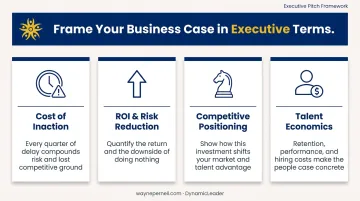
Quantify your initiative in terms executives track:
- Cost of inaction — What does doing nothing cost over 12 months? (Gallup estimates low engagement costs the global economy roughly $10 trillion in lost productivity annually.)
- ROI or risk reduction — What's the expected return, and over what period?
- Competitive positioning — What does this protect or enable strategically?
- Talent economics — Replacing one employee costs 50–200% of annual salary (SHRM). Retention is a financial argument, not an HR one.
DynamicLeader's CCB Process — Clarity, Co-strategy, Bold Action maps directly onto this pitch structure. Clarity defines the problem in terms the executive already uses. Co-strategy involves them in shaping the solution rather than being sold one. Bold Action closes with a concrete, phased plan — clear accountability, defined success metrics, no ambiguity.
How to Make the Ask in a Way That Lands
Lead with the Problem, Not Your Solution
C-suite leaders disengage fast when someone walks in with a fully-formed answer before establishing shared understanding of the problem. Open by articulating the business risk or missed opportunity (in the executive's own language) before you introduce your proposed response.
If you're pitching a culture initiative, don't start with "I'd like to propose a culture program." Start with: "Our voluntary attrition among high performers has increased 18% over two years. At replacement costs of 150% of salary, we're absorbing roughly $2.4M annually in preventable turnover."
Now they're leaning forward.
Pair Data with a Story
Research published in PubMed's meta-analysis on narrative vs. statistical evidence found a meaningful distinction: statistical evidence influences beliefs and attitudes, while narrative evidence influences intentions. You need both.
Data establishes credibility. A story creates urgency. Pair a concrete example from your own organization or an analogous one with supporting numbers. The goal is to make the risk feel real, not theoretical.
Anticipate Objections Before They Surface
Most executive objections fall into three categories: risk, timing, and resource trade-offs. Address all three before you're challenged.
Use Gary Klein's premortem approach: before finalizing your presentation, ask yourself what would cause this initiative to fail and build responses into the deck proactively. When an executive raises a concern you've already addressed, it demonstrates preparation and shows you've thought through the downside, not just the upside.
Structure the Ask with Precision
Vague asks signal unpreparedness. Be specific:
- What you need: Budget figure, headcount, access, or a formal decision
- Timeline: When the decision is needed and why
- Success definition: What does 90-day progress look like, specifically?
- First step: A pilot or low-risk phase reduces friction and creates an easier entry point
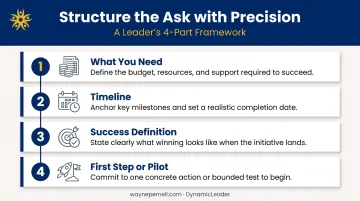
A defined pilot — with clear success criteria, a cost-projection validation, and a set evaluation timeline — gives executives a way to say yes without committing to the full scope before proof exists.
Keep the Buy-In Alive After You Get It
Securing executive approval matters. Keeping it requires just as much discipline as earning it in the first place.
According to Prosci research, 79% of projects with highly effective sponsors meet or exceed objectives, compared to just 27% with ineffective sponsors. Sponsorship erodes when executives stop hearing about progress — or when what they hear has drifted from the original promise.
Establish a Progress Cadence
Build a brief, regular update rhythm that ties initiative milestones back to the business outcomes you pitched. This doesn't require a formal report every month. A two-paragraph summary connecting progress to the metrics the executive cares about — retention, cost, productivity — is enough to maintain visibility and confidence.
Surface Quick Wins Early
Kotter's change model identifies generating short-term wins as a non-negotiable step — not a nice-to-have. Identify a visible, measurable result you can deliver in the first 30–60 days and communicate it in the same language used during the original pitch.
If you sold the initiative on reducing attrition risk, your 60-day win should reference attrition-related indicators — using the same framing proves you delivered what you promised, not a variation of it.
Build the Long-Game Reputation
Leaders who consistently get C-suite buy-in don't just present well — they've earned a reputation as strategic thinkers who understand organizational priorities and deliver on commitments. That reputation is built through follow-through, not first impressions.
The leaders Dr. Wayne works with inside organizations like Schwab, Pfizer, and Whole Foods treat executive relationships as ongoing partnerships — not transactional approval processes. They track shifting priorities, connect their work visibly to evolving strategic goals, and consistently produce the outcomes they commit to. That track record is what turns a single yes into sustained sponsorship.
Frequently Asked Questions
How do you secure executive buy-in?
Align your initiative to the executive's existing strategic priorities, quantify the impact in business terms — risk, ROI, competitive positioning — and build internal coalition support before the formal ask. By the time you're in the room, the decision should largely be made.
Why do executives push back on new initiatives?
Pushback typically stems from risk aversion, competing priorities, or distrust of the data — not disagreement with the idea itself. Framing the initiative in executive language and naming the cost of inaction shifts the conversation from evaluation to urgency.
What are the 5 C's of strategy implementation?
The 5 C's are Clarity, Communication, Commitment, Collaboration, and Continuity. Each element supports execution by ensuring leaders understand the strategy, align resources, and maintain consistent follow-through across the organization.
What are the 4 P's of strategic leadership?
Harvard's City Leadership Initiative defines the 4 P's as Perception, Process, People, and Projection. Together, they describe how leaders read their environment, build systems, develop talent, and communicate direction — all core to earning sustained executive trust.
What are the 7 C's of strategic management?
The 7 C's — Clarity, Competence, Consistency, Creativity, Communication, Customer Focus, and Change Management — give leaders a framework for aligning organizational strategy with executive priorities and sustaining momentum through execution.