Introduction: Why Small Group Leader Training Defines Team Performance
Most organizations pour significant resources into developing their senior leaders — and then leave the people who actually run day-to-day teams without real support. Team leads, group facilitators, and front-line group leaders get handed a role and a handshake — no coaching, no clear expectations, no structured path forward.
According to McKinsey, only 11% of more than 500 executives strongly agreed that their leadership development programs achieve and sustain desired results. A leading cause: programs fail to connect development to real business context — exactly the gap that shows up at the small group leader level first.
This article is written for senior leaders, directors, founders, and CHROs who are responsible for developing the small group leaders inside their organizations — not just managing them. The 11 tips below cover everything from intentional selection to coaching conversation techniques that actually change behavior.
Key Takeaways
- Small group leaders need intentional selection — availability is not a qualification
- Clear written expectations prevent early failure better than any training session
- Coaching relationships outperform one-time training events every time
- The 70/30 and 80/20 coaching rules move conversations from advice-giving to building leader capacity
- Consistent rhythms, real feedback, and the right questions separate leaders who plateau from those who keep growing
Why Small Group Leader Development Is a Strategic Priority
The Multiplier Effect
A single well-coached small group leader influences every person on their team. Invest in one leader and you return value across five, eight, or twelve people simultaneously. At DynamicLeader, Dr. Wayne Pernell has documented a 329% increase in revenue and production with a team of twelve high-potential employees after clarifying vision, establishing processes, and redefining expectations. Results like that emerge from building leadership capacity at the group level, not just at the top.
Yet most organizations don't treat small group leader development as a strategic priority. They treat it as an afterthought. That gap starts with a terminology problem most organizations never address.
Training vs. Coaching — A Critical Distinction
These two terms get used interchangeably — and the confusion costs organizations real development.
- Training transfers knowledge and skills — how to run a meeting, set goals, handle a difficult conversation
- Coaching develops the leader's own thinking, self-awareness, and judgment
Research from a 2023 meta-analysis found coaching effects were stronger for behavioral outcomes than for attitudes or personal characteristics. Training builds the what. Coaching builds the who. Both are necessary.
The "Guru" Trap
Many new small group leaders feel pressure to have all the answers. That instinct works against them.
The most effective group leaders don't position themselves as the smartest person in the room. They facilitate conversation, keep the group focused, and drive toward shared goals. Shifting from a guru identity to a guide mindset is one of the most important moves a coach can help a new leader make.
Tips 1–3: Select the Right People and Set Clear Expectations
Tip 1: Recruit With Intentionality, Not Just Availability
The default in most organizations is to fill group leader roles with whoever volunteers or seems convenient. This is one of the fastest ways to set a leader up to fail.
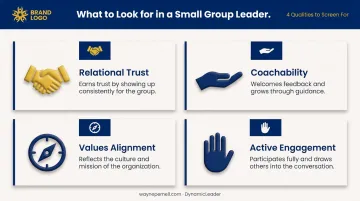
Intentional selection means screening for specific qualities — not just competence or tenure. Look for:
- Relational trust — Are they someone others naturally turn to?
- Coachability — Do they receive feedback without defensiveness?
- Values alignment — Do they live the organizational culture, not just tolerate it?
- Active engagement — Are they already contributing to team culture before being asked?
Tenure and technical skill matter, but a highly capable person who isn't coachable or relationally trusted will struggle to lead a group no matter how much training you provide.
Tip 2: Tell Leaders Exactly What You See in Them
When approaching a potential group leader, specificity is everything. Generic encouragement — "you'd be great at this" — doesn't create buy-in. It creates a vague sense of flattery.
What actually works: naming the exact qualities you've observed and connecting them directly to the leadership role.
Compare these two approaches:
| Generic | Specific |
|---|---|
| "I think you'd be great at leading this group." | "I've noticed how you bring people in during team discussions and make space for different perspectives. That's exactly what this group needs in a leader." |
The leader who understands why they were chosen — not just that they were chosen — shows up with more ownership and confidence from day one.
Tip 3: Provide Clear, Written Expectations Before They Start
Unclear expectations are a quiet leadership killer. Before a group leader facilitates a single meeting, they need written expectations that cover:
- Time commitment (meetings, prep, coaching check-ins)
- Behavioral standards within the group
- Communication norms with their coach or senior leader
- What success looks like at 30, 60, and 90 days
Don't just hand these over — walk through them together. A leader who understands the "why" behind each expectation is far more likely to execute than one who simply received a document and was sent on their way.
Tips 4–6: Build Coaching Relationships, Not Just Training Schedules
Tip 4: Start a Real Relationship Before You Start Giving Directives
Small group leaders perform better when they feel genuinely known — not just tracked. Before focusing on output, invest time in understanding what drew this leader to the role, what concerns them, and what success means from their perspective.
Four questions worth asking early:
- "What drew you to this role?"
- "What's your biggest concern about leading this group?"
- "What does a successful group look like to you?"
- "What kind of support would help you most right now?"
These aren't small talk. They're diagnostic. The answers reveal where a leader's drive comes from, what they're avoiding, and where their self-awareness stops — all of which will shape how you coach this person over the months ahead.
Tip 5: Ask Tough Questions That Reveal Real Readiness
Readiness to lead a group isn't just about skills. It's about psychological availability, personal alignment, and honest self-assessment. A coach's job is to surface hidden obstacles before they become leadership failures.
The question "Are you ready for this?" almost always gets a reflexive yes. Reframe it:
"What do you think would be the hardest part of this role for you right now, and why?"
This forces genuine reflection instead of a performance of confidence. The answer reveals far more about where coaching energy should be focused than any skills assessment.
Dr. Wayne's approach at DynamicLeader centers on reading both the spoken answer and the hesitation beneath it — a discipline that begins before the first formal coaching session.
Tip 6: Co-Create a Group Leader Plan Together
Those diagnostic questions reveal exactly what a leader needs to succeed. The next step is turning that insight into a plan they actually own — because a leader who helped build the plan will execute it. One handed down from above will be tolerated, then quietly set aside.
A practical small group leader plan should include:
- Group goals: Define the specific outcomes this group is working toward — not just "connection" or "growth," but concrete markers of progress.
- Meeting cadence: Settle frequency, session length, and format early so logistics don't become recurring friction.
- Trust-building approach: Identify two or three specific moves the leader will make in the first month to establish psychological safety.
- Conflict and disengagement protocols: Agree in advance on how the leader will respond when someone goes quiet, pushes back, or checks out entirely.
Co-creation is central to DynamicLeader's CCB Process: Clarity, Co-strategy, Bold Action. The co-strategy step is where ownership transfers — and ownership is what converts a plan into results.
Tips 7–9: Make Training Ongoing, Not a One-Time Event
Tip 7: Design Training as a Rhythm, Not an Event
The most common failure in small group leader development is the one-time training event — a half-day onboarding, an annual workshop, a kickoff session that builds early momentum but stalls once the calendar moves on.
A study by Saks and Belcourt tracked training application across 150 organizations and found employees applied about 62% of training immediately after, dropping to 44% at six months, and only 34% after one year. Without reinforcement, even good training fades.
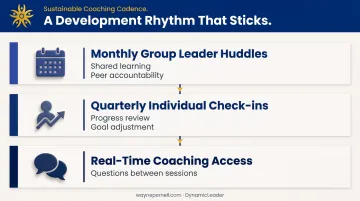
A sustainable development cadence looks like:
- Monthly group leader huddles — shared learning, problem-solving, peer accountability
- Quarterly individual check-ins — progress review, obstacle identification, goal adjustment
- Real-time coaching access — a communication channel for questions between formal sessions
One often-overlooked detail: honoring leaders' time through consistency, punctuality, and focused agendas signals that their development is taken seriously. Leaders notice — and they respond to it.
Tip 8: Use a Hybrid Approach — Structured Learning + Live Coaching
Not all development content requires the same delivery format.
| Asynchronous / Self-Directed | Live Coaching |
|---|---|
| Frameworks and mental models | Relationship dynamics and trust |
| Skill-building content and reading | Real-time problem-solving |
| Reflection prompts and journaling | Accountability and honest feedback |
| Pre-work before group sessions | Navigating conflict or disengagement |
The best programs use both. DynamicLeader's small-group leadership coaching programs are built on this hybrid model — combining structured leadership development content with live, real-time coaching to build both capability and confidence in leaders at every stage.
Tip 9: Build Feedback Loops — Survey Your Leaders Regularly
Training programs that don't measure their own effectiveness will quietly lose effectiveness. The remedy is straightforward: ask.
- Ask new leaders: "What didn't prepare you well enough for what you've encountered?"
- Ask experienced leaders: "What's working in this program, and what isn't?"
This does two things. First, it improves the program. Second — when senior leaders ask group leads for honest feedback, they model exactly the behavior they want those leaders to demonstrate with their own teams. That makes feedback loops both an evaluation tool and a culture signal in one move.
Tips 10–11: Coaching Techniques That Unlock Real Growth
Tip 10: Apply the 70/30 and 80/20 Rules in Coaching Conversations
These two rules change everything about how a coaching conversation runs.
The 70/30 Rule: The person being coached should be talking 70% of the time. The coach listens for 30%. This forces self-reflection and self-diagnosis in the leader — rather than creating dependence on the coach's advice. When a leader arrives at their own insight, they own it. When they're given an answer, they borrow it.
The 80/20 Rule: Roughly 80% of a coaching conversation should focus forward — on goals, options, and next steps. Only 20% should look backward at what went wrong. Leaders who spend most of a coaching session in post-mortem mode leave feeling heavy rather than energized. Keeping the ratio forward-facing builds momentum and solution focus.
Both rules point to the same principle: the coach's job is to draw out what's already inside the leader — not install what the coach thinks should be there.
Tip 11: Use Structured Questioning and Active Listening
The GROW Model is a straightforward framework for structuring coaching conversations:
- Goal — "What do you want to achieve from this conversation?"
- Reality — "Where are things actually right now?"
- Options — "What possibilities haven't you fully considered?"
- What will you do? — "What specific action will you take, and by when?"
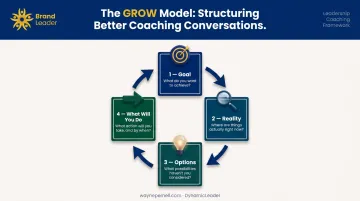
GROW keeps conversations from wandering without turning the session into an interrogation.
Active listening is harder than it sounds. Most coaches — and most leaders — are mentally drafting their response while the other person is still speaking. True active listening means quieting that internal voice entirely and staying present with what's being said.
Dr. Wayne's coaching practice includes a specific discipline around silence: holding space for four seconds, then nine, then eighteen — without fidgeting, filling the gap, or rushing to respond. Most leaders, when actually given that space, go deeper than their first answer. What comes out after the silence is almost always more honest than the first response.
Listening for what isn't being said is equally important. The hesitation before an answer, the topic that gets redirected, the confidence that sounds slightly forced — these carry as much information as the words themselves.
Frequently Asked Questions
What are the 70/30 and 80/20 rules in coaching, and how do they apply to small group leaders?
The 70/30 rule means the leader being coached speaks 70% of the time, encouraging self-reflection and ownership rather than dependence on the coach's advice. The 80/20 rule means 80% of the conversation focuses on forward-looking solutions, keeping leaders energized and action-oriented rather than stuck analyzing what went wrong.
What is the difference between training and coaching a small group leader?
Training transfers specific knowledge or skills — how to run a meeting, handle conflict, set team goals. Coaching develops the leader's own thinking, self-awareness, and judgment over time. Both are necessary, and neither fully replaces the other.
How often should small group leaders be coached?
A minimum baseline is monthly group leader huddles plus quarterly one-on-one coaching conversations. Frequency should increase when a leader is new to the role, navigating a difficult group dynamic, or preparing for greater responsibility.
How many people should be in a small group for effective leadership?
Groups of 5 to 12 give a single leader enough span to maintain real connection with each member. The ICF narrows that to 5 to 8 for coaching contexts specifically. Beyond 12, sub-groups or additional leaders typically become necessary.
What are the most common mistakes organizations make when training small group leaders?
Three patterns come up consistently:
- Treating training as a one-time event rather than an ongoing rhythm
- Filling leadership roles based on availability rather than readiness
- Skipping the coaching relationship entirely, leaving leaders to figure it out after the initial handoff
How do you measure whether small group leader development is actually working?
Track both qualitative signals, such as leader confidence, group cohesion, and retention, alongside quantitative indicators like engagement scores and participation rates. The Kirkpatrick Model's Level 3, meaning observed behavior change, is the most meaningful measure — far more reliable than post-session satisfaction surveys alone.