Introduction
Most senior leaders have been told, at some point, to "work on their confidence." A well-meaning mentor said it. A 360 review suggested it. Maybe an inner voice has been running that same loop for years.
The problem isn't the intention behind the advice. The problem is what it produces: a waiting game. Leaders who treat confidence as a prerequisite start deferring decisions until they feel ready. They soften direction to avoid visible accountability, over-solicit input before acting, and wait for a certainty that never quite arrives.
This pattern shows up across industries — in finance, technology, healthcare, and Fortune 50 boardrooms alike. It affects executives with decades of experience and genuinely impressive track records. Korn Ferry's 2024 research found that 71% of U.S. CEOs experience symptoms of imposter syndrome. The confidence gap isn't a junior problem — it's a senior one.
The reframe this article makes is simple but consequential: confidence is a byproduct of effective leadership, not a prerequisite for it. The leaders who move fastest aren't waiting to feel ready. They're operating from a clear decision-making framework — and that's exactly what this article breaks down.
Key Takeaways
- Chasing confidence keeps leaders stuck — it's abstract, unmeasurable, and puts the cart before the horse
- Confidence follows clarity and action; it doesn't precede them
- The cost spreads beyond you: your team loses direction, trust erodes, and execution slows
- The fix isn't more self-work; it's more clarity about your priorities, your role, and your next move
- Coaching that works targets how you show up and what you decide, not how you feel about yourself
The Trap: Why Leaders Get Stuck Chasing Confidence
The Problem with "Become More Confident" as a Goal
Unlike a KPI or a business objective, confidence has no finish line. There's no metric that tells you when you've arrived. Leaders can spend years orienting toward it — in coaching, in reflection, in self-help — and still feel like they're not quite there.
At the senior level, this manifests in specific, costly ways:
- Delaying high-stakes decisions until circumstances feel more certain
- Defaulting to consensus when conviction is what the moment requires
- Avoiding visible accountability in front of peers, boards, or direct reports
- Reopening settled decisions when execution encounters friction
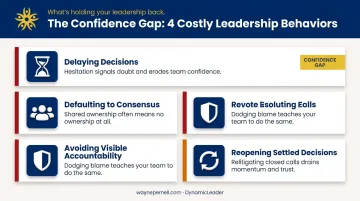
None of these behaviors signal a lack of skill. They signal a misunderstanding of how confidence actually works.
The Mechanism Runs in Reverse
Albert Bandura's self-efficacy theory established this decades ago. His research identifies enactive mastery experiences — actual successful performance — as the most powerful source of efficacy beliefs. In plain terms: doing builds believing, not the other way around.
A leader who waits to feel confident before acting will wait indefinitely. The action itself is what generates the confidence.
The Compounding Loop
That mechanism also runs in reverse. The longer a leader waits, the worse it gets.
The leader's inner narrative reads each delay as fresh evidence of unreadiness. "If I were truly ready, I would have acted by now." The hesitation becomes a data point that reinforces the self-narrative of inadequacy rather than disrupting it. What started as a reasonable caution hardens into a pattern.
This pattern is most acute at transition points. KPMG found that 57% of senior women leaders most often experienced imposter syndrome when being promoted or moving into new roles — precisely the moments that demand the most decisive leadership presence.
What Confidence Actually Is — and Isn't
There are two things leaders tend to conflate under the word "confidence," and the distinction matters enormously.
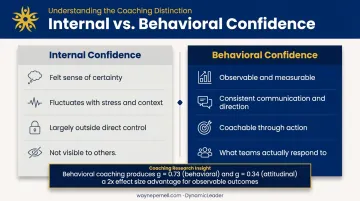
Internal confidence is a felt sense of certainty — the subjective experience of being sure. It fluctuates with context, sleep, stress, and circumstance — and it's largely outside a leader's direct control in any given moment.
Behavioral confidence is what teams actually respond to: the consistency with which a leader shows up, communicates direction, and makes decisions. It's observable. It's measurable. It's coachable.
Organizations don't need their leaders to feel certain. They need leaders who act with structure and clarity even when they're not certain. A leader who operates this way is perceived as confident by others — whether or not that's the internal experience.
The Visibility Gap
Most leaders dramatically overestimate how visible their internal doubt is to others. Research on what psychologists call the illusion of transparency shows that people consistently overestimate how much others can read their emotional states. That anxiety you're certain everyone in the room can see? They almost certainly can't.
This misread is costly. Leaders hold back — don't speak, don't decide, don't claim space — based on an assumption that's simply wrong. The doubt is far more private than it feels.
That gap is exactly why behavior-focused coaching produces stronger results than attitude-focused approaches. A 2023 meta-analysis of 20 randomized controlled trial studies found that executive coaching's effect on behavioral outcomes (g = 0.73) was more than double its effect on attitudes (g = 0.34). The implication for leaders: changing what you do is a faster, more reliable lever than waiting for how you feel to catch up.
The Real Cost of the Confidence Chase
What It Does to Your Team
When a senior leader visibly hedges — softening direction, reopening closed decisions, seeking one more round of input — teams don't experience this as thoughtfulness. They experience it as ambiguity.
The downstream effects are concrete:
- Alignment erodes when people can't get a clear read on priorities
- Execution slows when direction keeps shifting
- High performers disengage when they stop trusting that decisions will hold
- Trust degrades when leaders appear uncertain about their own calls
Gallup's research puts numbers behind this: managers account for 70% of the variance in team-level engagement. How a leader shows up doesn't stay with the leader — it multiplies across every person on the team.
What It Does to the Organization
The organizational cost of leadership indecision is staggering. McKinsey research found that for an average Fortune 500 company, ineffective decision-making can consume more than 530,000 days of working time annually — roughly $250 million in wasted labor costs. That number isn't abstract; it's the direct output of leaders who aren't moving.
At the C-suite level, the leverage on each decision is amplified. A delayed call ripples into missed quarters. An unclear communication spawns competing interpretations across three departments. An avoided conversation calcifies into a culture problem that costs far more to fix than it would have to address. Those consequences simply don't exist at the same scale lower in the organization.
The Personal Cost That Goes Unmentioned
Leaders who spend years working on confidence often acknowledge that the target keeps moving. Reach one threshold of certainty, and the next threshold appears.
That's not a failure of effort — it's a failure of the goal. Confidence pursued as a destination tends to reinforce the feeling that you haven't arrived. Every gap you find becomes more evidence of inadequacy, not progress. What leaders actually need isn't more confidence — it's a different operating system entirely.
What to Do Instead: Lead with Clarity, Not Confidence
Replace the Question
The shift starts with replacing one question with another.
Instead of: "How do I become more confident?"
Ask: "Where do I need more clarity?"
Clarity about your role. Clarity about your priorities. Clarity about what you stand for and what the decision criteria are. When a leader gets clear on these, action follows naturally — and repeated, structured action builds confidence as a side effect.
Dr. Wayne Pernell puts it directly: "Confidence comes from feeling uncomfortable and taking action anyway... not backing down. Rather, create confidence and courage by taking consistent action." The mechanism runs in one direction: action first, confidence second.
The Action-First Principle
Identify the smallest high-leverage decision you've been deferring. Not the biggest, most complex call on your plate — the one you've been avoiding because you're waiting to feel ready.
Move on it with the information you have now.
This isn't recklessness — it's calibration. Most of the information you need is already available. What's missing is a reliable framework for using it under pressure.
Frameworks Reduce Hesitation
When leaders have clear decision criteria and a reliable process for navigating ambiguity, they stop waiting for certainty before acting. You don't need to feel confident if you have a clear method.
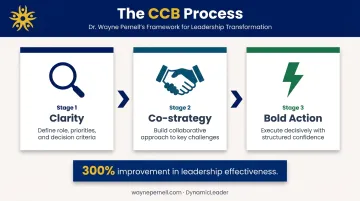
This is the core logic of Dr. Wayne Pernell's CCB Process — Clarity, Co-strategy, Bold Action. It starts with clarity (not confidence), builds through collaborative strategy, and produces bold action as the natural output. Leaders who work through this process consistently report that bold action becomes far less daunting once the clarity and co-strategy stages are complete.
DynamicLeader clients working through this framework have produced measurable results — including a 300% improvement in effectiveness for a siloed IT leadership division struggling with fragmentation and misalignment. The shift came from structured clarity about direction and cross-functional collaboration, not from waiting for individual leaders to feel more certain.
Build Confidence Through Reflection, Not Pre-Reassurance
Post-action reviews — brief, structured, consistent — train leaders to see their own competence accumulating. What decision did I make? How did it land? What triggered hesitation, and did I act anyway? What pattern is emerging?
This practice builds durable confidence because it's evidence-based. You're not telling yourself you're capable. You're watching yourself prove it, repeatedly, in real conditions. That's what shifts the internal experience: evidence accumulated after action, not reassurance manufactured before it.
How Executive Coaching Accelerates the Shift
What Distinguishes Coaching That Works
Effective executive coaching for senior leaders doesn't target how they feel. It targets specific behaviors, decision patterns, and where their strengths are actually landing versus where they're getting in their own way.
This makes confidence coachable — because it makes it observable. Instead of asking "are you more confident this month?" effective coaching asks "what decisions did you defer, and what would you do differently?" The goal shifts from a feeling to a behavior, which means it can be measured, discussed, and changed.
The Value of an Outside Perspective
A coach who has worked across hundreds of leadership contexts can see patterns the leader can't see from inside the role. Where is this leader operating from genuine clarity? Where are they stuck in a loop they can't name? From inside the role, those distinctions are nearly invisible. From the outside, they're plain.
Research on executive coaching ROI shows that 87% of survey respondents agreed executive coaching has a high return on investment, according to FMI data cited by the International Coaching Federation. The effect is strongest for behavioral outcomes — which is precisely where the confidence-to-clarity shift happens.
DynamicLeader's Embedded Approach
One distinction in how Dr. Wayne Pernell works: coaching happens in actual leadership moments, not just in a room. The embedded, shadowing-based approach — watching how things actually run, sitting in the real context — means feedback is grounded in observed behavior rather than a leader's self-report.
Self-reports of leadership effectiveness are notoriously unreliable. Research consistently shows that self-ratings matter least for leadership effectiveness outcomes, while peer and supervisor ratings matter most. An outside observer in real context closes the gap between how leaders think they're showing up and how they're actually landing.
This is what makes the combination of proprietary assessments, embedded observation, and the CCB Process work: clarity gets built as things actually happen, not reconstructed from memory days later. That includes:
- Proprietary assessments that surface blind spots before the coaching conversation starts
- Embedded observation grounded in what's actually occurring in the room, not a leader's edited account
- The CCB Process (Clarity, Co-strategy, Bold action) that moves insight directly into execution
Frequently Asked Questions
What are the common C's of confidence for leaders?
Practitioner frameworks vary, but clarity, consistency, and courage show up most reliably — and matter most in practice. These behavioral C's describe what others can actually observe, not just what a leader feels internally.
Is confidence a skill that can be learned, or is it a personality trait?
Confidence is a learnable, behaviorally grounded competency — not a fixed trait. Bandura's self-efficacy research and decades of leadership coaching practice both support this. The mechanism is mastery experiences: doing builds believing, repeatedly, until the belief becomes durable.
What's the difference between confidence and competence in leadership?
Competence is having the skills and knowledge to act well. Confidence is the willingness to act and be seen doing so. Many senior leaders are highly competent but undermine their own presence by waiting until they feel completely ready — the willingness to be seen is what gets blocked, not the ability.
Can a leader be effective without feeling confident?
Yes. The most effective leaders act on clarity and structure even during uncertainty. Consistent action in real conditions builds the confidence others perceive — which often has little to do with what the leader feels internally at any given moment.
How does executive coaching help leaders who struggle with self-doubt?
Coaching creates an objective view of strengths and behavioral patterns, replacing the abstract goal of "being more confident" with specific, observable actions. It provides accountability to act before internal certainty arrives, and that repeated action is what builds internal certainty over time.