Introduction
Senior leaders face a paradox: the higher you climb, the less direct feedback you receive — and the harder it becomes to identify what's actually limiting your performance. Yet expectations keep rising. Boards, investors, and teams all need you operating at your best.
Executive coaches and organizational consultants use structured leadership models to navigate this challenge. These frameworks do more than structure a session — they convert insight into sustained behavioral change.
A 2023 meta-analysis of 20 randomized controlled studies found executive coaching had its largest effect on behavioral outcomes (Hedges' g = 0.73) — significantly stronger than its effect on attitudes or personal characteristics alone. Structure matters. The right model converts awareness into action.
This article walks through the most widely used coaching frameworks, explains how leadership style theories shape the coach-leader relationship, and helps you identify which approach fits your situation.
Key Takeaways
- Leadership models are structured frameworks that guide coaching conversations from challenge to measurable behavioral change.
- The most widely used models are GROW, CLEAR, OSKAR, FUEL, and STEPPPA — each built for a different type of challenge.
- Leadership style theories — transformational, servant, transactional — shape how coaches build relationships and influence development.
- No single model fits every leader — effective coaches select and adapt based on the individual's context and readiness.
- Real effectiveness shows up in behavioral shifts and measurable organizational results, not in session satisfaction alone.
What Are Leadership Models in Executive Coaching?
Leadership models are structured, repeatable frameworks that give coaching conversations a direction. They help both coach and leader move from insight to action in a systematic way, rather than relying on instinct or letting the conversation drift without purpose.
Three terms often get conflated, and the distinctions matter:
- A coaching model is the roadmap — the phases or steps that structure the engagement (GROW, CLEAR, FUEL, etc.)
- A coaching style is how the coach shows up within those steps — directive, facilitative, or somewhere between
- A coaching method is the specific technique deployed inside the process — active listening, powerful questioning, 360-degree feedback
Why does structure matter at the executive level specifically? At senior leadership, time is compressed, stakes are organizational, and conversations must produce measurable outcomes — not just personal reflection.
The ICF's 2025 Core Competencies organize professional coaching around co-creating the relationship, communicating effectively, and cultivating learning and growth. Professional coaching has a defined architecture, even when it feels conversational.
The model is the container. What happens inside it depends on whether the framework fits the actual challenge — and whether the coach can adapt it when it doesn't.
Common Leadership Models Used in Executive Coaching
These models are not interchangeable. Each was designed to solve a different kind of leadership challenge. Selecting the wrong one — or defaulting to a familiar one — is one of the most common failures in executive coaching engagements. What follows is a breakdown of five widely used models, what each does well, and where each falls short.
GROW Model
Developed by Sir John Whitmore in the early 1990s and introduced through his book Coaching for Performance, GROW structures each session around four stages:
- Goal — Define what the leader wants to achieve
- Reality — Assess the current situation honestly
- Options — Explore possible paths forward
- Will — Commit to specific action
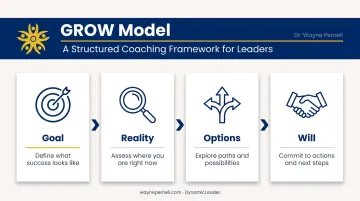
GROW's strength is its simplicity. It can guide a full engagement or a single 30-minute conversation, and it works well when the leader has reasonable self-awareness but needs structure to move forward.
Best for: Performance coaching, goal-oriented sessions, specific decisions, improvement targets.
Watch out for: GROW can feel surface-level when the underlying issue is emotional, relational, or systemic. Whitmore himself warned that GROW used mechanically, without genuine coaching skill, produces directive conversation, not real coaching.
CLEAR Model
Developed by Professor Peter Hawkins in the 1980s, CLEAR predates GROW and is built for depth. The stages:
- Contract — Establish clear expectations and confidentiality
- Listen — Draw out the full picture without rushing to solutions
- Explore — Surface root beliefs and systemic patterns
- Action — Create specific commitments
- Review — Reinforce learning across sessions
CLEAR prioritizes psychological safety before it moves toward action — making it effective when working with guarded leaders or when organizational trust has broken down.
Best for: Multi-session engagements, cultural or relational transformation, leaders navigating identity shifts.
Watch out for: The contracting, listening, and exploring phases front-load the process. CLEAR is less suited for urgent performance recovery where fast tactical action is the priority.
OSKAR Model
Developed around 2000 by Mark McKergow and Paul Z. Jackson for a coaching program at Walkers Snackfoods, OSKAR is explicitly solution-focused:
- Outcome — What does success look like?
- Scaling — Where are you now on a 1–10 scale?
- Know-how — What resources and strengths already exist?
- Affirm and Action — Recognize progress and define next steps
- Review — Assess and adjust
The scaling step is particularly useful — it creates honest, low-friction checkpoints that break large goals into visible progress markers. OSKAR builds momentum through affirmation rather than problem analysis.
Best for: Leaders who feel overwhelmed, stuck, or resistant to coaching; situations where rebuilding confidence matters as much as strategy.
Watch out for: OSKAR's solution-focus is a design feature, not a limitation — but it can underserve leaders who genuinely need to examine root causes before moving into solutions.
FUEL Model
Developed by Zenger Folkman as part of their Extraordinary Coach framework, FUEL is designed specifically for behavior and performance change inside organizations:
- Frame the Conversation — Establish context and purpose
- Understand the Current State — Clarify the present reality and its impact
- Explore the Desired Goal — Define what better looks like
- Lay Out the Plan — Build a concrete, accountable action plan
FUEL moves in a straight line from current-state awareness to structured execution. It's strong on accountability and works well when the gap between current and desired performance is clearly defined.
Best for: Leaders with specific behavioral patterns to address — procrastination, poor delegation, conflict avoidance — where the coaching goal is measurable.
Watch out for: FUEL's structured accountability requires a coach capable of balancing challenge with support. Push too hard without trust, and the leader shuts down.
STEPPPA Model
Developed by Dr. Angus McLeod in 2003, STEPPPA is unique because it treats emotion as a central driver of coaching, not a variable to manage around. The stages:
- Subject — Define the topic
- Target — Clarify the goal
- Emotion — Examine the emotional state driving (or limiting) progress
- Perception — Explore how the leader sees the situation
- Plan — Build the action path
- Pace — Set the timeline
- Action/Adapt — Execute and adjust
By placing Emotion and Perception before planning, STEPPPA surfaces the internal narratives that often determine whether an executive follows through — or quietly reverts to old patterns under pressure.
Best for: High-pressure executives navigating organizational change, identity shifts, or team conflict; situations where emotional drivers are material to the performance challenge.
Watch out for: STEPPPA demands emotional readiness from both coach and leader. It's a poor fit for leaders who want purely tactical sessions or organizations not ready to work at this level.
Which Model Fits Which Situation?
| Model | Primary Use | Time Horizon | Emotional Depth |
|---|---|---|---|
| GROW | Goal-focused performance sessions | Single session or short engagement | Low |
| CLEAR | Relational and cultural transformation | Multi-session, long-term | Medium–High |
| OSKAR | Rebuilding confidence and momentum | Flexible | Low–Medium |
| FUEL | Behavioral change with measurable targets | Mid-length engagement | Low–Medium |
| STEPPPA | Identity-level and emotionally complex challenges | Medium to long-term | High |
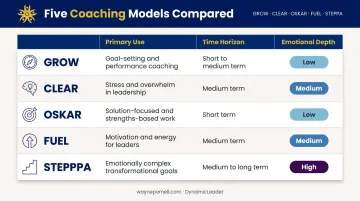
No model is universally superior. The deciding factor is the nature of the challenge — and whether the coach has the skill to deploy the model at its intended depth.
Leadership Style Theories That Shape Executive Coaching
Beyond the tactical session frameworks, experienced executive coaches draw on classical leadership theories to shape the coaching relationship itself. Three are especially relevant.
| Style | What It Looks Like in Coaching | Best Applied When |
|---|---|---|
| Transformational | Connecting individual growth to organizational vision; challenging thinking; mentoring through developmental assignments | Leader needs to shift identity or expand their leadership ceiling |
| Servant | Coach subordinates their agenda to the client's needs; focused on unlocking potential, not directing outcomes | Discovery phases; building trust; leaders who feel unseen or stuck |
| Transactional | Performance-driven, accountability-based; clear expectations and measurable results | Short-term engagements; specific improvement targets; execution phases |
The 2012 Regent University article "The Leader Coach: A Model of Multi-Style Leadership" argues that effective coaching draws from multiple styles rather than one fixed approach — connecting servant leadership to values exploration, transformational leadership to identity-level change, and transactional leadership to accountability and structure.
Research on identity-level coaching supports this. A 2024 Oxford Brookes study found coaching supported senior leaders' identity work by increasing self-awareness and helping them gain new perspectives on their effectiveness — results that emerged specifically from the depth of transformational and servant-style approaches combined.
The practical implication: a coach's ability to shift between these styles — reading the moment and the leader — is often what separates a productive engagement from a transformative one.
How to Choose the Right Leadership Model for Your Situation
The right model is never about what's most popular or what the coach knows best. It's always determined by the leader's current challenge, their readiness for change, and the depth of outcome required.
Key Selection Factors
- Is the goal a specific performance target? Reach for GROW or FUEL. Behavioral or identity transformation? CLEAR or STEPPPA go deeper.
- New to coaching? Start with an accessible structure. Experienced leaders can handle the rigor of CLEAR or STEPPPA.
- Short-term sprint or multi-session engagement? Urgency favors GROW and FUEL; sustained depth favors CLEAR.
- Individual development or culture-wide change? The former may warrant OSKAR or FUEL; the latter calls for CLEAR or a blended approach.
How Effective Coaches Approach This
The most effective executive coaches don't treat models as rigid scripts. They select based on assessment, adapt as needs evolve, and blend frameworks across a single engagement.
Dr. Wayne Pernell's CCB Process at DynamicLeader reflects this approach. The three phases move sequentially:
- Clarity — structured discovery through leader interviews, stakeholder shadowing, and proprietary assessments to establish an honest picture of what's actually happening
- Co-strategy — a collaborative growth plan built around the organization's vision and values
- Bold Action — execution through coaching, offsites, or company-wide training, all aligned to the strategic plan from phase two
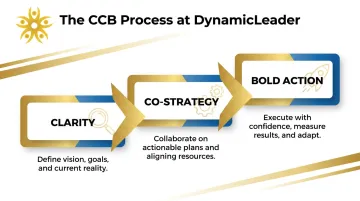
This sequence draws on principles present across multiple coaching models — diagnostic rigor, co-created strategy, accountable execution — while staying anchored to measurable organizational outcomes rather than a prescribed framework.
Common Pitfalls
- Choosing GROW when the real issue is emotional or relational
- Selecting CLEAR when urgent performance recovery is the priority
- Defaulting to OSKAR because it feels comfortable, when root-cause analysis is actually needed
- Applying a model the coach knows well rather than one that fits the client
The model is only as effective as the coach-leader relationship. No framework replaces the trust, challenge, and accountability that define exceptional executive coaching. Structure supports the work — the relationship is what moves people.
What to Watch Out for When Selecting a Coaching Model
Selecting the wrong coaching model — or the wrong coach — is an expensive mistake at the executive level. Watch for these patterns before you commit:
Complexity isn't the same as effectiveness. If the situation calls for clear, action-oriented structure, a more sophisticated framework adds friction without adding value.
Comfort isn't a reliable signal of fit. The right model should stretch, not just validate. If every session feels easy and affirming, that's worth questioning. Measurable shifts — in behavior, team dynamics, and organizational output — are the real indicators.
Ask the coach directly:
- How do you assess which framework to use at the start of an engagement?
- What do you do if the initial approach isn't producing results?
- What experience do you have blending frameworks across industries and leadership levels?
A coach who can't answer these questions clearly — or who defaults to one model regardless of context — is a significant risk at the executive level.
The Association for Coaching's competency framework requires coaches to explain their process, approach, models, and techniques, and to establish measurable outcomes with progress monitoring. Hold any prospective coach to that standard.
Frequently Asked Questions
What are some leadership coaching models?
The most commonly used models in executive coaching are GROW, CLEAR, OSKAR, FUEL, and STEPPPA. Each offers a different structure for moving a leader from a defined challenge toward specific action — varying in how much they prioritize emotional depth, speed to action, or accountability planning.
What is the difference between a coaching model and a coaching style?
A coaching model is the structural framework that guides session flow — the steps or phases (like GROW or CLEAR). A coaching style describes how the coach shows up within those steps — directive, facilitative, challenge-focused, or supportive. Skilled coaches blend both to match the client's needs.
Which leadership model is most commonly used in executive coaching?
GROW is the most widely recognized starting point, valued for its simplicity and flexibility across different contexts. That said, experienced coaches rarely rely on a single model — selection depends on the executive's goals, current challenges, and stage of development.
Can an executive coach use more than one leadership model?
Blending models is often necessary. Different phases of a coaching engagement naturally call for different frameworks, and integrating elements from multiple models typically produces deeper, more durable results than applying a single approach rigidly.
How do I know if a coaching model is actually working?
Effectiveness shows up in measurable behavioral change, improved team performance, and progress toward the goals established at the start of the engagement. Positive feelings about sessions are useful data, but the real measure is observable shifts in how the leader actually operates.