Key Takeaways
- Decision-making frameworks give leaders a repeatable, bias-reducing process for navigating complex choices under pressure.
- Core frameworks covered here include GROW, OSKAR, the 6-Step Define-to-Review process, and proprietary approaches like the CCB Process — each suited to different situations and decision types.
- Cognitive biases — confirmation bias, overconfidence, recency bias — derail even the most seasoned executives without a structured check in place.
- Skilled coaching slows reactive thinking, surfaces blind spots, and builds the consistent decision habits that separate good leaders from great ones.
- The right framework depends on the decision type, urgency, and whether the challenge is individual or team-level.
Introduction
Leaders make dozens of high-stakes decisions every week. And yet, research from McKinsey found that 61% of leaders say most of their decision-making time is used ineffectively — despite spending nearly 40% of their working hours on decisions.
The problem is how the brain defaults under pressure. Daniel Kahneman's work on System 1 and System 2 thinking describes this precisely: System 1 is fast, instinctive, and emotional; System 2 is slow, deliberate, and analytical.
Most executives are running System 1 in situations that demand System 2.
Without a structured approach, decision-making falls into predictable traps — gut instinct, groupthink, or analysis paralysis. These patterns stall teams, erode trust, and cost organizations real momentum.
This article covers the decision-making frameworks most commonly used in leadership coaching, the cognitive biases that derail smart leaders, and how to match the right framework to the right situation — so that 40% of your week starts working for you.
Why Effective Decision-Making Is a Leadership Coaching Priority
Poor decision-making isn't just an individual leadership failure — it's an organizational cost. According to McKinsey, ineffective decision-making costs a typical Fortune 500 company 530,000 days of manager time annually, equivalent to roughly $250 million in wages.
And the scale of the problem is striking: only 20% of organizations say they excel at decision-making, while 72% of senior executives report that bad strategic decisions are about as common as good ones in their organizations.
What Gets in the Way
The most common obstacles Dr. Wayne Pernell observes when working with senior leaders aren't strategic blind spots — they're psychological ones:
- Jumping to solutions before the real problem is defined
- Missing critical information due to ego, time pressure, or confirmation bias
- Overweighting recent experience rather than the full picture
- Fear of appearing indecisive in front of their team — which actually produces worse decisions
As Dr. Wayne notes, most leaders don't lack data. They lack clarity. When the stakes are high, that gap is where decisions go wrong.
Why Coaching Addresses This Differently
Traditional consulting delivers answers. Training transfers knowledge. Coaching is different — it builds the internal capacity to think clearly, consistently, under pressure, across the hundreds of decisions that define a leader's impact.
The International Coaching Federation describes coaching as "partnering with clients in a thought-provoking and creative process that inspires them to maximize personal and professional potential."
In practice, that means helping leaders build the habits and self-awareness that no training curriculum alone can produce.
4 Decision-Making Frameworks Every Leader Should Know
A decision-making framework reduces cognitive load, builds shared language across a team, and makes the process repeatable under pressure. The goal is to expand a leader's toolkit — not every situation calls for the same approach, and the best leaders know which tool to reach for.
The GROW Model
Developed by Sir John Whitmore in the late 1980s, GROW is one of the most widely used frameworks in executive coaching. Its four stages:
- Goal — Define what a successful outcome looks like, specifically and measurably
- Reality — Honestly assess current conditions without defensiveness or spin
- Options — Generate multiple paths forward without premature judgment
- Will / Way Forward — Commit to a specific course of action with clear accountability
GROW works particularly well in one-on-one coaching sessions where a leader needs to move from vague concern to decisive action. The model's real power is in the Options stage: most leaders skip directly from Reality to a single solution. GROW forces a genuine pause to explore alternatives first.
The 6-Step Define-to-Review Framework
This framework addresses the most common and most costly leadership decision failure: solving the wrong problem. Albert Einstein reportedly said that if he had one hour to solve a problem, he'd spend 55 minutes defining it. Most executives do the reverse.
The six stages:
- Define — Identify the real problem, not just the presenting symptom
- Diagnose — Gather data, consult the right people, apply critical thinking tools
- Options — List possible solutions and map their consequences
- Decide — The designated decision-maker reviews the options and chooses
- Assign, Act & Communicate — Clarify ownership and inform stakeholders
- Measure & Review — Evaluate whether the decision achieved its intended outcome and adjust
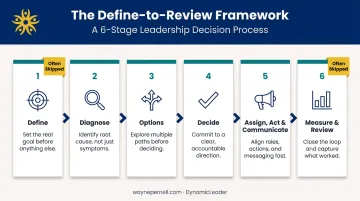
This framework is well-suited for complex organizational decisions with multiple stakeholders. The Define and Measure stages are where most teams cut corners — and where most decision failures originate.
The OSKAR Solution-Focused Model
Developed by Mark McKergow and Paul Z. Jackson around 2000, OSKAR is particularly effective when leaders are stuck in problem-focused thinking and need to redirect toward what's already possible.
The five stages:
- Outcome — Define what success looks like in concrete terms
- Scaling — Use a 1–10 scale to assess current state and track progress
- Know-how — Identify existing strengths and capabilities already available
- Affirm & Action — Build on what's working and commit to next steps
- Review — Reflect on progress and adjust
Where GROW moves from problem to goal, OSKAR assumes capability already exists and surfaces it. For leaders stuck in a cycle of analyzing what went wrong, this reframe is often exactly what breaks the pattern.
Other Models Worth Knowing
Three additional frameworks serve specific leadership contexts:
- CLEAR (Contracting, Listening, Exploring, Action, Review) — Best for team coaching and decisions that require psychological safety. Developed by Peter Hawkins, it builds trust before moving to action.
- STEPPPA (Subject, Target, Emotion, Perception, Plan, Pace, Adapt or Act) — Useful when stress or interpersonal dynamics are clouding a leader's judgment. It integrates emotional intelligence explicitly into the decision process.
- AOR (Activities, Objectives, Results) — Suits metric-driven executives who need a direct line from decisions to measurable outcomes.
Reading the decision environment — its stakes, timeline, and emotional charge — is what determines which framework to reach for. That skill, more than mastery of any single model, is what separates reactive leadership from deliberate leadership.
How Cognitive Bias Derails Even Smart Leaders
Dr. Wayne Pernell brings both a PhD in clinical psychology and four decades of work with senior executives to this observation: intelligence and experience do not immunize leaders from cognitive bias. High-confidence leaders are often more susceptible, because they've learned to trust their pattern-recognition — and that trust becomes the blind spot.
Research confirms this: cognitive biases affect professionals across management, finance, medicine, and law, with overconfidence among the most consistently documented.
The Four Biases That Show Up Most
Confirmation bias — Seeking information that confirms what you already believe, while dismissing contradictory data. McKinsey points to Blockbuster's dismissal of Netflix as a textbook example of executive confirmation bias in action.
Recency bias — Overweighting the most recent experience or data point. In practice, this means the last strategy that worked becomes the default for the next problem — even when conditions have changed.
Overconfidence bias — HBR's foundational research on decision traps identifies this as the most persistent source of executive judgment error. It surfaces when evaluation criteria aren't clearly defined and risk is systematically underestimated.
Availability bias — Overestimating the likelihood of events that are vivid or memorable, rather than statistically probable. A dramatic past failure shapes risk assessments long after the relevant conditions have changed.
System 1 vs. System 2 in High-Stakes Decisions
Kahneman's framework maps directly onto leadership decision-making. System 1 is fast, efficient, and unconscious — useful for routine calls. System 2 is deliberate and effortful — necessary for complex, high-stakes choices.
The problem: under pressure, the brain defaults to System 1 precisely when System 2 is most needed.
Coaching helps leaders catch that shift before a decision is already made. Dr. Wayne's work — grounded in his CCB Process (Clarity, Co-strategy, Bold action) — creates the structural pause between stimulus and response that System 2 requires. Leaders practice it until it becomes habitual under pressure, not just in calm reflection.
Practical Bias-Interruption Techniques
These methods work both in coaching sessions and as standalone habits:
- Name the bias out loud — Labeling it reduces its automatic power
- Seek disconfirming evidence deliberately — Ask "what would have to be true for the opposite conclusion to be correct?"
- Require at least three options before any decision is finalized — forcing alternatives breaks the illusion that the first framing is the only one
- Run a pre-mortem — Gary Klein's pre-mortem method asks the team to imagine the decision has already failed, then work backward to identify what went wrong
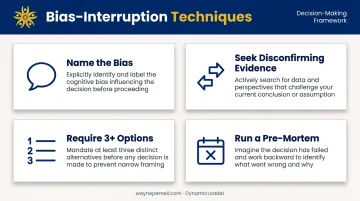
Most of these techniques stall without external perspective. A leader inside the situation is drawing on the same mental models that created the bias in the first place — which is precisely why an outside view isn't optional for high-stakes calls, it's structural.
How Leadership Coaching Sharpens Your Decision-Making
Knowing a framework and using it under pressure are two entirely different things. Leaders often understand the right process intellectually, then revert to reactive habits when the stakes are highest. A leadership coach builds the structured accountability and regular reflection that turn framework use from occasional to habitual.
Addressing the Define-Stage Failure
The most common and costly mistake in decision-making is solving the wrong problem. Dr. Wayne describes his approach as listening not just to what's being said, but to what's not being said. His process involves asking the tough questions and helping leaders name the real issue — without blame and without shame.
Client feedback captures this well: "He doesn't just listen — he listens between the lines. Dr. Wayne helped us uncover the root issues we didn't know were holding us back."
That capacity to surface hidden assumptions before moving to solutions is something frameworks alone can't provide. It requires a skilled outside perspective. That's the foundation the CCB Process is built on.
The CCB Process in Practice
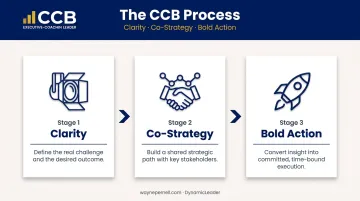
DynamicLeader's proprietary CCB Process — Clarity, Co-strategy, Bold action embeds structured decision-making into leadership coaching engagements.
- Clarity — The leader defines the real challenge and desired outcome, not just the surface-level presenting issue. This includes stakeholder interviews, observation, and proprietary assessment instruments.
- Co-strategy — Rather than deciding in isolation, the leader builds a shared strategic path with key people. This stage reduces the blind spots that come from top-down decision-making.
- Bold action — Insight converts into committed, time-bound execution. Not incremental adjustment, but decisive movement forward.
This process has been used with leadership teams at organizations including Charles Schwab, Whole Foods Market, and Pfizer to move from confusion and internal friction to aligned, confident decisions.
The Team-Level Ripple Effect
When a leader develops stronger decision-making habits, the effect spreads. Teams begin to see clearer communication around roles — who decides, who advises, who simply needs to be informed. A culture of more accountable execution follows.
As DynamicLeader's results demonstrate: working with a disconnected 12-person team to clarify vision, establish processes, and redefine expectations produced a 329% increase in production and revenue in just over a year. Decision clarity and team alignment drove that outcome.
Matching the Right Framework to the Right Situation
| Situation | Best Framework |
|---|---|
| Individual coaching, personal leadership decision with clear goals | GROW |
| Complex organizational decision with multiple stakeholders | 6-Step Define-to-Review |
| Leader stuck in problem-focused thinking | OSKAR |
| Team-level decision requiring psychological safety | CLEAR |
| Fast-moving, metric-driven environment | AOR |
Most leaders default to the framework they know best — not the one the situation actually demands. The strongest decision-makers read the environment first: the stakes, the time horizon, who's affected, and the emotional charge on the team. That read determines the tool.
Pick one high-stakes decision you're navigating this week. Before going with instinct, run it through either the GROW model or the 6-Step process deliberately. Treat it as a practice rep, not a one-time test. The leaders who build exceptional judgment do so through structured repetition — not more information, more reps.
Building a Decision-Making Culture Across Your Team
Sustainable organizational performance requires decision-making clarity at every level — not just at the top. When ownership of decisions is unclear, teams slow down, bottlenecks form, and talented people wait for permission rather than acting with confidence.
A useful starting point is establishing shared language around decision roles: for any significant choice, who is the Decision-Maker, who is an Advisor, and who gets Informed of the outcome? Naming those roles upfront removes the ambiguity that stalls most teams — before a single meeting gets scheduled.
How Coaching Accelerates the Cultural Shift
Shared language is a start, but embedding it takes more than a memo. When a coach works with a leadership team, they surface where decision-making is emotionally charged, quietly contested, or siloed — and introduce frameworks that create consistent process across the group.
DynamicLeader's team-level work has included exactly this kind of alignment at organizations like Schwab and Pfizer. A three-day retreat with an SVP's siloed IT leadership team — focused on cross-functional collaboration and decision clarity — produced a 300% improvement in effectiveness and earned the team an industry award.

Starting the Conversation With Your Team
Start with a brief decision audit with your leadership team.
- Map the five to ten most recurring types of decisions your team makes
- Identify where ownership is unclear or contested
- Choose one framework to pilot consistently for 30 days
Shared language and consistent process build gradually. Pick one decision type, run the pilot, and expand from there.
Frequently Asked Questions
What are the 5 C's of coaching?
No single authoritative definition exists across ICF or EMCC — different coaching educators use different models. Common variations include Clarity, Commitment, and Curiosity alongside Challenge or Connection. Regardless of the specific model, the 5 Cs map the conversational arc coaches use to move leaders from unclear thinking to decisive action.
What are examples of decision-making frameworks?
The most widely used frameworks include the GROW Model, the 6-Step Define-to-Review process, OSKAR, and CLEAR. Each serves different contexts — GROW suits individual coaching, OSKAR works when leaders are stuck, and CLEAR is best when team trust is the central issue.
What is the 80/20 rule in coaching?
In coaching conversations, the 80/20 rule means the coach listens 80% of the time — keeping focus on the client's thinking, not the coach's. It also applies the Pareto principle to leadership: identify the 20% of decisions that drive 80% of results, then build decision-making discipline around those first.
How does leadership coaching improve decision-making?
Coaching helps leaders spot cognitive blind spots, work through structured frameworks, and pause before reactive decisions under pressure. The accountability built into a coaching relationship makes these habits stick — producing more deliberate and confident choices over time.
What is the difference between a decision-making model and a decision-making framework?
A model describes the underlying logic for how decisions should work — for example, GROW's progression from goal-setting to committed action. A framework provides a broader, repeatable process structure that can flex across different situations. In practice the terms get used interchangeably, but frameworks are generally more comprehensive and built to flex across situations where a single model would be too rigid.